What is Micro-fragmentation? International Day of Forests

On this International Day of Forests, it’s easy to focus on what we’re losing because there’s a lot to be concerned about.
Latin America is losing nature faster than anywhere else in the world. Wildlife populations have declined by 95% in the past 50 years, representing the steepest biodiversity collapse ever recorded. And the leading cause of this decline is habitat loss and degradation.
But the way this loss is happening might not be what you expect.
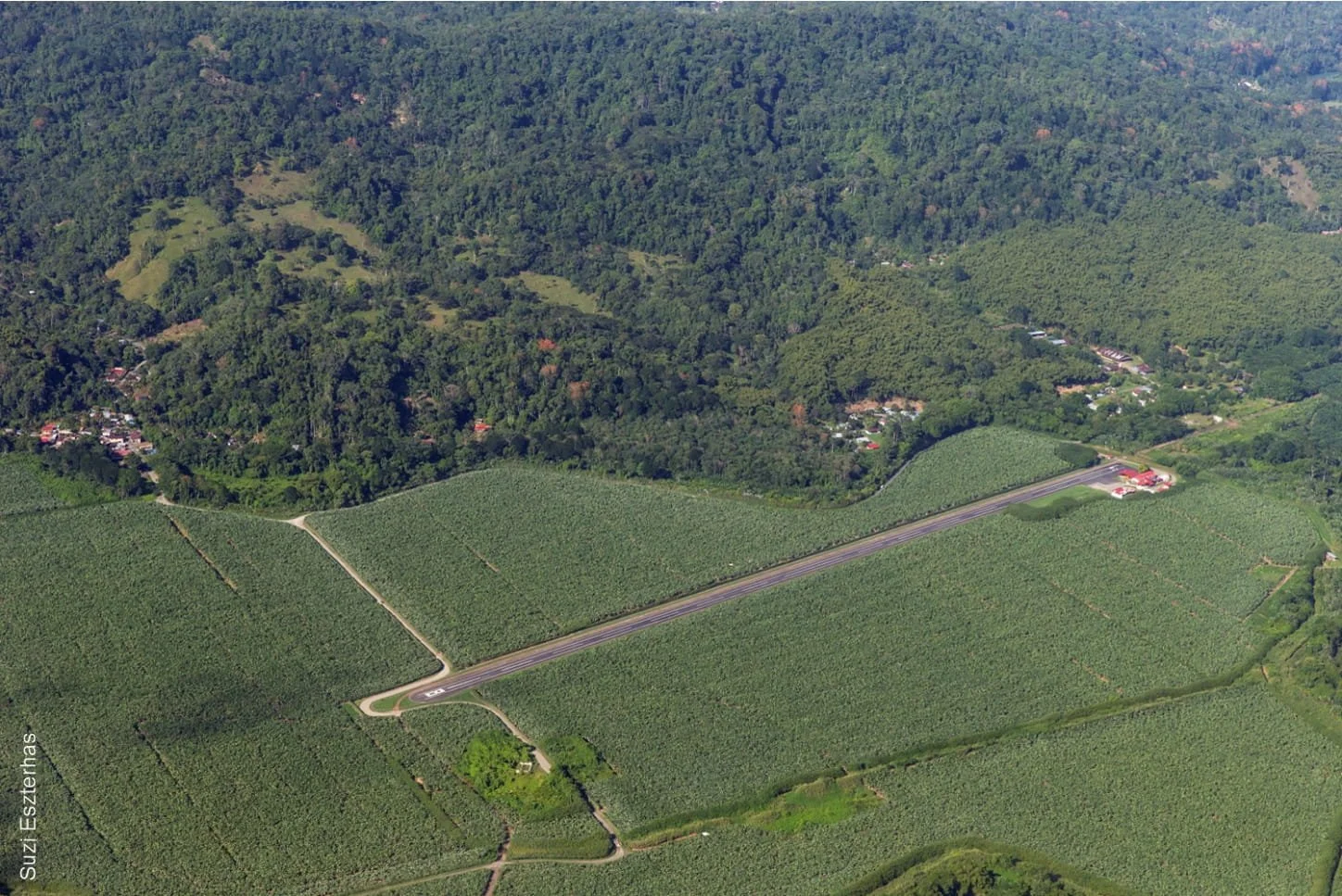
Crops in Costa Rica- Photo: Suzi Eszterhas
When we think about the loss of tropical rainforests, we often think about large-scale deforestation, where vast areas are completely cleared of trees for agriculture, logging, or development. And we imagine fragmentation in similar terms too, where big, protected areas are isolated from one another by vast distances.
But that is only part of the story, because across Latin America another kind of forest loss is also happening - one that rarely appears in deforestation statistics.
It’s happening quietly. One tree at a time. One property at a time. It’s the gradual process of degradation which happens when the forest gets thinned out and loses its structural complexity.
Research is increasingly showing that this widespread degradation, which is happening across vast areas of forest, can have ecological impacts that are equal to – and sometimes worse - than clear-cut deforestation.
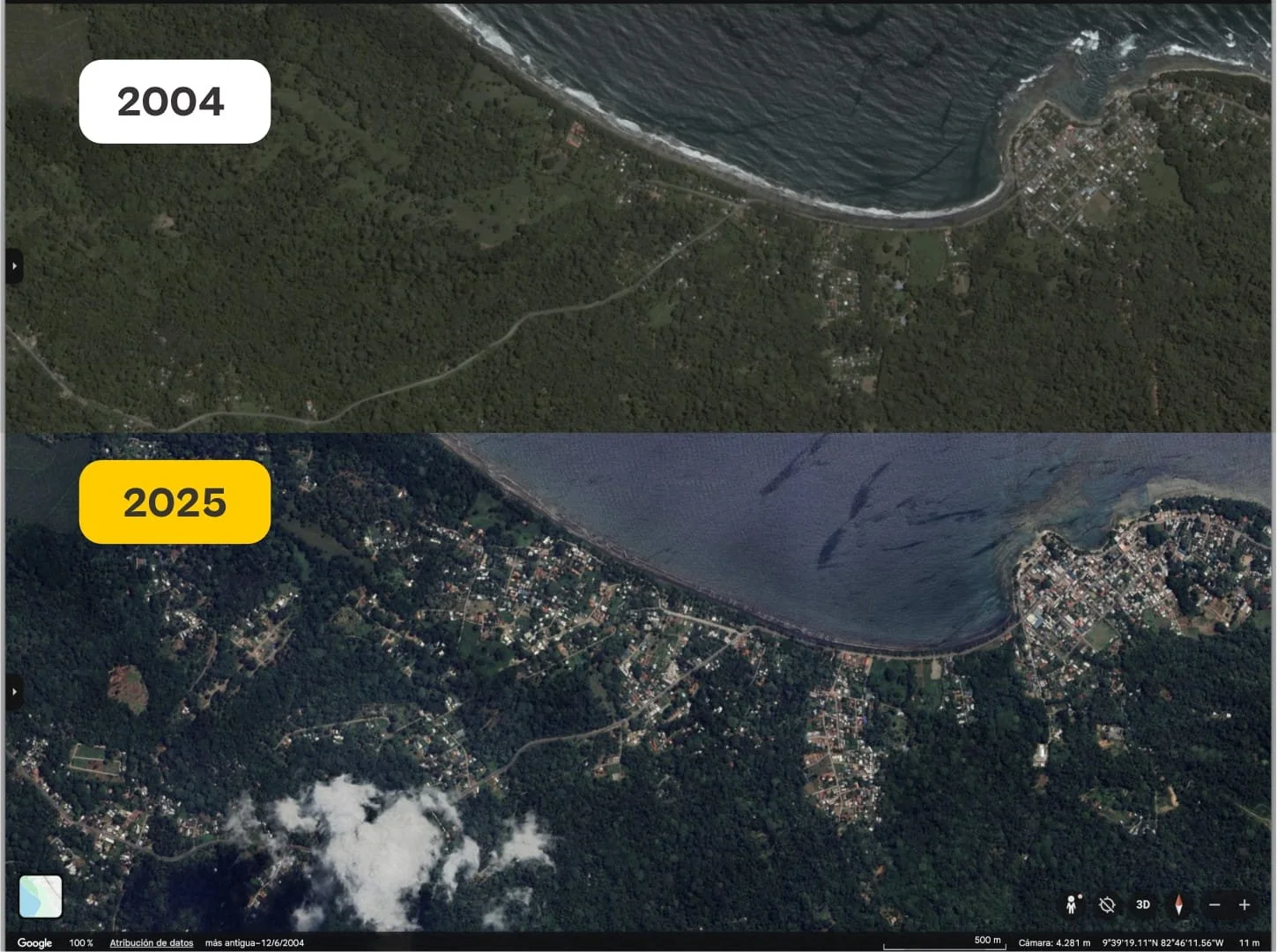
Satellite image of Playa Negra and Puerto Viejo de Talamanca.
Micro-fragmentation
One of the many ways this degradation affects wildlife is through a process of micro-fragmentation. This is when the physical connections between neighbouring trees are broken, which is particularly problematic for arboreal species like sloths that rely on canopy connectivity for survival and movement.
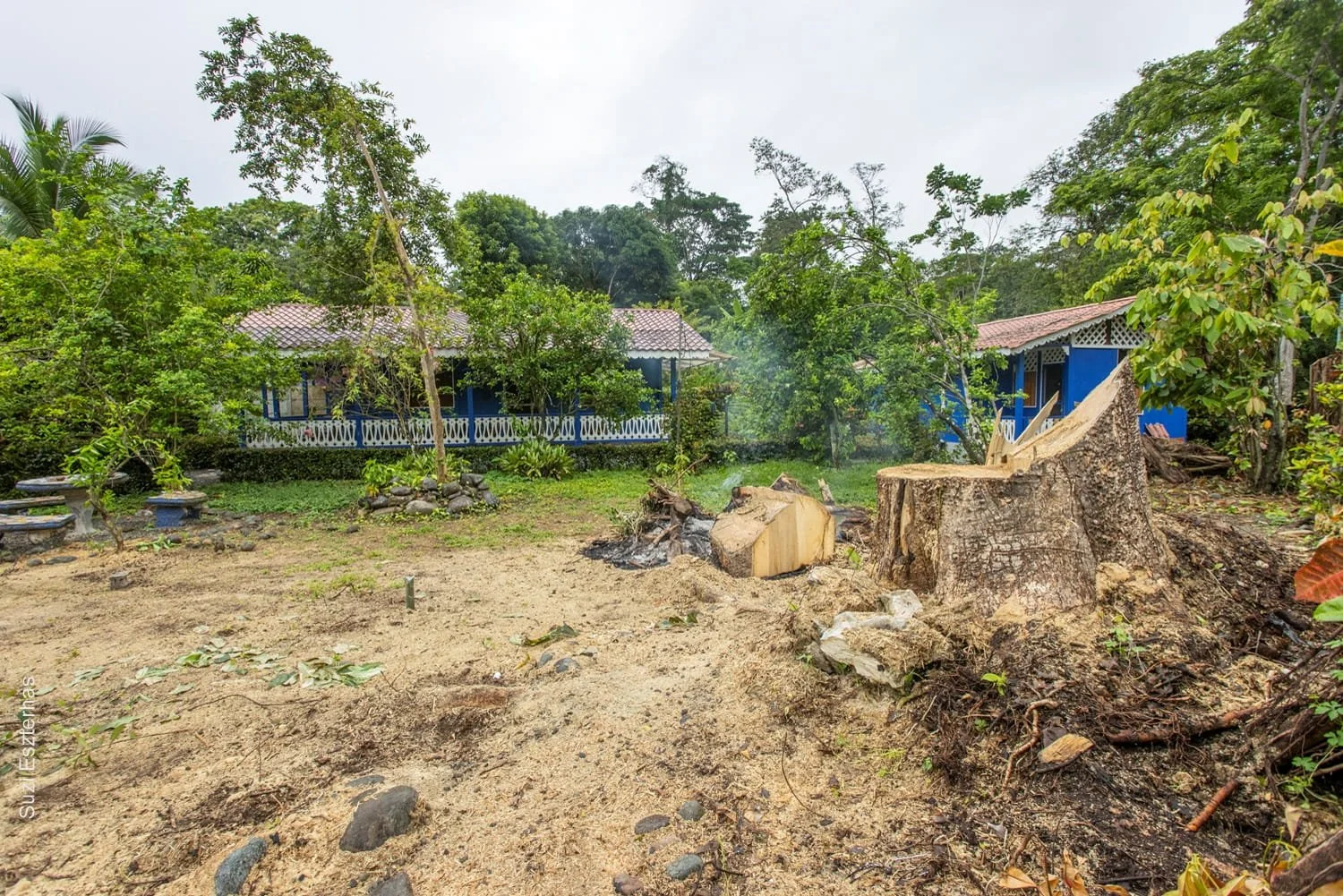
Some sloths we used to monitor for the Urban Sloth Project lived in the tree that was cut down. Photo: Suzi Eszterhas
Sloths are Canaries in a Coal Mine for Micro-fragmentation
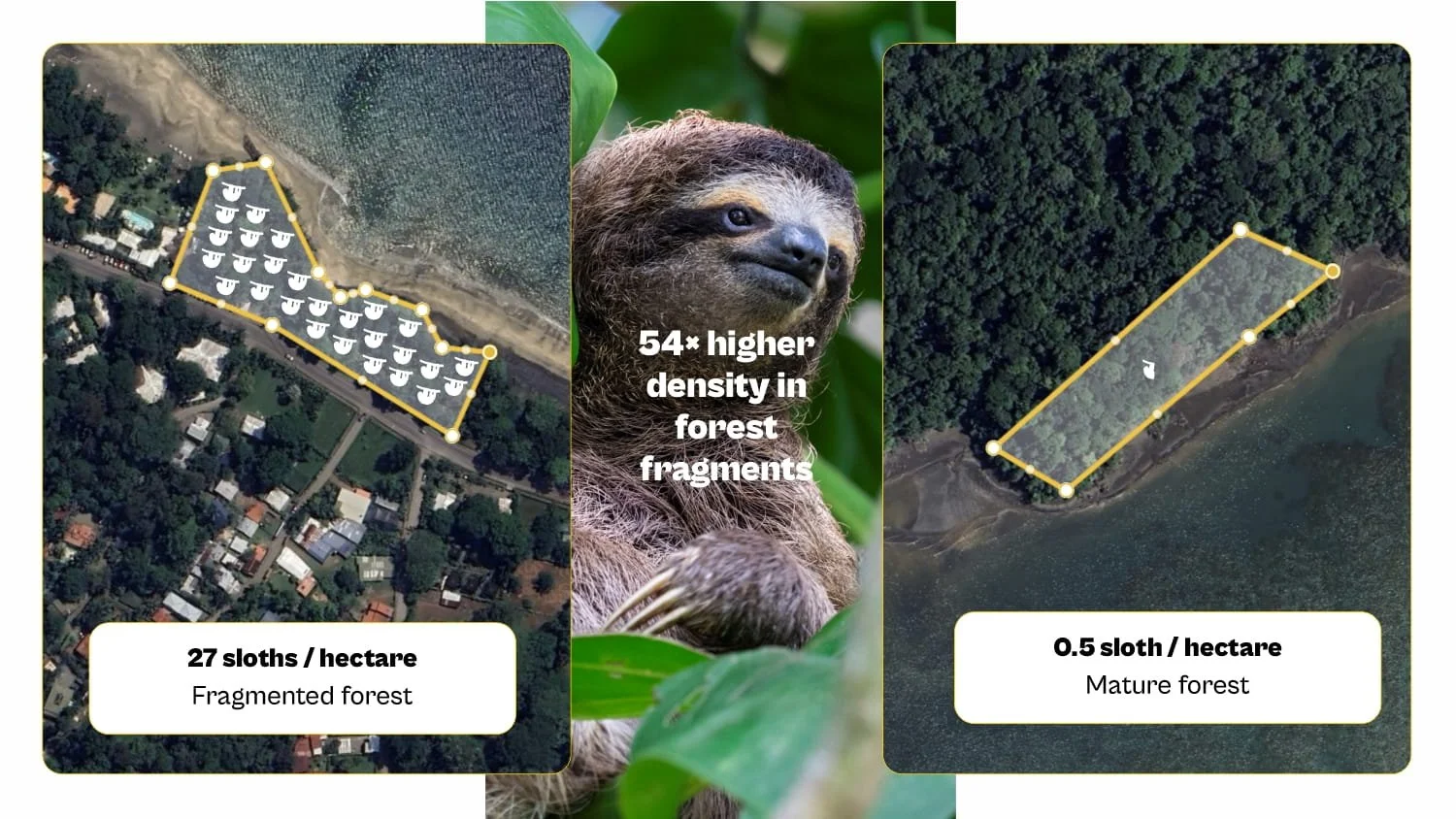
To us, the loss of a single tree might seem insignificant, but to sloths, it can mean the difference between life and death. They become trapped in small pockets of isolated forest and are unable to disperse safely. Our census data is revealing that sloth population densities can become up to 54 times higher in urban forest fragments than in mature, intact forests.
The problem is that for sloths to leave these fragments and disperse, they have to take enormous risks. Some descend to the ground, where they slowly crawl across roads and through gardens, exposed to cars, dogs and people. And others climb onto power lines, where many are electrocuted.
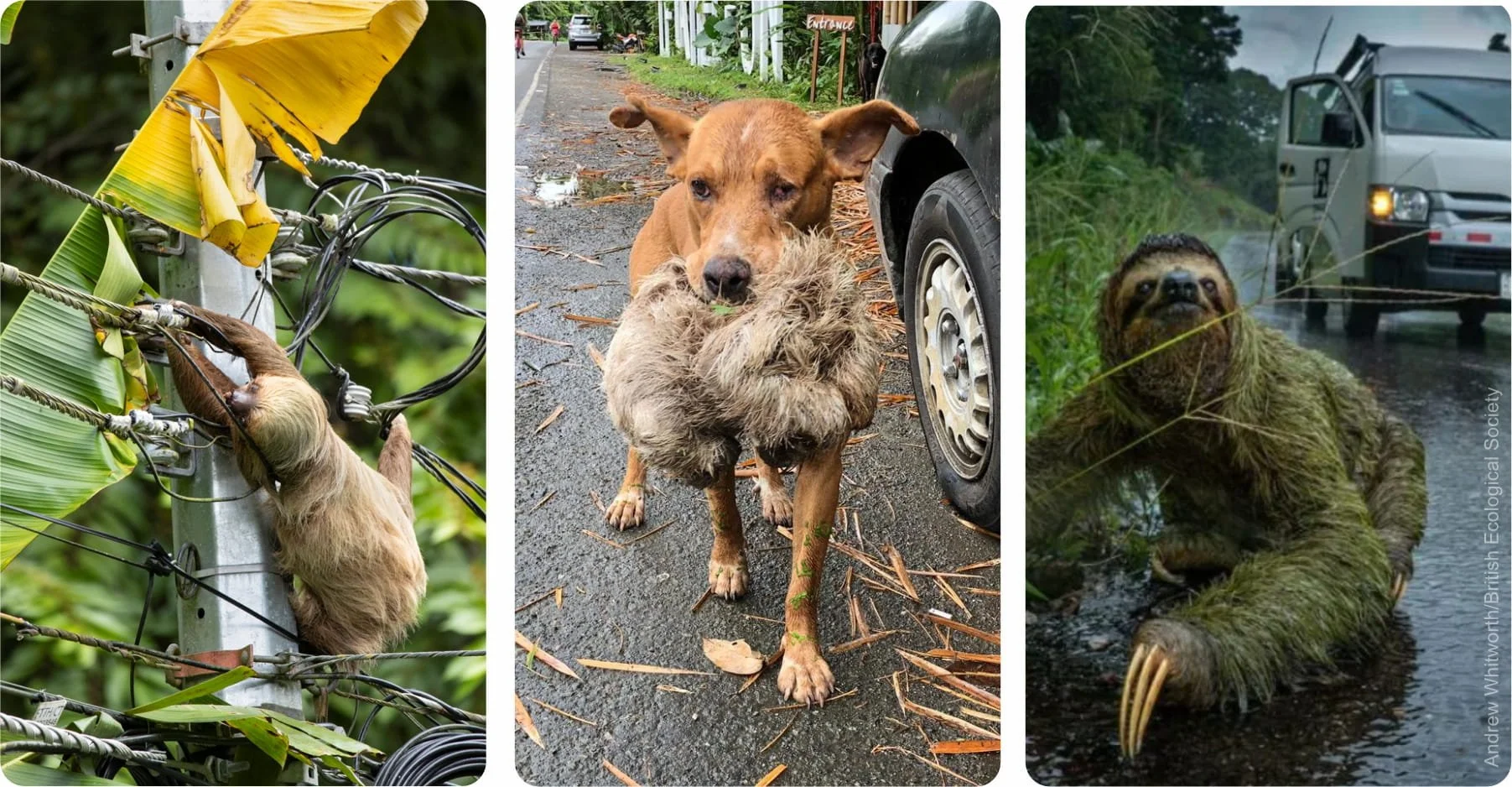
Power line electrocutions, dog attacks, and roadkill are among the biggest threats to sloths in urbanized areas.
In Costa Rica, the scale of this problem is enormous. We estimate that around 3,000 sloths are killed every year by human-related causes. And in the past two years alone, more than 13,000 arboreal animals have been killed after climbing onto power lines across the country.
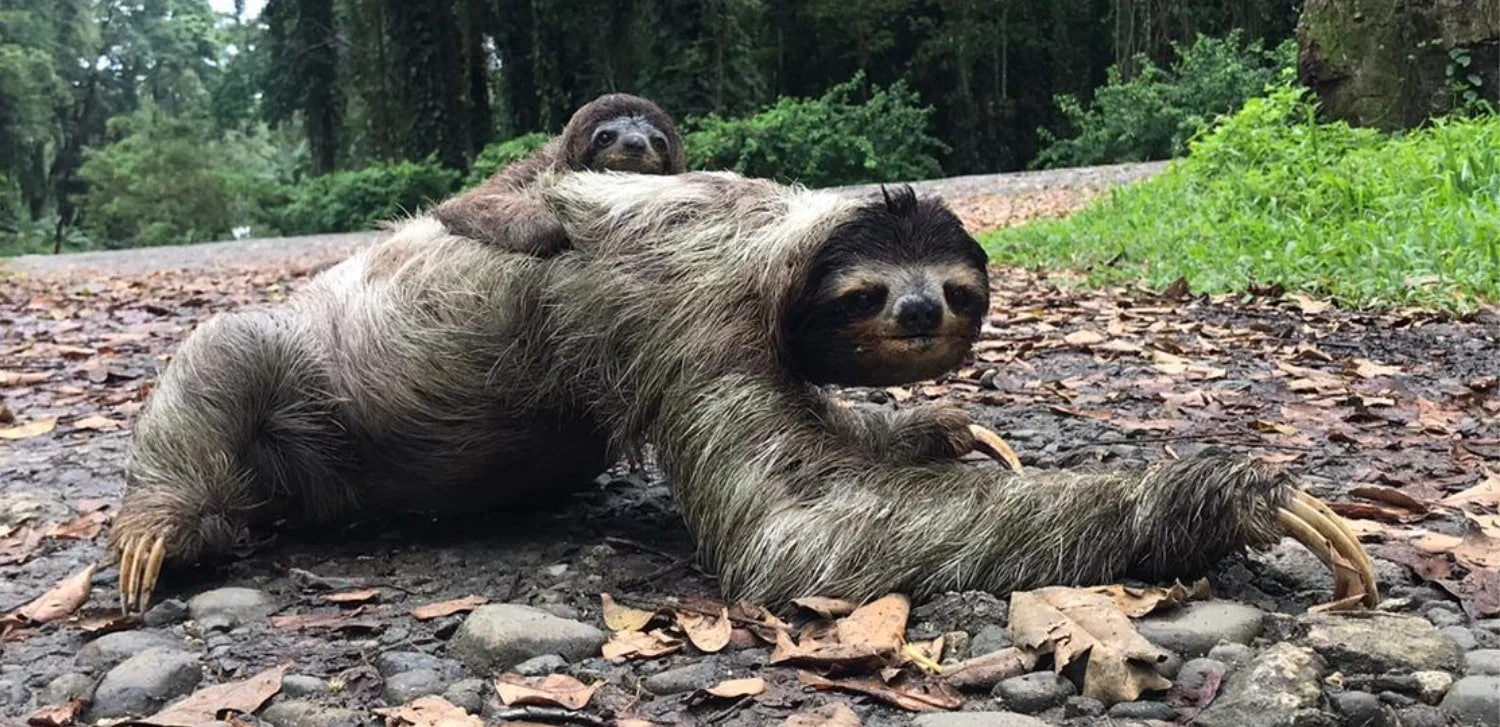
Luna, a sloth we monitored for the Urban Sloth Project, and her baby Sol.
This might seem surprising because Costa Rica is widely celebrated for its conservation successes and its extensive network of protected areas, which cover about a quarter of the country. But to understand why these problems are happening, we need to look beyond the protected areas and into the places where people and wildlife coexist.
Costa Rica’s human population has doubled in the last 40 years and urbanisation has increased by 250%. Over 68% of Costa Rica is managed by small private landowners and 7% by Indigenous communities.
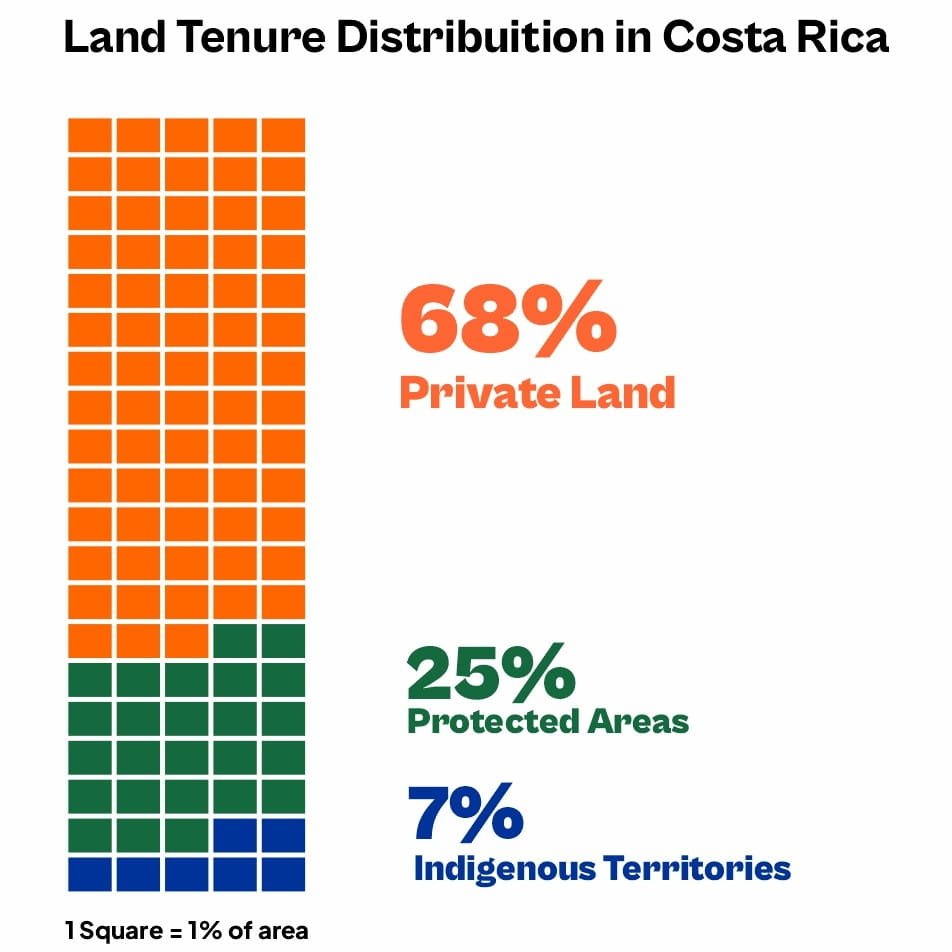
If we want to protect biodiversity at scale, we have to look at the decisions being made on those private lands. Maybe a few trees are removed to build a house or a garden is expanded. Each decision may seem small by itself, but when thousands of them accumulate across a landscape, the impact becomes enormous.
Connecting the Gardens and Bridging the Gaps
This is exactly the challenge that the Connected Gardens project was designed to address. The idea here is surprisingly simple - we reconnect the landscape, fragment by fragment, garden by garden, person by person.
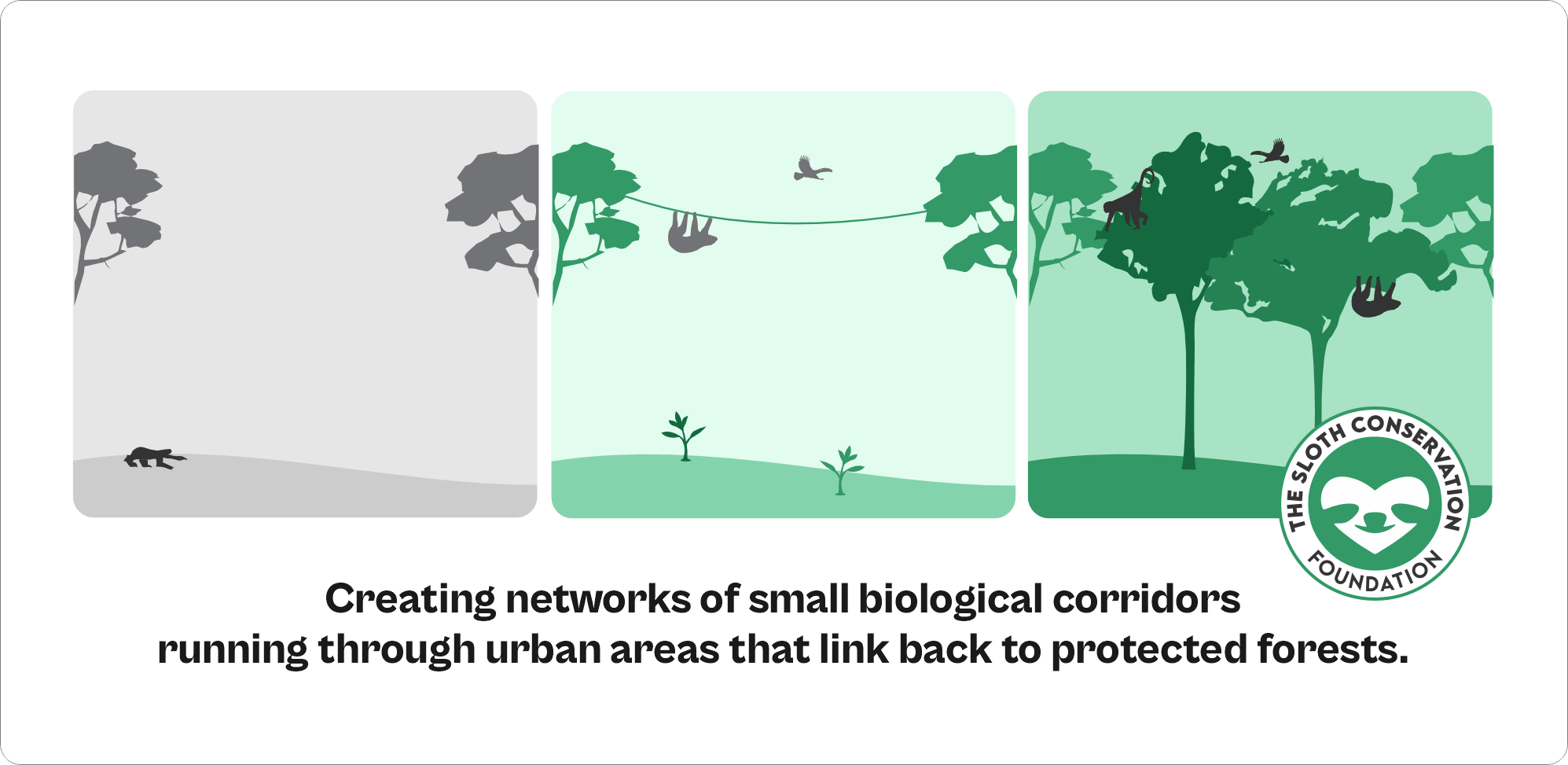
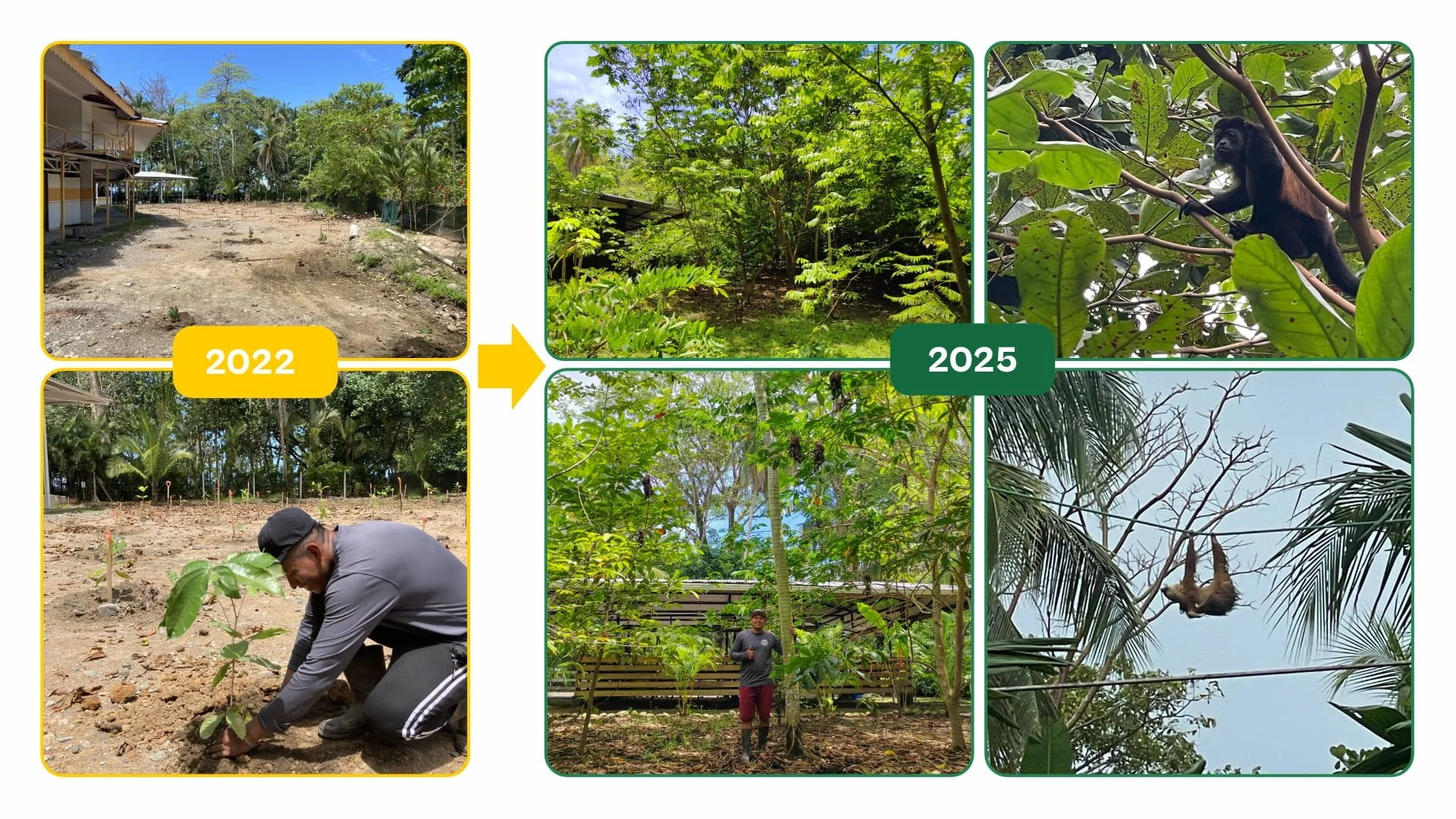
We install wildlife bridges to reconnect immediate canopy gaps, and we use targeted reforestation to restore natural canopy connectivity over time.
This differs from most traditional connectivity projects due to the scale at which we focus. We focus on the smallest scale - because when you’re working with sloths, every single canopy gap matters.
So we’re not just installing wildlife bridges over roads. We install them anywhere connectivity has been broken: across gardens, fences, driveways, even between schools and restaurants. And importantly, we don’t need large areas of land to do this. Most of the time, we’re not changing how the land is used, just how it’s managed.
By doing this, we’re able to build vast networks of small biological corridors that move through urban areas and reconnect back to surrounding forests.
And it’s working. Today, Connected Gardens includes partnerships with more than 1,000 landowners across Costa Rica’s South Caribbean.
We’ve installed 378 wildlife bridges and planted over 13,000 trees. Our camera traps have recorded over 8,000 wildlife crossings by more than 20 species, including the critically endangered Geoffroy’s spider monkey, which had never been recorded using wildlife bridges before.
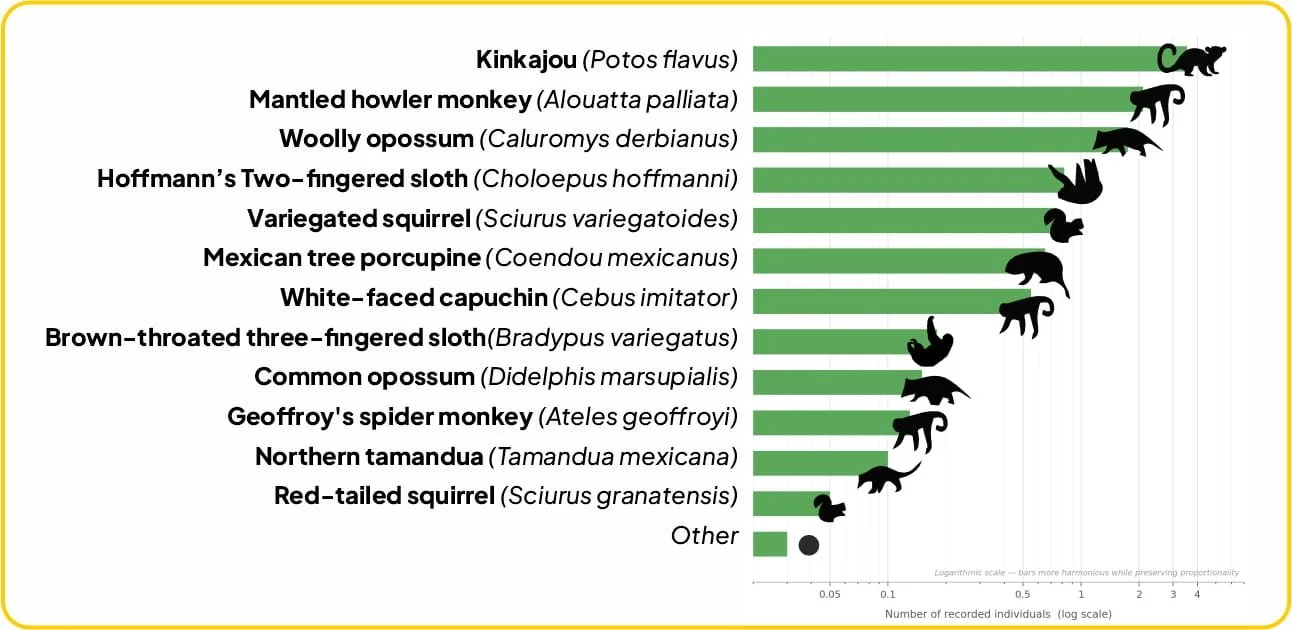
Species using pur wildlife canopy bridges
Connected Gardens is about turning thousands of small, ordinary decisions into a coordinated force for recovery.
It’s about putting the pieces of the landscape back together, and it’s about recognising the power that individuals have — and how that power multiplies when communities work together.
Because the data is showing us that conservation doesn’t only happen inside national parks, and it isn’t only led by governments or large organisations.
It’s led by everyday people.
It happens in gardens.
On farms.
And on pieces of land that people often think are too small to matter.
If you’d like to be part of this work, you can support the Connected Gardens project by making a donation. Together, we can keep reconnecting forests, one bridge, one tree, and one decision at a time.
“Many small people, in small places, doing small things can change the world.”