Debbie the Night Owl | May 2026
Our ongoing research into sloth circadian rhythms continues to reveal just how different two-fingered and three-fingered species can be.
Two-fingered sloths are generally thought to be more nocturnal than three-fingered sloths, and Debbie is certainly proving that to be true. The data loggers that all our tracked sloths wear show us how and when sloths move through the forest. We have recently been able to analyse months of data, and we can see a clear pattern.
This boxplot shows how much of the day Deborah is likely to spend sleeping. The grey shaded areas of the boxplot represent nighttime, and that is where the activity drops. Debbie shows a clear preference for sleeping during the day and being active at night.
Interestingly, Debbie seems to be a true creature of habit. She follows an incredibly consistent nighttime routine, often becoming active at the same time each evening.
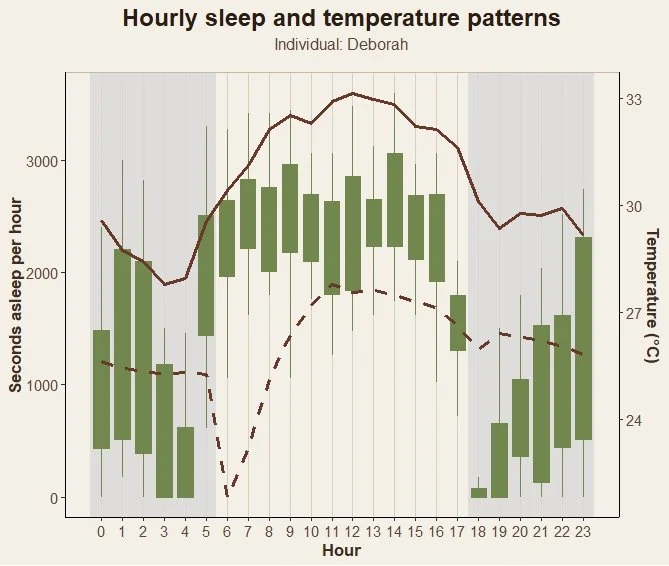
Grey shading = night
Green bars = sleep that may occur that hour
Thin green lines at top and bottom of bars = activity extremes recorded at that hour for that sloth
Solid line = microclimate temperature recorded by data logger
Dashed line = atmospheric temperature recorded by remote weather stations
This is especially exciting now that she has a baby, as we’ll be watching closely to see whether her little one adopts the same rhythm and routines over time.
It also explains why Debbie’s updates do not always prove to be that thrilling, as she is usually fast asleep during the day and doing all the fun stuff at night!
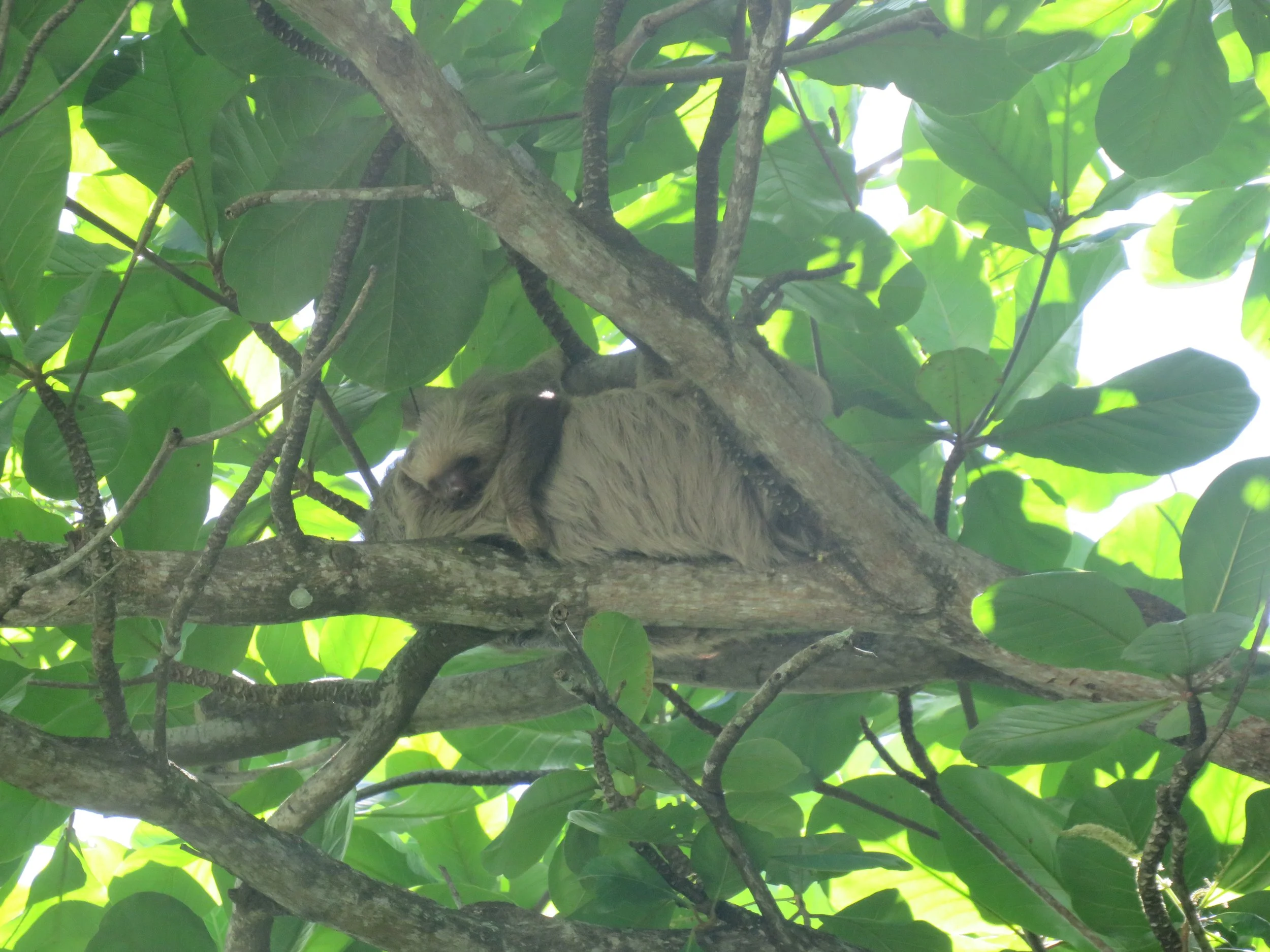
Baby Kiwi, fast asleep during the day while resting on Debbie.
In contrast to Debbie’s and other two-fingered sloths’ predictable schedule, three-fingered sloths show much more random patterns of activity. It is thought that this unpredictability may help protect sloths from predators, as animals with irregular routines are more difficult to locate and hunt.
This data is beginning to transform our understanding of sloth behaviour and daily life in the wild. The more we learn about how sloths use their habitat, when they are active, and how individuals differ from one another, the better we can protect them and the forests they depend on.
Long-term tracking is incredibly important, as it allows us to uncover behaviours that would otherwise remain completely hidden. Every new piece of data helps us build a clearer picture of how sloths survive in a rapidly changing world, and how we can improve conservation strategies to ensure their future.