September 2026
Update #61 of The Urban Sloth Project!
This month brought a dramatic capture, a territorial brawl, a thermal drone search, a very pregnant sloth, and a brand-new recruit. It also brought some hard news, which we share below. Here's the full report of our tracked sloths:
Martita
It was a sunny day when Dr.Cliffe, on her morning drive to the office, spotted a sloth high in a cecropia tree near the Indian Restaurant. The position looked like a good capture opportunity, so she called the team right away. As you know by now we have been struggling to recapture Martita to carry out her collar change! Her collar battery is now depleted, which made replacing it a top priority.
We packed the ladder, ropes, and everything else we might need. Cecropia branches are known for snapping easily, which isn't ideal, but it was our only option. Our expert tree climber, Dayber, assessed the tree, judged it sturdy enough, secured a rope to a strong-looking branch, and climbed up. Once he reached her, he anchored a second rope, attached it to Martita, and lowered her slowly to us. Dr.Cliffe received her at the bottom, and we did a full health check right away.
Everything was fine, and all she needed was a new collar. We fitted it, tested it, and confirmed it was working perfectly. Then we returned Martita to her cecropia tree, where she released herself back into the canopy.
She stayed in the same general area since for most of the month, though lately she has started drifting West towards unexplored territory…
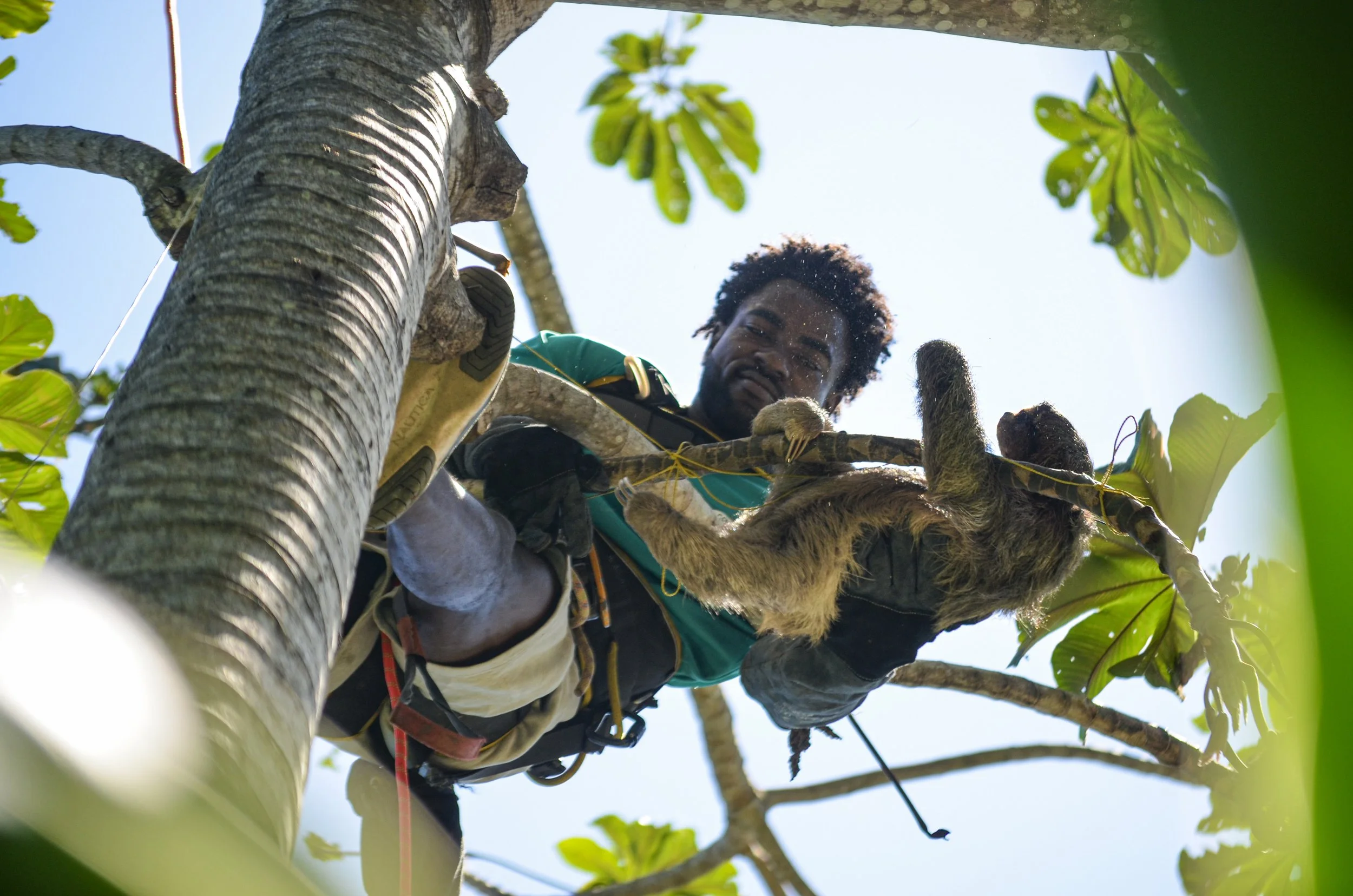
Martita, during her capture for the re-collaring!
Christina
Christina has little news this month, and for her that's a good sign. She's back among the big, tall trees where she raised her baby before he became independent. She's still very hard to spot, a truly wild sloth living in an urban strip of forest.
Daffodil
Daffodil gave us two poop samples for our DNA research (yes, we're thrilled). Daff truly loves the beach. She spends her days camouflaged beside a coconut frond that matches her coat perfectly, resting in the sea breeze.
Bob
Bob was captured this month for a health check, a microchip, and a swab. We found him in Martita's favorite cecropia tree, giving himself a thorough groom when we stumbled upon him.
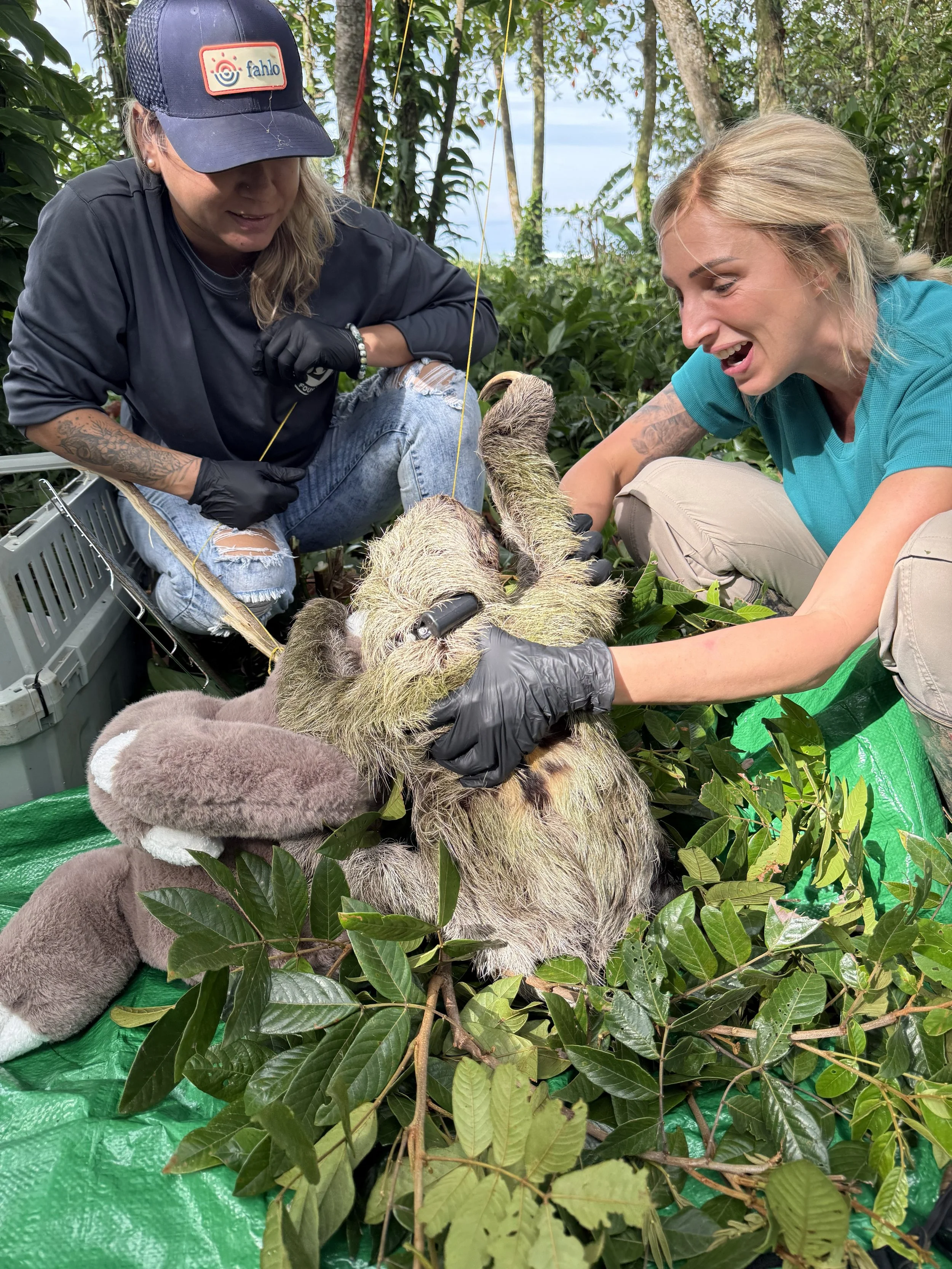
Dr.Cliffe, thrilled to be performing a health check on Bob!
After his checkup, he moved to a large tree with the wildlife bridge we built for Martita in front of the Indian Restaurant. On one of the tracking days, he was found there, fighting and vocalizing with a seemingly younger male in an apparent territorial dispute! (Sadly, no photos or video of the showdown.) In the end the two separated, with Bob staying put as the territory holder and the challenger leaving!
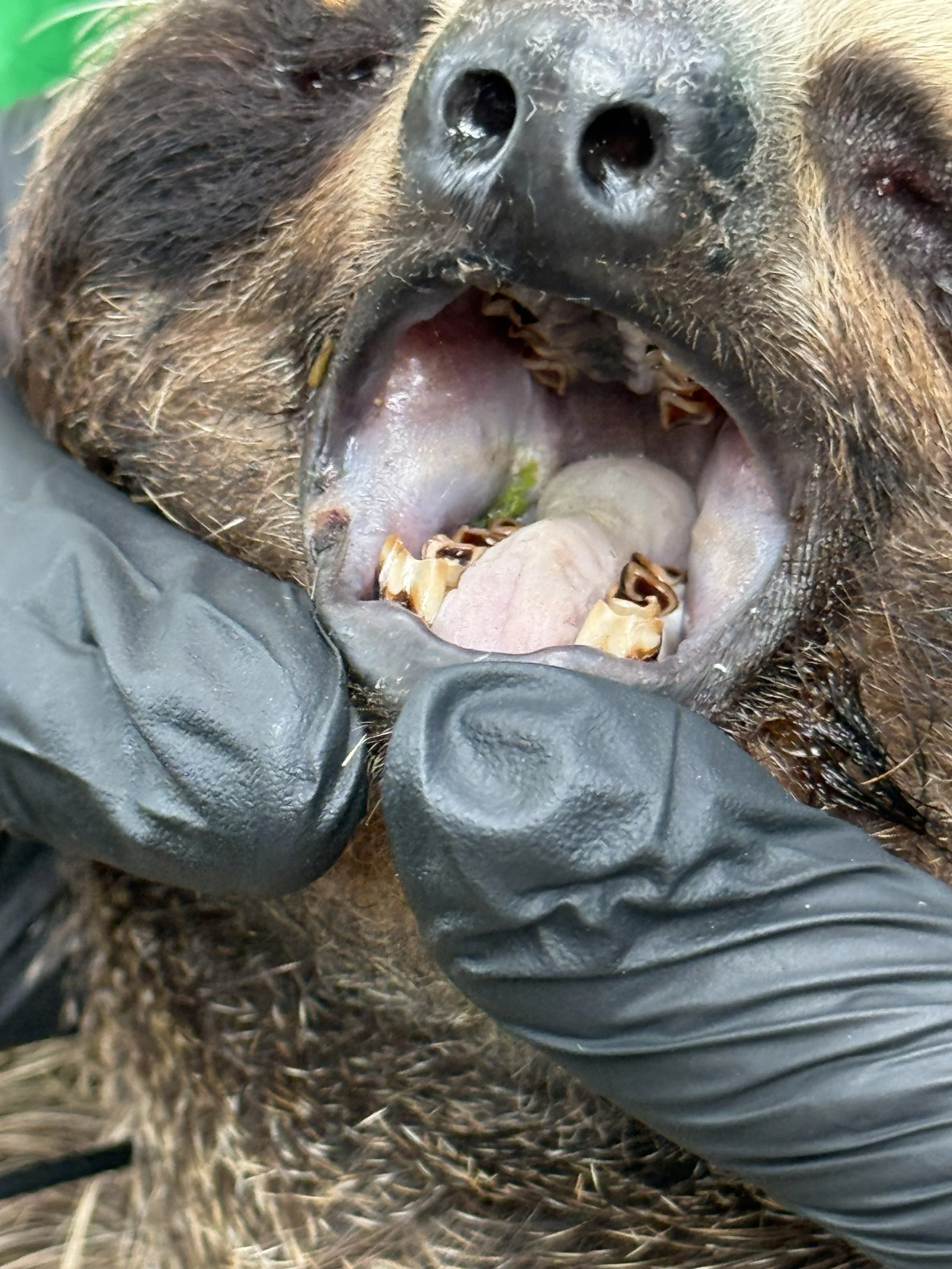
Look at those teeth!
Pistachio
Pistachio is still in the tree near Tasty Waves, always close to a mother with a baby. We keep trying to capture him so we can remove his collar and end his time with us in the project, but Pistachio simply never comes down for the team! Perhaps he's just not ready to leave the USP project.
Franklin
Franklin is proving very hard to catch. We still want to swap his collar, but he has stayed high in the canopy since our last attempt. This month he's been visiting very similar spots to Debbie, so there are clearly a few "golden spots" the two of them rotate between. On one especially hot day, he was lounging in a tall tree by the beach, stretched out in the vines.
Debbie
Debbie is quiet in her tree near the road. Now that she's without Kiwi, she seems to move less. She is doing well, alternating between her usual trees and a few less commonly visited ones, within her known territory though.
Kiwi (Debbie's baby) remains a mystery. It is most likely that Kiwi reached the stage of becoming independent. In two-fingered sloths (Choloepus), young typically start gaining independence around 6 to 9 months, so Kiwi may be exploring the Playa Negra area alone. The fact we haven’t seen the young one at all does leave us wondering though… We haven't seen Kiwi since she left mum’s side, and we haven't found a baby sloth in the area, alive or deceased. So for now, we simply don't know what happened.
Luiza
Yet another pregnancy!
Late last month during her re-collaring, we noticed Luiza looked pregnant. A gentle palpation confirmed it: we could feel the baby moving! Luiza was expecting, and she was close to giving birth! Then she vanished. As the weeks went by without a glimpse of her, the team joined forces for a search from air and ground. We sent a thermal drone up while scanning the forest below with binoculars and an antenna. When the antenna signal pointed at a tree by the Cocles lookout, the drone swept over it, and there she was, lying relaxed on her back in a Wild fig tree, feeding. Nearby sat another three-fingered sloth. Could it be the future father? We're keeping an eye on him.
We later returned for a second visit and another drone flight, and the team's notes from that day say it best:
"Luiza was radiant in the sunlight, glowing like an expectant mother amid the foliage. Her belly is huge and she looks beautiful. She was spotted nearly 30 meters away in a sangrillo tree near the Cocles lookout, and we captured stunning photos with both a drone and a camera."
We are patiently awaiting the new baby’s arrival and keeping a close eye on her until then!
Primary Forest Sloths
Flash
Flash's collar battery has died, and his recapture has been the frustration of the month! Finding a sloth by radio signal is hard enough in thick primary forest, but try doing it with plain eyesight! We managed to spot him twice, but even that wasn't enough, because he was too high up to capture. We also searched the whole area by drone and couldn't pick him out in the canopy. We'll try again next month!
Pipa
Pipa is still in her beautiful tree home by the road, and we keep finding her in the same blissful state: curled up asleep among her favorite leafy branches.
Not that she doesn't like to keep us on our toes. On another hot day, her signal put her in a brand-new tree, and for a while we couldn't find her anywhere. But then we remembered who we were dealing with. Pipa is a creature of habit, and like the coconut she's named after, she's happiest staying put. Her hobbies include lying curled up in a tree, and, well, lying curled up in a tree. Sure enough, we eventually got our eyes on her, right where a sloth should be.
Out of Action Sloths
Bruce
Bruce was recaptured this month to fit him with a microchip for permanent identification. These chips are similar to those used for pets and allow us to identify individual sloths long after their tracking collars have been removed.
This helps us avoid accidentally counting the same animal twice, and rescue centers can also scan the chip to find out whether a sloth has previously been part of our research or received veterinary care. Microchipping is a common practice amongst rescue centers in the country.
During the procedure though, we found an injury with an abscess on his back. We took him straight to the Sloth Sanctuary, where the vet cleaned the wound and started treatment.
We hope for a positive response this week and, if all goes well, to collect him and return him to the forest very soon!
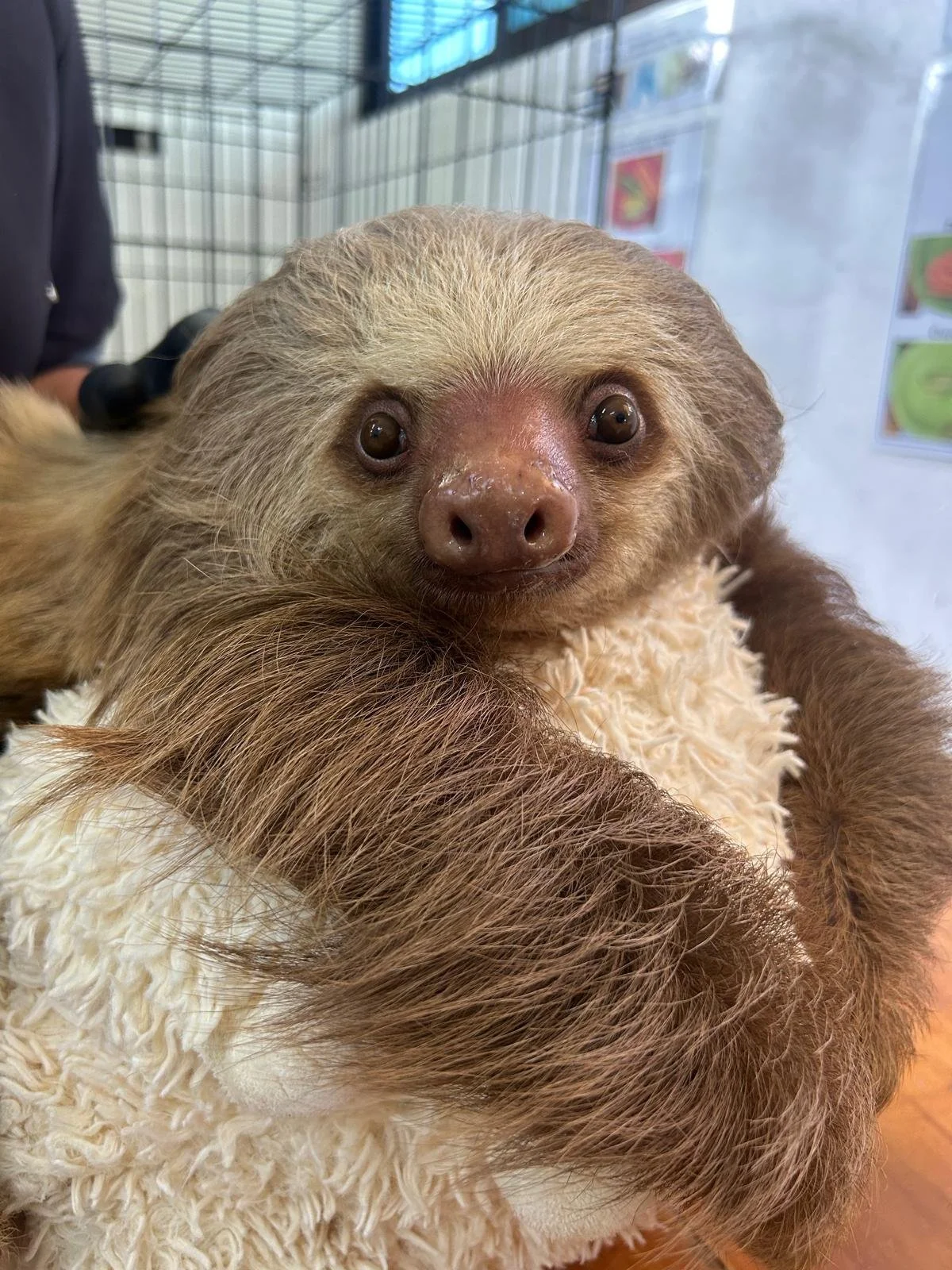
Bruce at the Sloth Sanctuary.
Pati
Pati was found on the ground, a little dehydrated and lethargic, after a reported fall. We also sent him to the rescue centre for a vet evaluation. He had weakness in his legs that made it hard for him to move, so he's now in treatment and physiotherapy, with the goal of getting him back to the forest very soon!
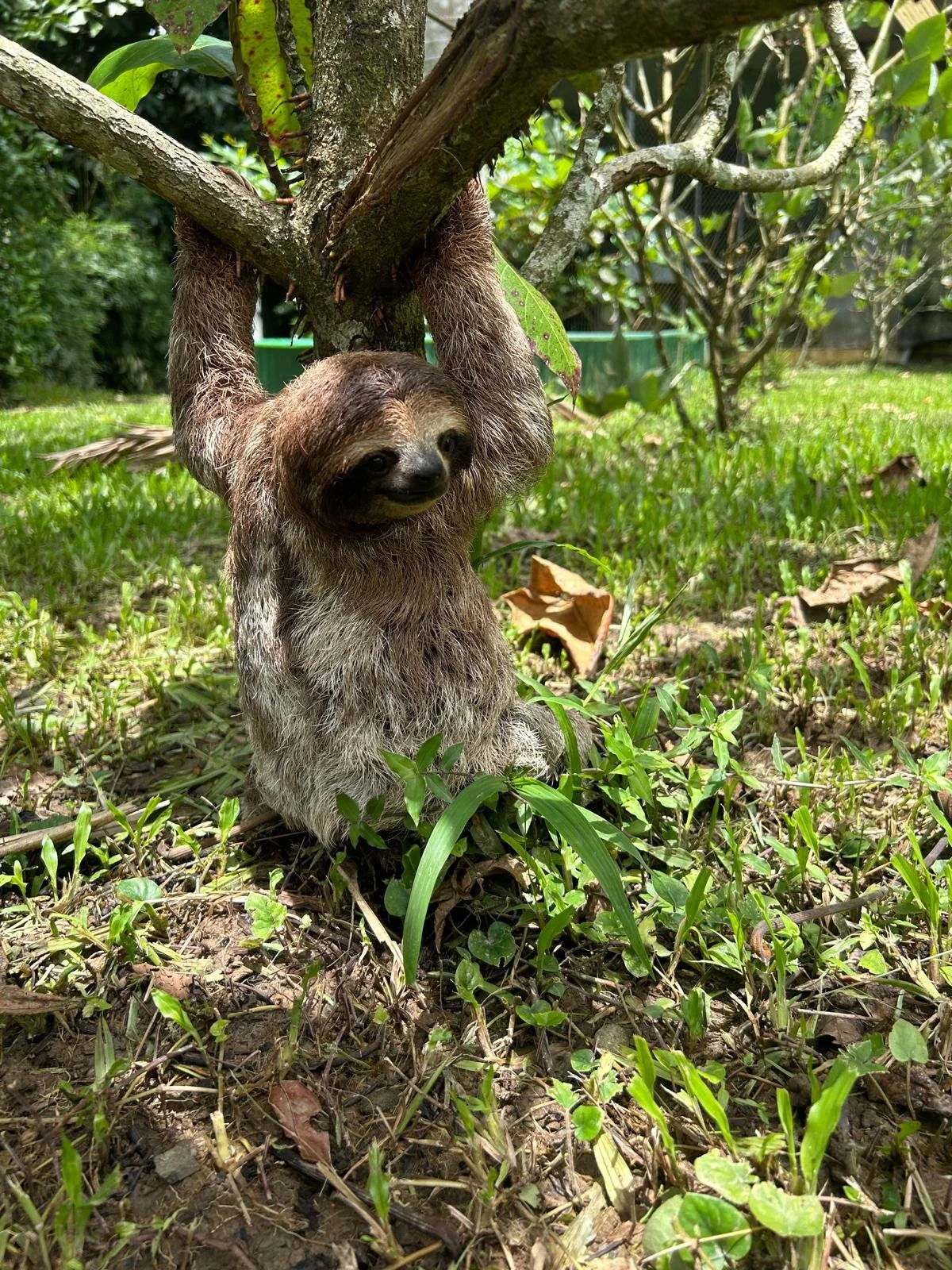
Pati doing rehabilitation exercises.
Sad news…
We also have to share the sad news about two of our sloths. After 47 tropical storms this year, and the highest amount of recorded rainfall in over 20 years, it is no surprise that wildlife, including our sloths, have been affected.
Elliot: We found him in the first week of September. We hadn't seen him for a few days and his transmitter was giving a strong signal but the mortality alert hadn't triggered. This alert changes the rhythm of the VHF signal when the collar detects no movement for a set period. Early in the month, the antenna started pointing straight at the ground, and while searching to see if his collar had fallen off, we sadly found him deceased. The weather and unusually low temperatures during that period also affected other sloths and may have contributed, but we can't confirm it.
Nigel: On one of our tracking outings, we noticed Nigel had a fungus on his arm. We wanted to catch him and take him to the Sanctuary, but he was extremely high in a massive tree, impossible to reach. He had a bleeding wound on his arm that looked infected, and he was dehydrated, weak, and thinner. The Connected Gardens team helped with the rescue using ladders, and we took him to the rescue centre for care. Sadly, he passed away overnight after cardiac arrest. He was also suffering from pneumonia. The necropsy attributed his condition partly to genetic factors, and we believe the weather and low temperatures aggravated it as well.
Despite these two unfortunate losses, we are pleased to welcome a new member to the tracked family!
Meet Silver!
Silver is a male three-fingered sloth (Bradypus), and he is tiny, weighing just 1.5 kg. He was spotted by a farmer's daughter in a very slender tree, 11 to 12 meters up, curled up and seemingly asleep. We came across him in the forest whilst on a survey to track Flash. Our climber assessed whether a capture was feasible, and once we had the go-ahead, we brought him down to fit him with a tracking device and collect scientific samples.
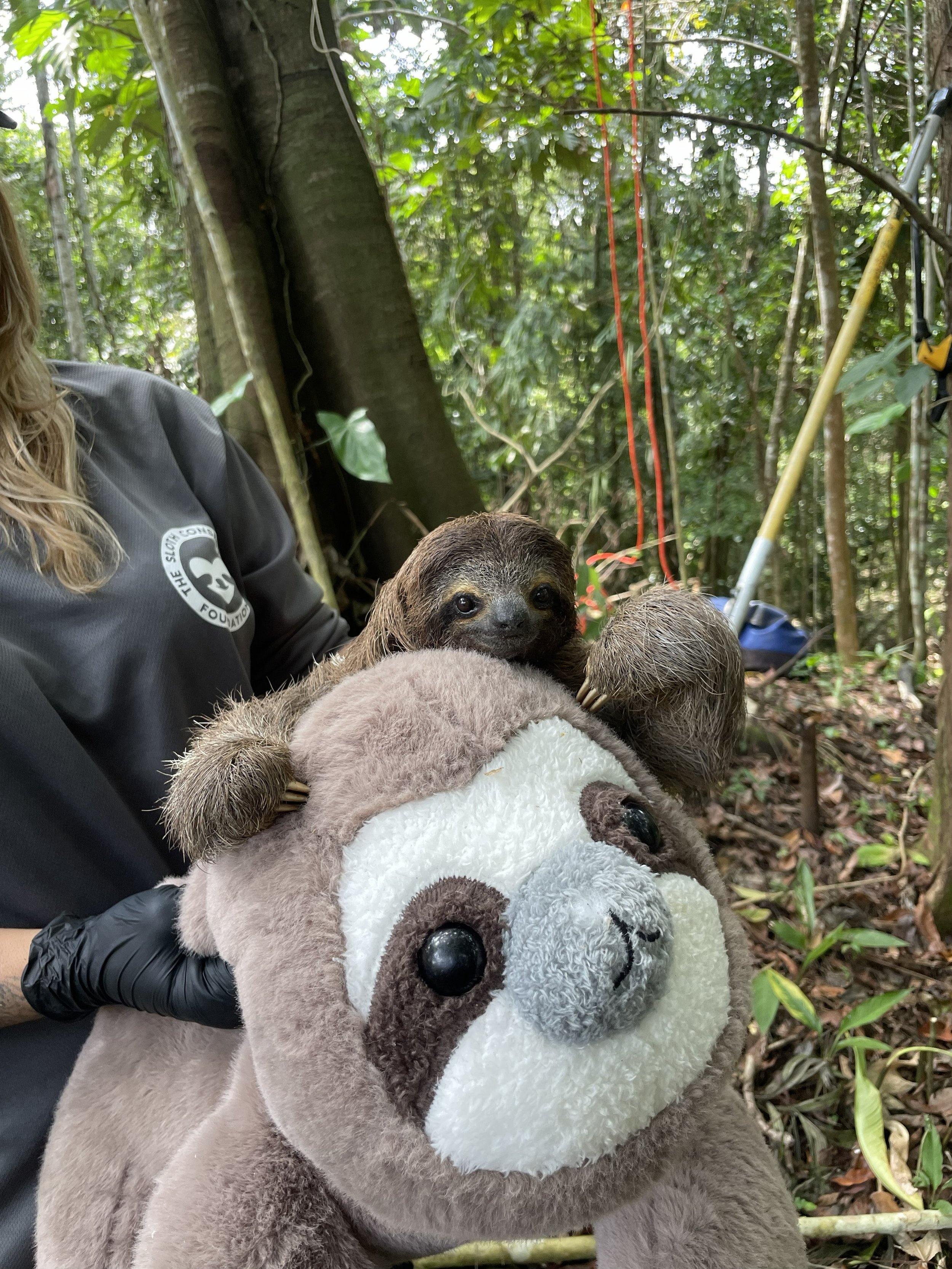
Silver holding on to Cafuné, our sloth-shaped aid for collaring sloths.
Silver went through the full process: a microchip, collar fitting, fecal swab, and moth samples, plus weighing, measuring, and a clinical evaluation. The vet check found slight nasal discharge and mild pulmonary rales, so we'll be monitoring him closely to see whether he recovers naturally.
We gave the farmer’s daughter the chance to name the sloth. The name comes from a childhood book series she was obsessed with, in which a dragon race had sloth companions riding on their necks, and one of those sloths was called Silver.
Welcome to the monitored family, Silver!
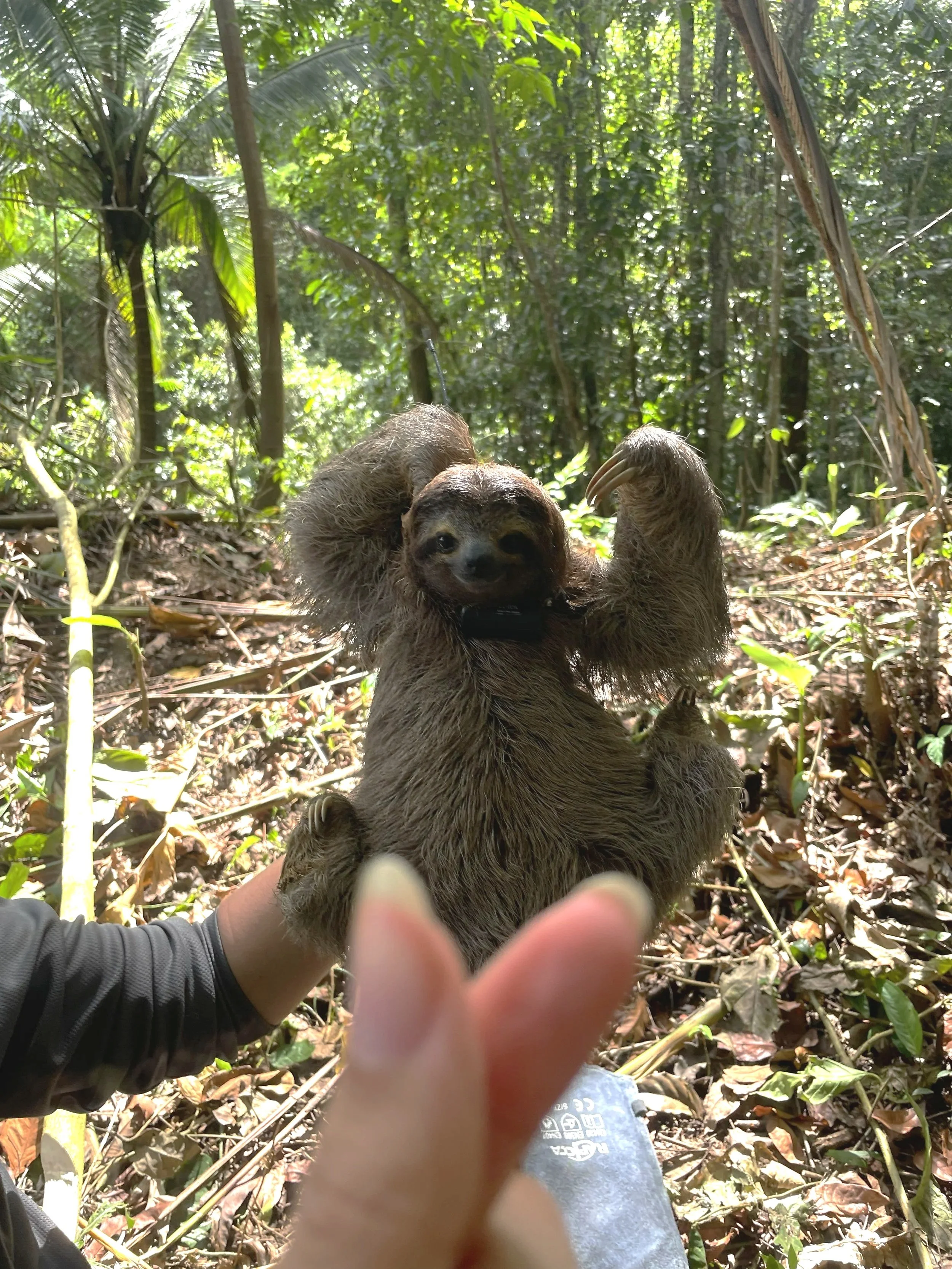
Your monthly supports makes all of this possible. Thank you, for making a better world for sloths.