May 2026
Update #57 of The Urban Sloth Project!
Luiza
Over the last month, Luiza has been moving around much more than usual and, although the tracking receiver frequently picked up strong signals, actually seeing her has proved to be another story entirely.
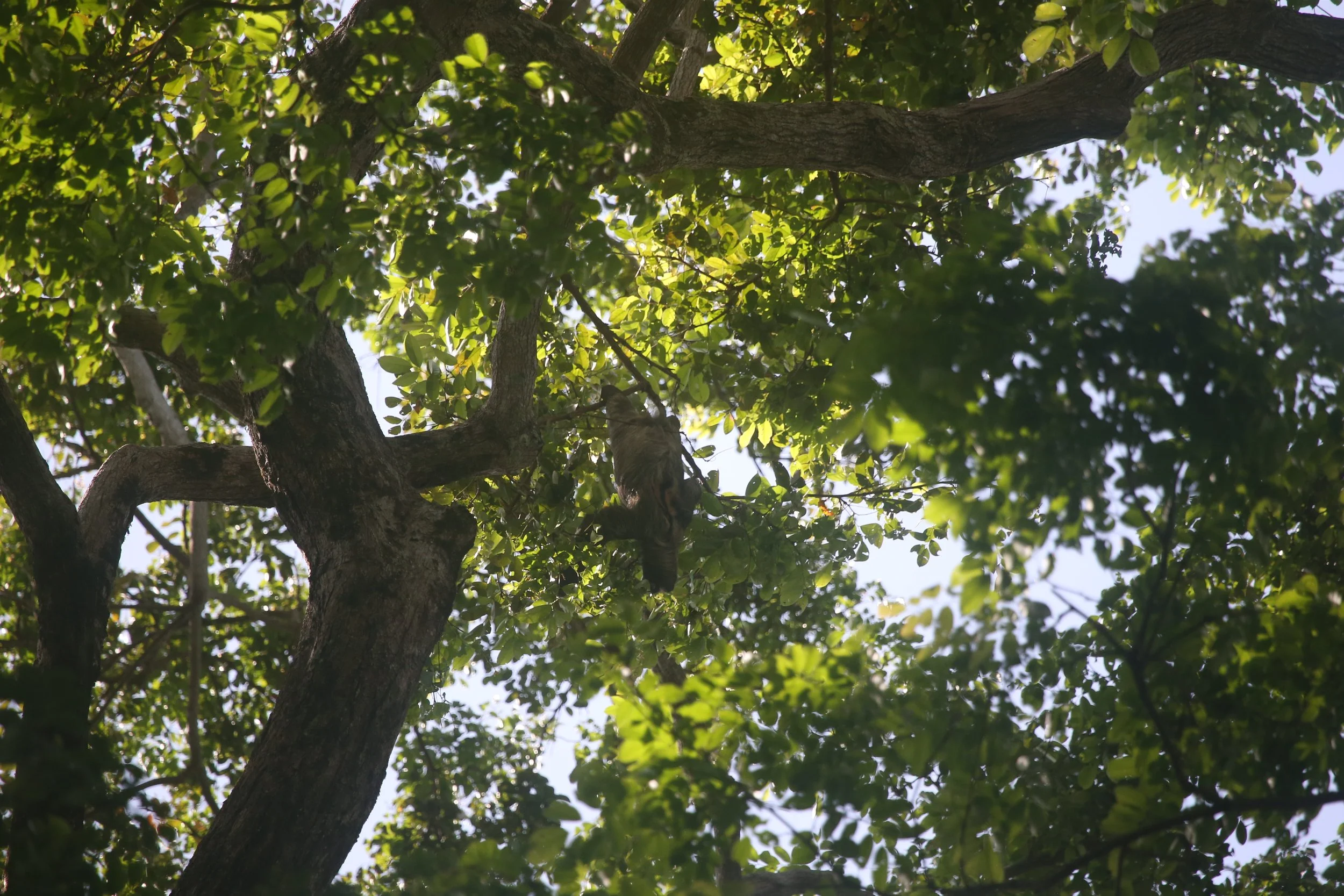
At one point, the signal guided us toward what appeared to be one of the tallest trees on the property. Just like the month before, Luiza continues to choose extremely high trees where she spends her days foraging, feeding, resting in the sun, and disappearing into the canopy. After all, this is exactly what sloths have evolved to do, and Luiza’s doing a great job of it. Sometimes she is more than 30 metres above the ground, hidden among thick vines and branches, making it nearly impossible to see her clearly. Case in point:
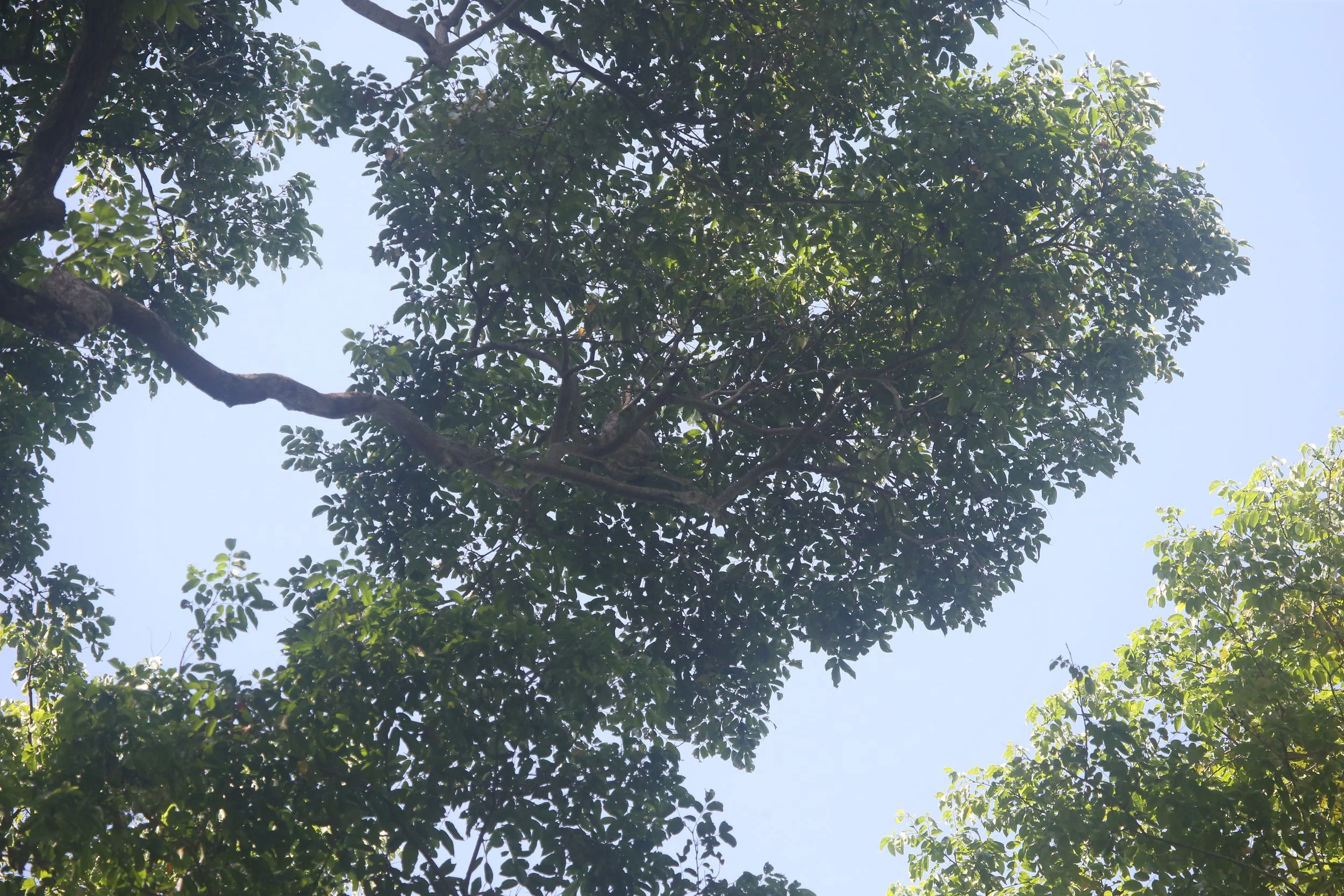
Luiza, detected 30m high in the tree using our laser rangefinder.
The team still suspects there is a possibility Luiza may be pregnant. Her secretive behaviour, large size and preference for staying so high in the canopy continue to make us wonder what exactly she is up to up there.
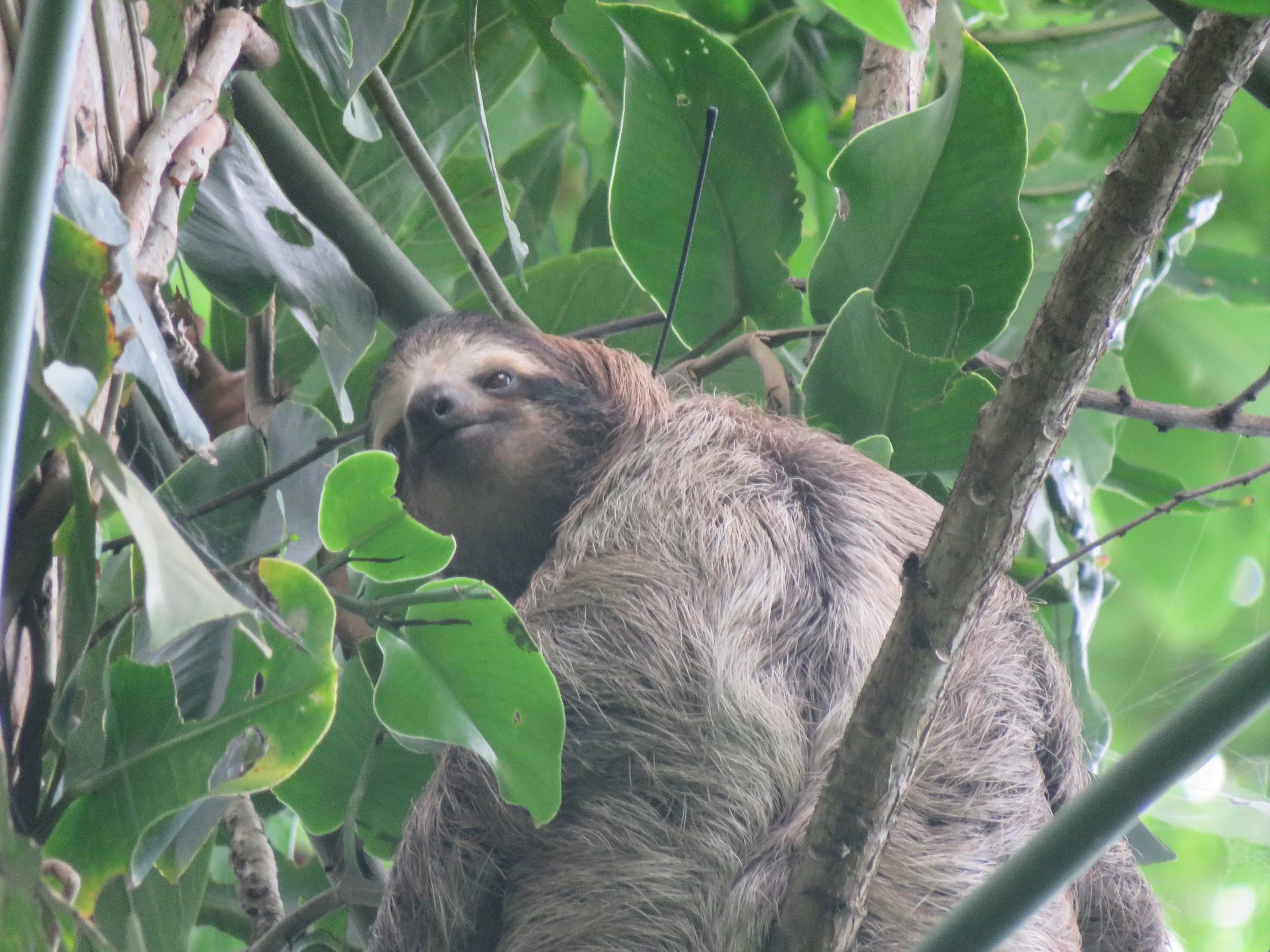
However, just a few days ago we were able to get a good look at Luiza and capture a close up photo of her for the first time in months! Can you see the sloth-mouth shaped bites in the leaves?
This month also brought some interesting insights into Luiza’s circadian rhythm, after analysis of the movement data registered by the data logger on her collar showed us when Luiza is active and resting during the hours of day and night.
The graph below proves what we already seemed to have observed in three-fingered sloths: a highly unpredictable pattern of activity, where some days they are active throughout daylight hours, while on others they spend much of the same period asleep and inactive. This randomness may actually be an important survival strategy. One theory is that by being unpredictable, sloths make it harder for predators to anticipate their movements and routines.
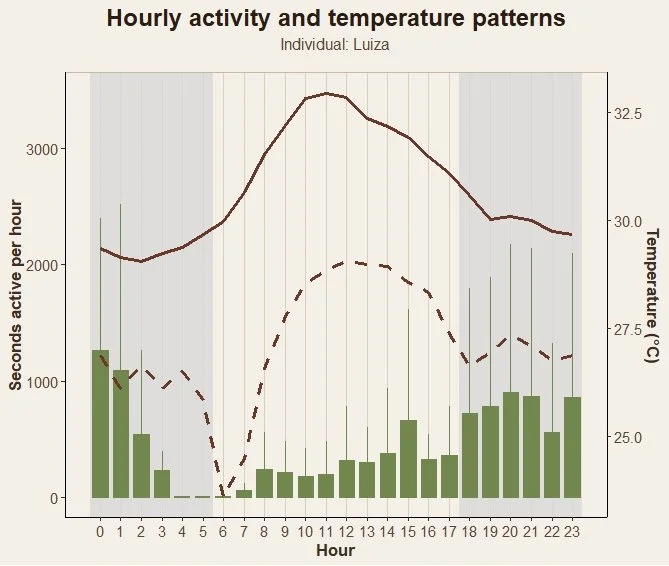
Grey shading = night
Green bars = sleep that may occur that hour
Thin green lines at top and bottom of bars = activity extremes recorded at that hour for that sloth
Solid line = microclimate temperature recorded by datalogger
Dashed line = atmospheric temperature recorded by remote weather stations
Martita
This month, Martita has continued her new life on the far side of the road after her adventurous crossing into the area surrounding the Indian restaurant with her baby, Patty.
According to the tracking signal, she has been using one of the enormous trees hidden behind the restaurant, which is part of a beautiful cluster of giant trees shared by both two-fingered and three-fingered sloths. The restaurant owners have been incredibly cooperative, allowing the team access even outside of opening hours. As you already know by now, the support of local businesses and property owners makes an enormous difference to our work. Many sloths choose to live around private properties, restaurants, or hotels and, when owners are willing to collaborate, it allows us to continue monitoring safely and consistently while also helping local people learn more about the wildlife around them.
At the same time, this situation also highlights the challenges we sometimes face. In the past, a lack of cooperation from property owners has meant that we have been unable to monitor certain sloths. Education and collaboration are absolutely essential for conservation in urban spaces.
For much of this month, Martita has remained frustratingly difficult to locate. The signal suggested she was nearby, but repeated searches failed to produce a clear sighting. Eventually, the team decided to set a plan in motion: a full stakeout from the restaurant itself. Armed with tracking equipment and sitting in beach chairs beneath the trees, the team patiently waited… and finally, after hours of searching, Martita and Patty appeared high in the canopy.
We were incredibly relieved to confirm they were both safe and healthy after struggling for so long to find them.
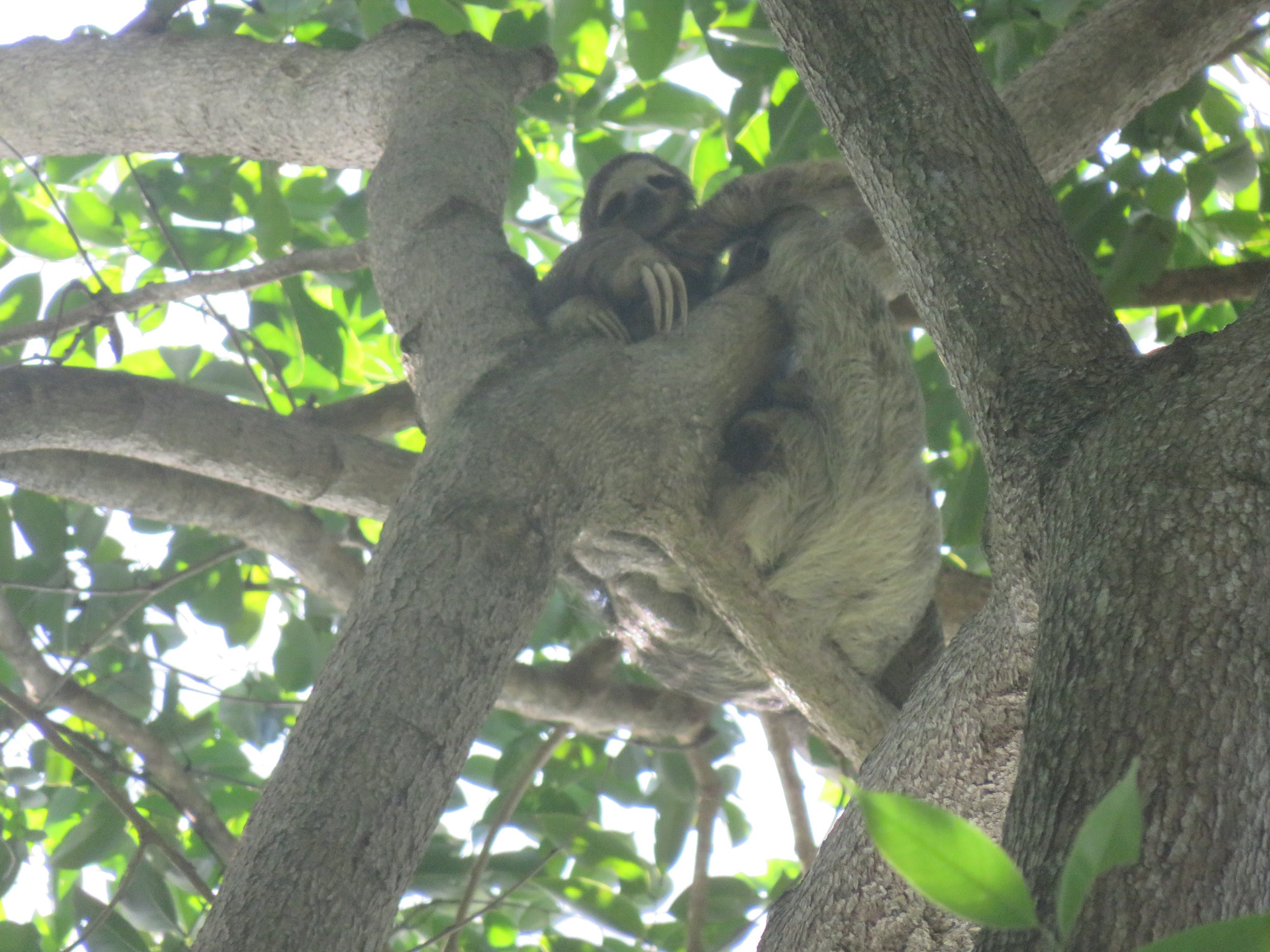
Baby Patty was curiously looking down at us when we found them.
Pistachio
Pistachio continues to be one of our most ‘urban’ urban sloths. Month after month, he remains faithfully attached to his territory between the wall of the Caribeans café and the nearby trees, making him one of the easiest individuals to track.
What continues to amaze us is just how comfortable Pistachio seems with constant human activity. As part of our monitoring work, we measure environmental conditions each time we locate all tracked sloths, including noise levels around them. Around Pistachio’s favourite hangout spots, we have recorded sound levels approaching 100 decibels from nearby traffic, lawnmowers, music, and café activity, yet he remains completely unbothered by the noise.
What makes this even more unusual is that he is not trapped there. The surrounding canopy connectivity is actually quite good, meaning he could easily move into quieter areas if he wanted to. Instead, he seems to actively choose these busy restaurant-side trees as his preferred resting spots.
For humans, experts recommend limiting exposure to sounds around 100 decibels to no more than 15 minutes without hearing protection. Seeing Pistachio peacefully sleeping through this noise continues to surprise us and reminds us just how adaptable some sloths can become in urban spaces.
This month, we also captured a sweet picture of Pistachio mid-yawn on a rare visit to a nearby tree.
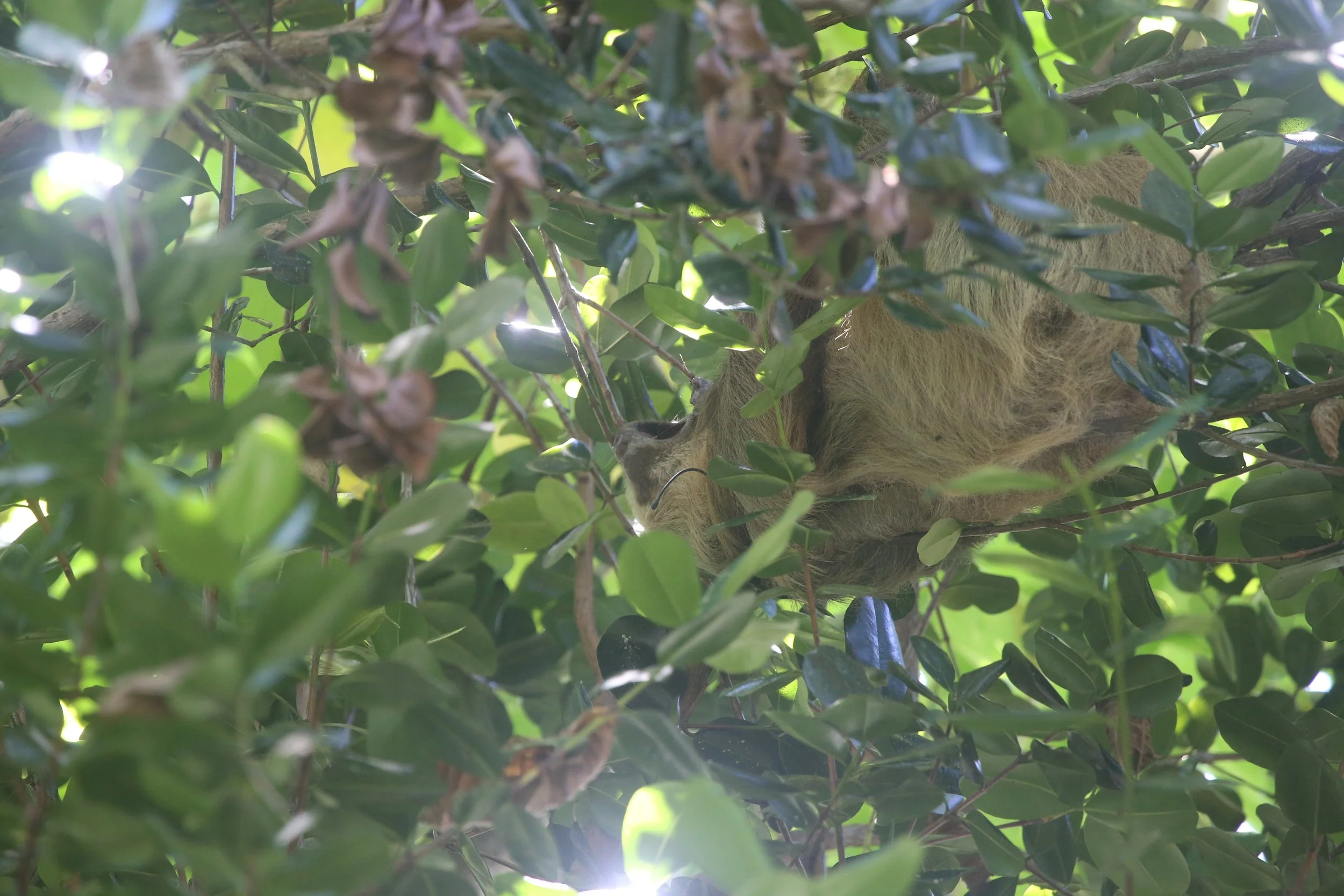
Debbie
Debbie has once again shifted her position slightly, moving away from the beach and back toward one of her favourite trees near the road, a large tree completely covered in thick vines where she loves to hide with her baby.
This month, consistent tracking signals guided us directly to this spot but, we kept struggling to get eyes on Kiwi. The baby was so perfectly camouflaged against Debbie’s fur and the surrounding vines that we could barely distinguish anything at all. We only managed to catch a glimpse of a tiny hand and part of the collar, which occasionally became visible through the dense vegetation.
Even though Debbie was out of sight, back at the SloCo offices, we were busy analysing some data from Debbie’s data logger. Movement registered by her logger has given us some insight into her activity patterns throughout day and night. It is thought that two-fingered sloths are more nocturnal, and the data analysis has proven just this, showing that Debbie is consistently more active during the night, and moves around less during the day.
The graph below illustrates this pattern:
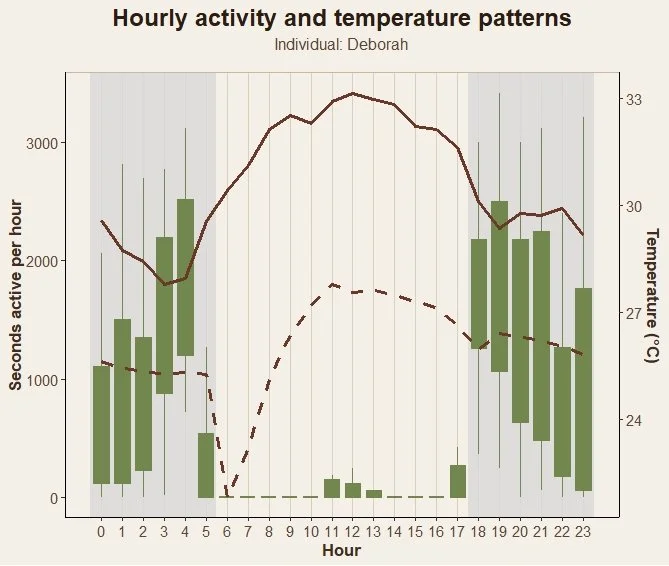
Grey shading = night
Green bars = sleep that may occur that hour
Thin green lines at top and bottom of bars = activity extremes recorded at that hour for that sloth
Solid line = microclimate temperature recorded by datalogger
Dashed line = atmospheric temperature recorded by remote weather stations
The green activity bars are larger in the grey shaded areas, which shows she is moving around more at night. During the day on the other hand, these green bars are smaller, which indicate less movement during the day.
Luckily, just a few days before the end of the month, Debbie and baby Kiwi moved out of the vine-filled tree, allowing us to finally get a good look at them both; well, mostly Kiwi, who was lying comfortably on top of Debbie.
Tango
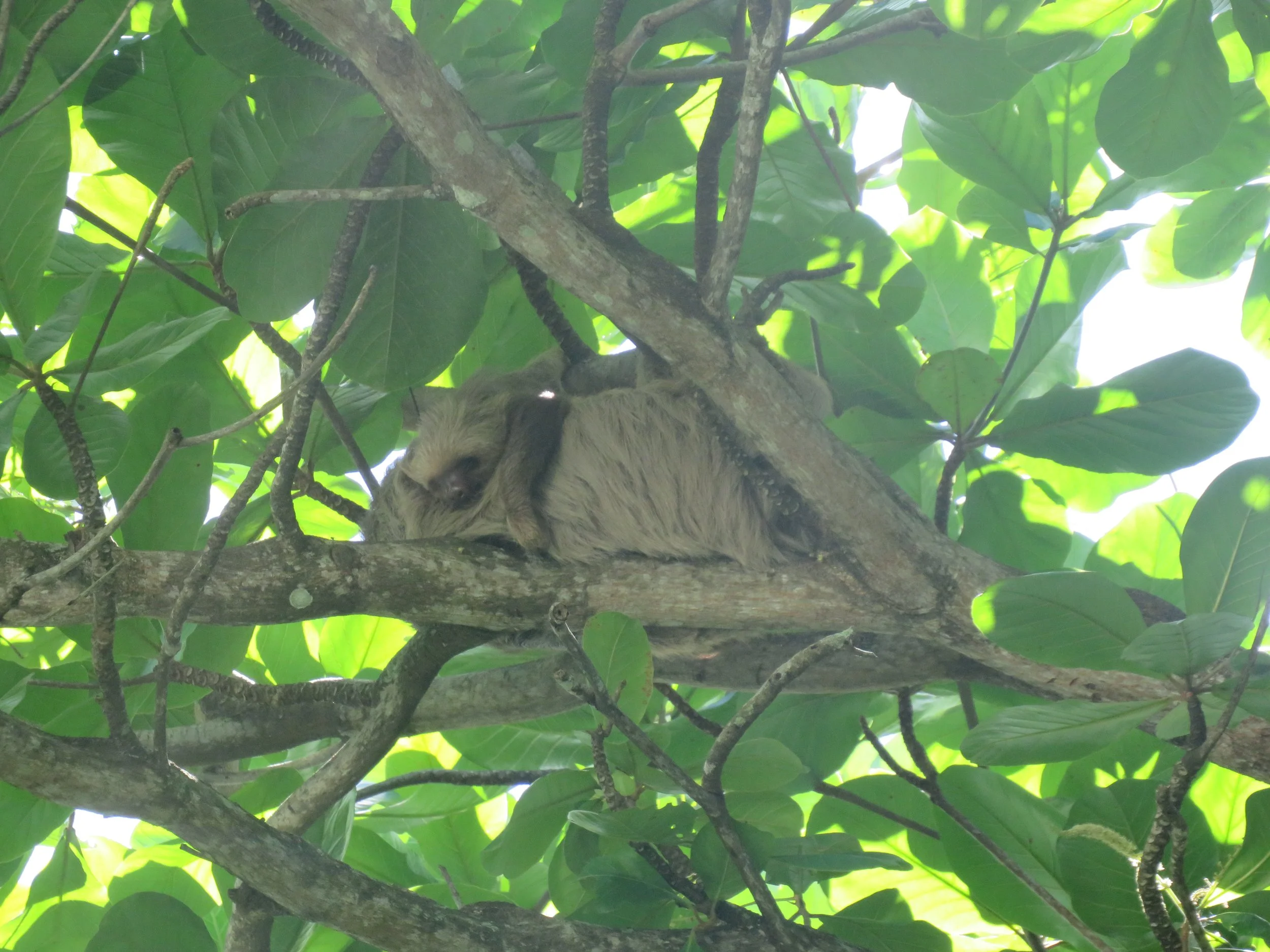
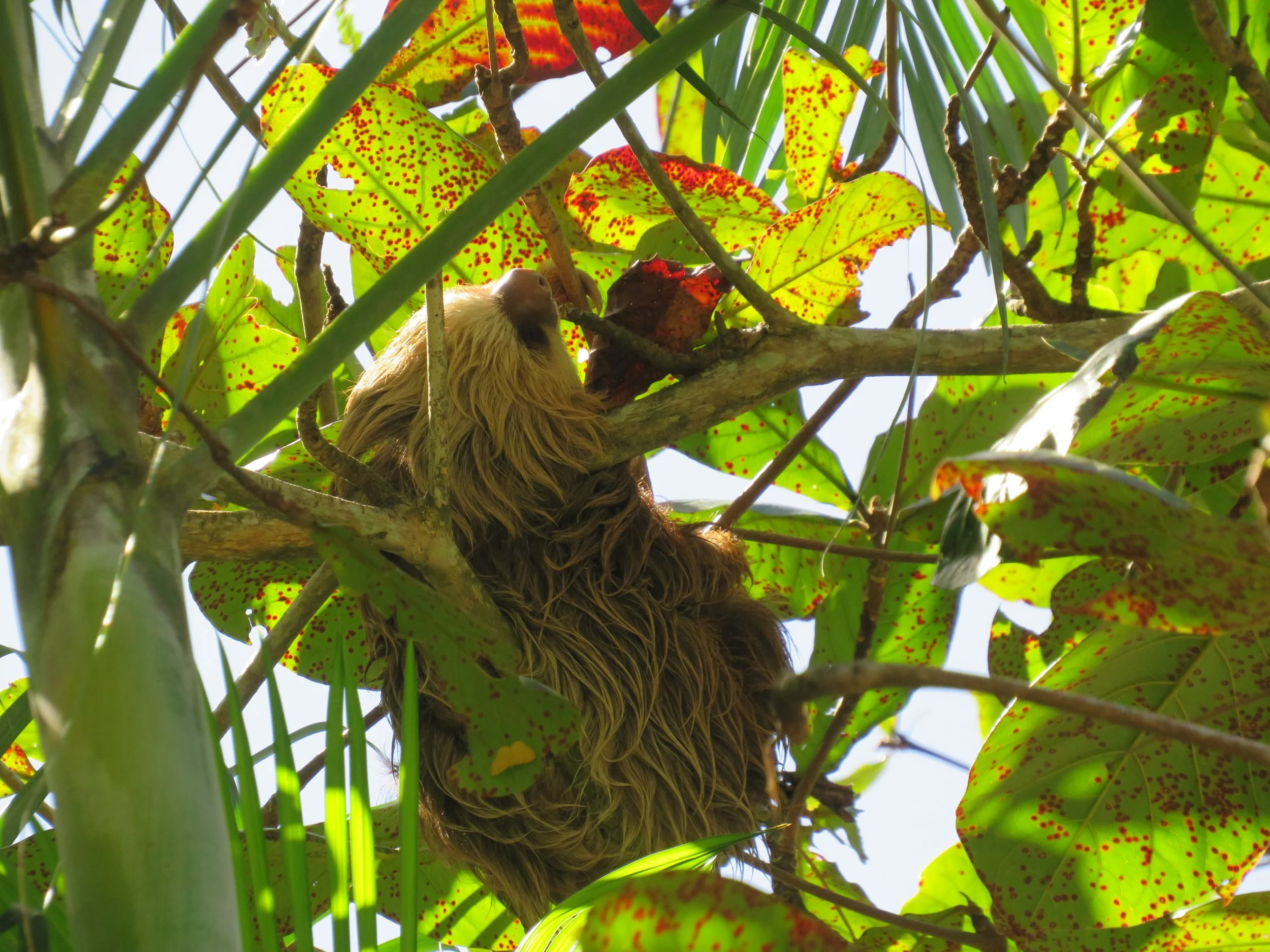
Tango is still recovering at the rescue centre. Even though the recovery process may seem to be taking longer than normal, the veterinary team says he must remain under observation for a while longer to ensure he doesn’t take a sudden downturn. We’ll keep you updated and share any news as soon as we have more information! But for now, here’s a picture of Tango in the wild, so you don’t forget about him.
Nigel
Nigel continues to spend most of his time around the large tree in the maritime zone where we planted the trees our donors generously funded for Earth Day. His signal remains strong, stable, and easy to follow, making him a favourite for the tracking team.
Over the past few weeks, he has mostly stayed within the same small area, occasionally moving to a nearby coconut palm that he now appears to have officially designated as his personal bathroom tree. Frequent fresh droppings found beneath the palm have confirmed this habit.
Nigel has really started to show his personality over the last month and has become one of the funniest and most expressive sloths we monitor. Somehow, every time we spot him, he is either stretching dramatically between branches, frantically snacking on leaves, or tangling himself into positions that hardly seem physically possible.
One particularly special moment this month came when the Connected Gardens team was, just by chance, installing a new wildlife bridge in neighbouring trees. While the humans carefully moved through the canopy carrying ropes and equipment, Nigel calmly watched the entire operation unfold from above. Eventually, he slowly climbed down toward the lower branches, groomed himself carefully, and stretched out into a perfect sunbathing position as if entirely unfazed by the unusual activity around him.
There is truly never a dull moment with Nigel.
Nigel hanging upside down during one of his regular performances.
New Urban Sloth!
Franklin
We’re excited to officially introduce Franklin, one of the newest sloths to join our Urban Sloth Project! Franklin is a Hoffmann's two-fingered sloth shares his habitat with Debbie, and was one of the sloths we would often see in the same trees as Debbie. One of the days this month, he was particularly low, and we took the opportunity to add a new sloth to our project!
At first, we thought he was still a juvenile because of his smaller size. However, after finally capturing, weighing, and collaring him, it became clear that Franklin is definitely an adult male, he had just looked small whilst tightly curled up in the tree.
Franklin is actually one of the very few males currently included in our project, which makes him especially interesting to follow. He has already proven to be easy to track, predictable in his movements, and surprisingly comfortable around the busy beachside environment.
One of the most interesting parts of Franklin’s story is his close association with Debbie. The two are still regularly found using the same trees, and because of this, the team has started wondering whether Franklin could possibly be Kiwi’s father. Of course, there’s no way to know for certain without genetic testing, but it is certainly an intriguing possibility.
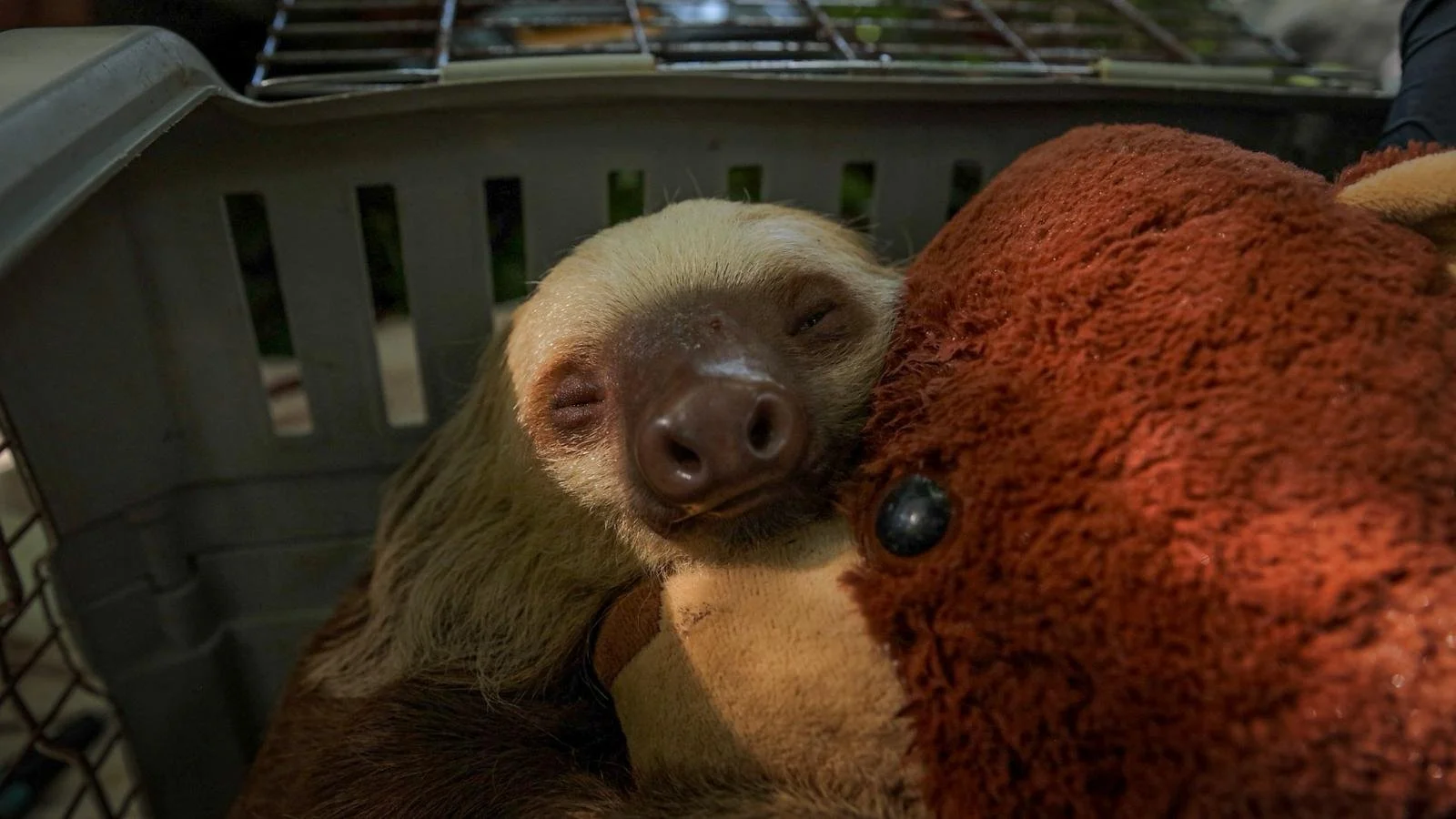
Franklin during the collaring process. All collaring is carried out extremely carefully by trained professionals, using the least invasive methods possible to ensure the safety and wellbeing of the sloth.
We’re excited to continue learning more about Franklin and his role within this little beachside sloth community!
Primary Forest Sloths
Pipa
This month, Pipa has remained mostly among the almond trees near the roadside forest. On one particularly lucky day, we spotted her stretched out fully in the sun at the top of a broken tree near the road. For the first time in a while, we could clearly see her entire body, instead of just a small hidden shape tucked into the vines.
Pipa appears to have established a very small and stable territory, rarely moving far from the roadside trees near the forest entrance. It seems this little pocket of forest provides everything she needs.
Unlike some of our other primary forest sloths, such as Flash, who have chosen to move deeper into the interior of the forest, Pipa seems to prefer this more exposed section of forest, closer to the dirt road that leads into it. One possible reason for this preference could be the increased sunlight these peripheral trees receive throughout the day.
We consistently notice that sloths living in mature primary forest tend to move less frequently than individuals living in more fragmented habitats. One possible explanation is that food resources are more abundant and easier to access in mature forests, reducing the need to travel long distances in search of leaves and shelter.
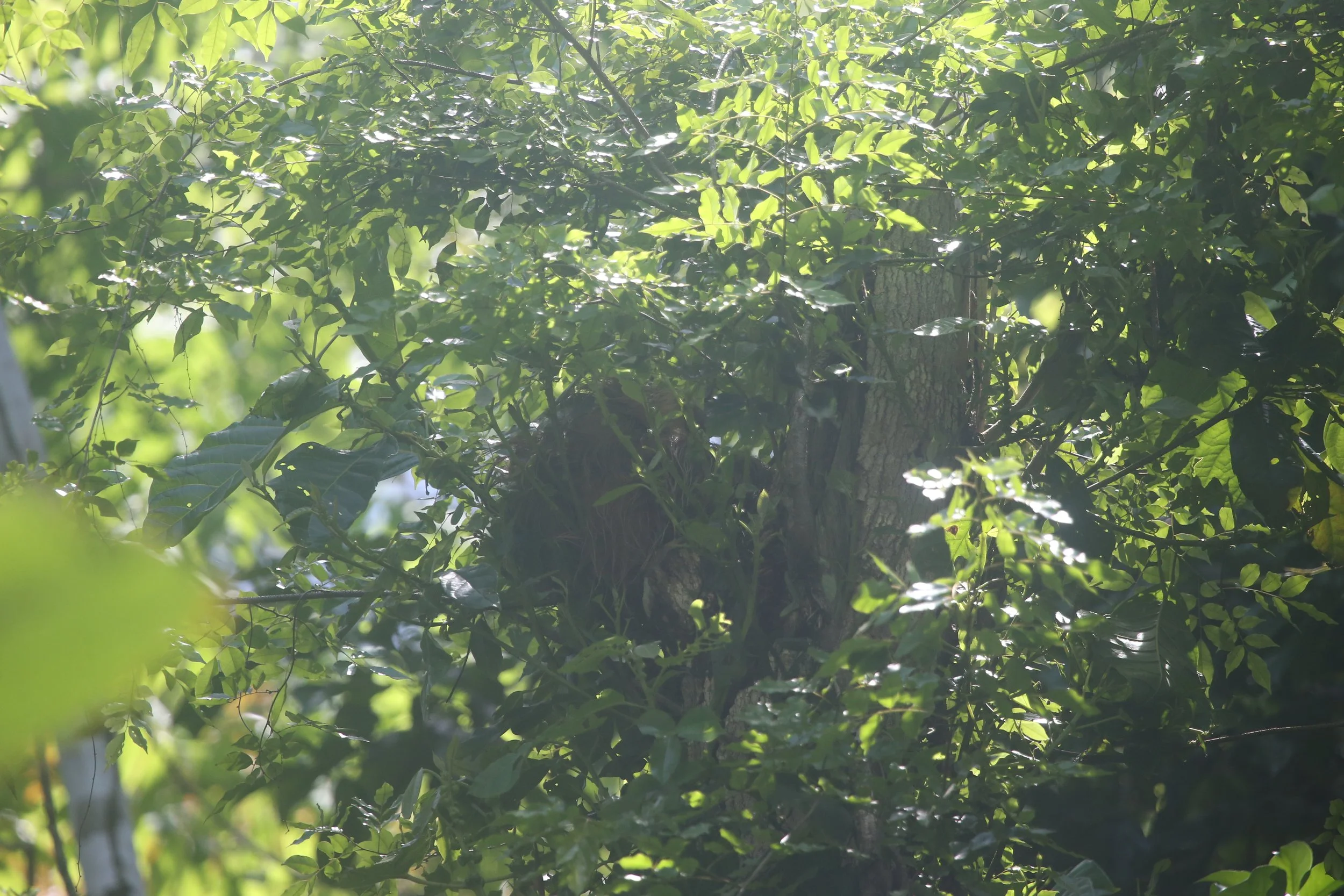
This clump of wet fur is Pipa!
Flash
Flash continues to live deep within one of the most remote and well-preserved areas of forest in our monitoring range. Unlike many of the sloths closer to the roads and beach, Flash strongly prefers the peaceful interior of the primary forest and regularly returns to his same favourite trees near the creek.
During this month’s rainy period, he spent much of his time curled among vines in the middle section of the canopy, not too high, not too low, but always well hidden. After heavy tropical rainstorms left his fur damp and messy, we spotted him stretching out beneath small openings in the canopy to dry in the sunlight.
Flash has a particularly calm and solitary personality. He moves quietly through the forest, almost disappearing completely among the hanging lianas and moss-covered branches. Sometimes only the tracking receiver signal reminds us he is there at all!
Submit Your Questions for Dr. Rebecca Cliffe
We’re excited to announce an upcoming Q&A session with Dr. Rebecca Cliffe!
As part of our ongoing updates and community conversations, we’re inviting Sloth Fellowship members to submit questions for Dr. Cliffe. Whether you’re curious about sloth conservation, research, facts or life behind the scenes at SloCO, we’d love to hear from you.
We’re also sharing a special video featuring some of the first questions submitted by Carter, the special little boy and dedicated supporter many of you read about in our last update. His thoughtful questions brought huge smiles to our team, and we can’t wait for you to see them.
Please send in your questions by replying to this latest Sloth Fellowship update email, and we will do our best to feature them in the upcoming Q&A!
Thank you, as always, for being part of the Sloth Fellowship and for supporting the work we do every day for Costa Rica’s wildlife.