
New Investigation Reveals Florida Regulators Failed to Act as More Than 50 Sloths Died | July
Based on months of internal emails obtained through public records requests, investigative journalist Katie Surma from Inside Climate News uncovered that Florida wildlife regulators received multiple warnings about Sloth World long before the public knew what was happening, yet failed to intervene as the death toll continued to rise.
The First Warning
According to the investigation, the Florida Fish and Wildlife Conservation Commission (FWC) received its very first warning on December 9, 2024, before a single sloth had even arrived in Orlando.
The warning came after a member of the public noticed Sloth World advertising job openings while preparing to receive its first shipment of sloths and alerted the agency.

Job advert at Glassdor
After discovering that no permits were associated with the business, an FWC employee sent an email to an investigator stating:
"So just wanted to pass along to you."
The investigator did not visit the facility until eight months later. By then, at least 31 sloths had already died.
Under Florida Law
Perhaps one of the most alarming findings is that Florida regulations did not require Sloth World to report the deaths. Internal FWC records indicate that regulators only became aware of the growing number of deaths after a complaint was filed. It remains unclear who submitted that complaint or exactly when it was made. However, we now know that several former employees would later contact us directly to warn us about what was happening inside the facility.
FWC investigator R.K. Brown carried out the first inspection on August 7, 2025. During questioning, former employee Peter Bandre explained that the deaths were caused by an unusually cold weather event combined with the failure of the warehouse's heating system. According to Brown's inspection report, the facility had already gone through two veterinarians in less than a year, and only six sloths remained alive during that inspection.
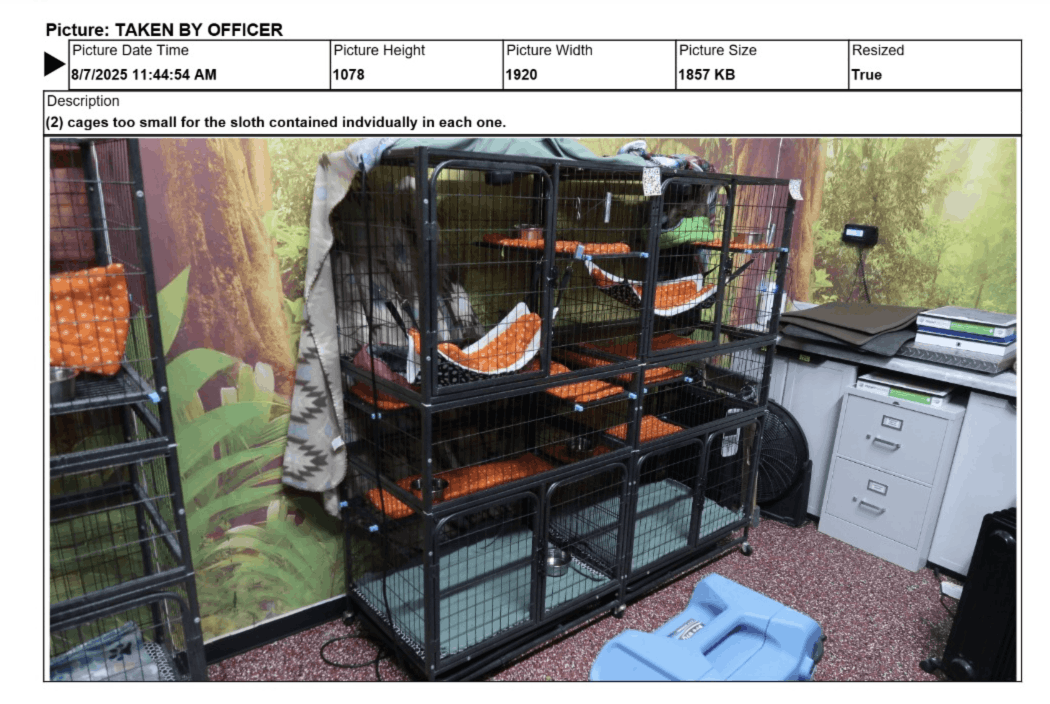
Incident report image
Despite repeated inspections, regulators concluded there was no basis for enforcement. An FWC spokesperson later stated that the business's actions "did not meet the legal standard for animal cruelty" under Florida law.
The necropsy reports painted a grim picture, documenting diarrhea, hair loss, excessive thirst, severe emaciation, suspected traumatic injuries, and conditions consistent with the extreme stress caused by transport. One of the most concerning findings was that multiple sloths carried viral infections, and pathologists warned they might be dealing with a previously unidentified virus, raising concerns about potential zoonotic disease risks.
Warning Signs Continued to Grow
Throughout the remainder of 2025 and into early 2026, more and more warning signs emerged.
The records reveal a pattern of escalating concerns: veterinarians resigned, federal agencies raised alarms, former employees continued reporting additional deaths, and inspectors repeatedly documented fewer animals without clear explanations for their disappearance.
In March 2026, officials from the United States Department of Agriculture (USDA) contacted the FWC stating they had "a lot of animal welfare concerns" about Sloth World and wanted to share information that could support a state investigation.
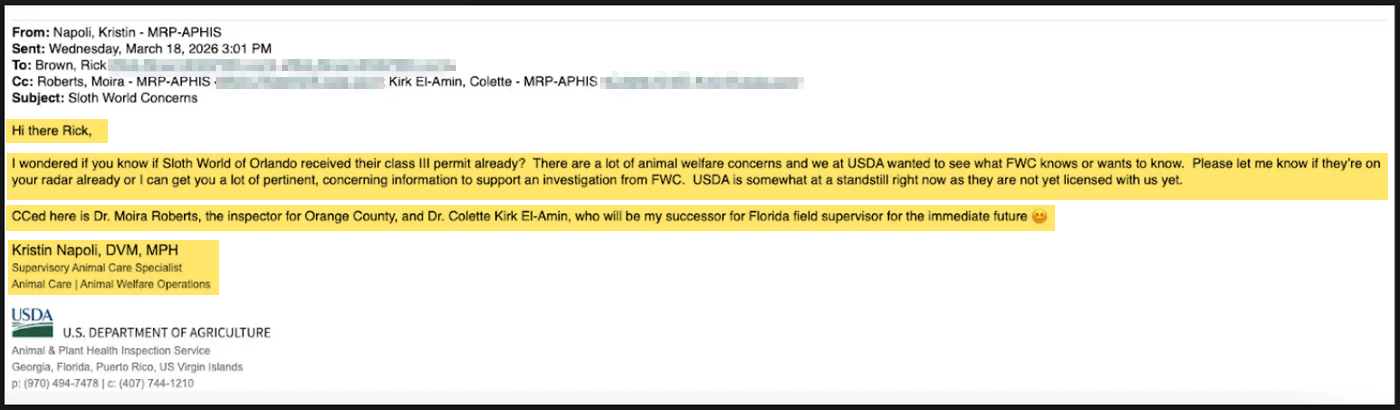
Credit: Inside CLimate News
Among the records was a March 18 communication from the USDA to the FWC that included an internal veterinary email summarizing allegations made by former employee Peter Bandre. According to Bandre, although Sloth World never officially opened its doors, owner Benjamin Agresta had already generated nearly half a million dollars through advance ticket sales.
The USDA veterinarian wrote:
"Mr. Agresta obviously puts profit over the [animals'] health and well-being."
The same email also alleged that Agresta suggested burning the body of a pregnant sloth that had not yet shown signs of illness in an apparent attempt to conceal the suspected virus.
The USDA also confirmed to Inside Climate News that it lacked the legal authority to intervene because Sloth World had not yet opened to the public and therefore did not require an Animal Welfare Act license.
"No Captive Wildlife – FWC Violations Observed."
Despite mounting red flags, investigators closed out another complaint in January 2026 alleging that an Orlando facility housed roughly 80 sloths and that animals were dying during transport.
Brown wrote to an FWC colleague "Please close this complaint out. The agent recently learned of previous issues that have already been investigated and cleared."
On April 16, Inside Climate News published its first investigation, sparking international outrage and placing unprecedented public pressure on Florida officials to act. Just five days later, internal FWC notes dated April 21 documented the following:
"Update on Sloth World 4/21/26.
Friday, Sloth World fired several employees.
Employees have reached out to Rick with several concerns.
Rick is doing an inspection today.1:59 pm
Rick conducted his inspection.
No Captive Wildlife - FWC violations observed.
Facility is clean and animals are well maintained.
There are only two people taking care of the Sloths.
March 9 there were 26 sloths, Today there are only 13, no explanation for what happened or where they are located.
They will reach out to the vet and get back with Rick.
The Vet that was on staff quit and they are actively looking for a replacement.
USDA has not responded yet.
They are still planning to have the grand opening.
Rick will closely monitor the situation."
Even after months of evidence, mounting deaths, and widespread public outrage, the agency's conclusion remained unchanged:
"No Captive Wildlife - FWC violations observed."
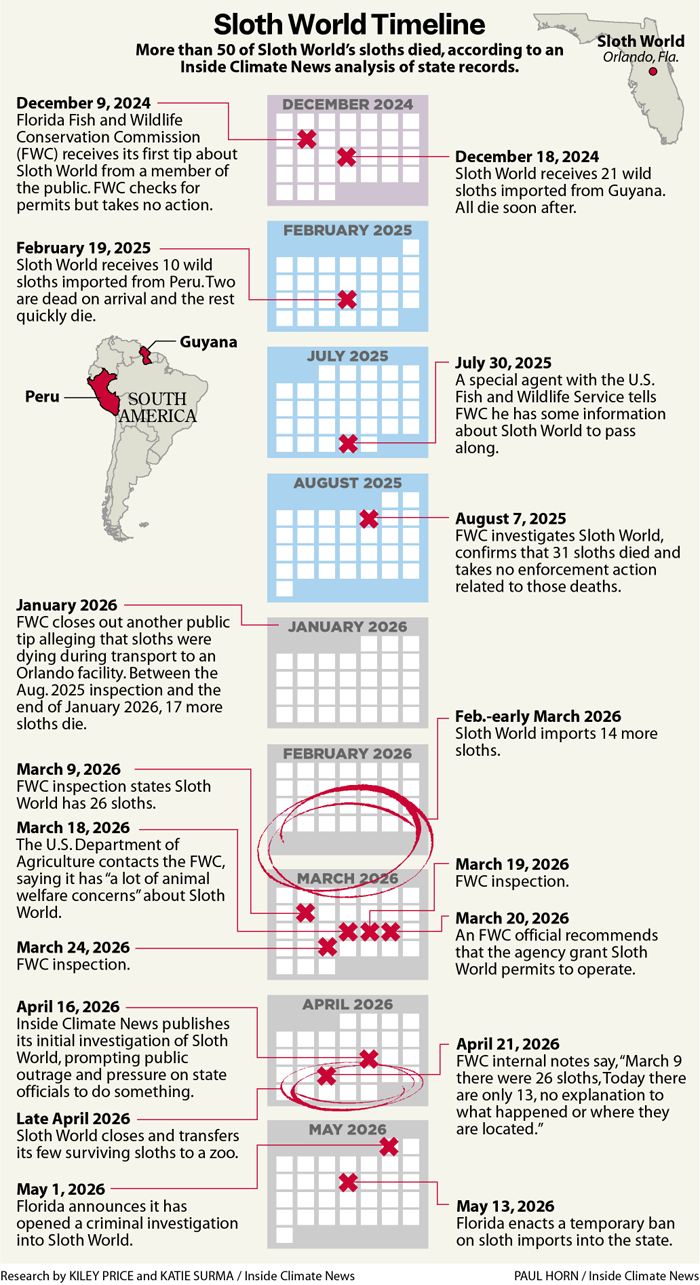
Source: Inside CLimate News
From Investigation to Action
Since January 2026, The Sloth Conservation Foundation (SloCo) and The Sloth Institute (TSI) had been working alongside investigative journalists Katie Surma and Kiley Price, former employees, and scientific experts to uncover the facts behind Sloth World Orlando while simultaneously engaging with lawmakers and wildlife authorities.
In early May, Dr. Rebecca Cliffe and Sam Trull traveled to Orlando, where they met with state and federal lawmakers, local officials, commissioners, and the Florida Fish and Wildlife Conservation Commission (FWC) to present the scientific evidence surrounding the commercial sloth trade and the urgent need for stronger protections.
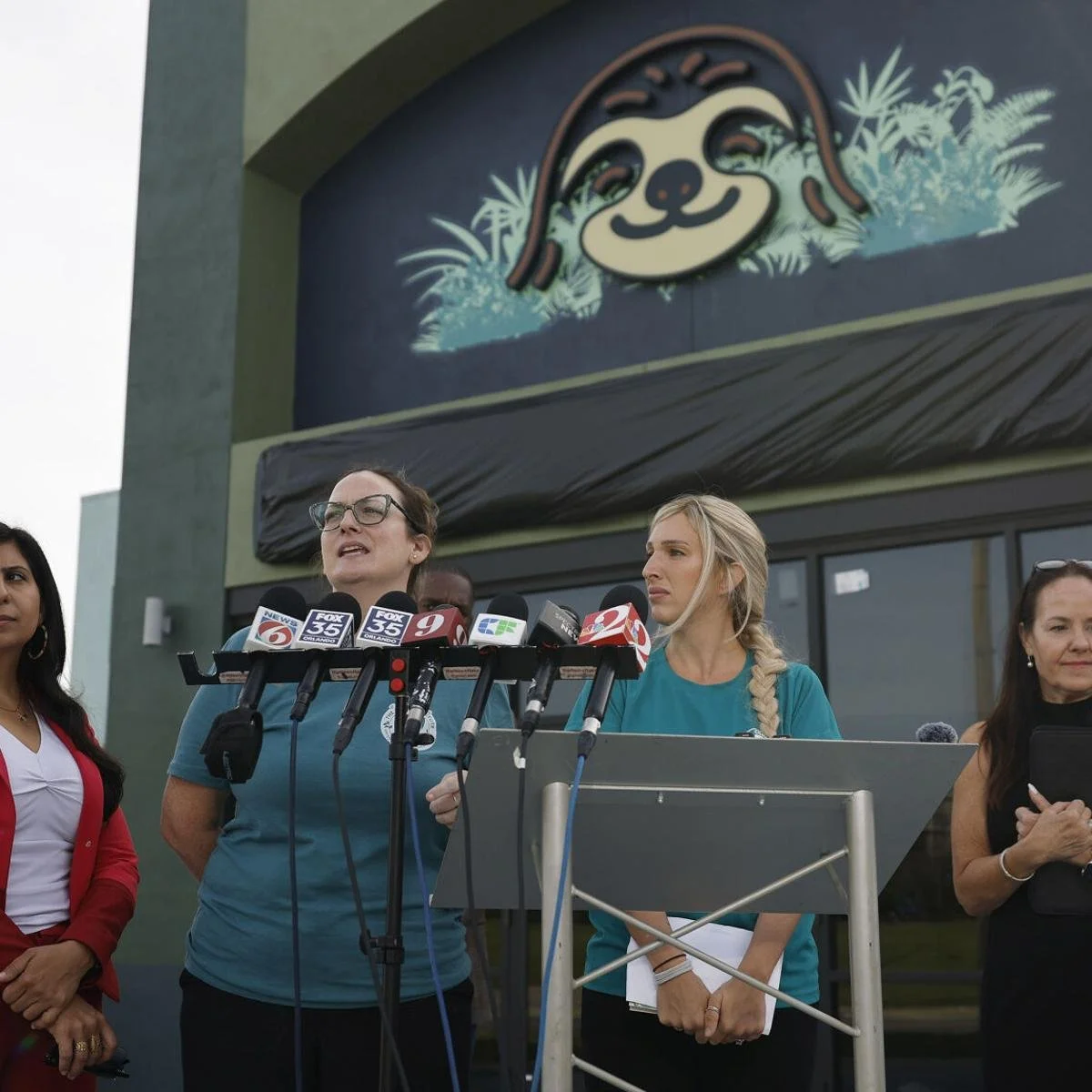
Sam Trull and Dr. Rebecca Cliffe
Just days later, Florida announced a temporary halt on all sloth imports into the state, followed by a new requirement that every future sloth import must first obtain a dedicated wildlife import permit. For the first time, meaningful policy change had begun.
But Our Work Is Far From Over
The temporary suspension and stronger import regulations represent an important milestone, but they are only the first step.
Through the Sloth Protection Alliance, SloCo and TSI continue working to:
permanently ban the importation of wild-caught sloths into the United States
strengthen regulations governing captive sloths
end commercial sloth encounter experiences
create a new "Sensitive Species" classification for scientifically vulnerable wildlife
ensure greater transparency and accountability when animals die in commercial facilities
The tragedy of Sloth World Orlando exposed serious failures in the system. Now, we have an opportunity, and a responsibility, to ensure it never happens again.
How You Can Help
The progress we've made has only been possible because people around the world chose to speak up. But our work is far from over.
You can support the Sloth Protection Alliance by signing our petition calling for stronger protections for wild sloths and an end to their commercial exploitation. If you're able, please also consider making a donation. Your support helps us continue investigating the wildlife trade, provide scientific evidence to policymakers, develop stronger legislation, and advocate for lasting protections that keep sloths where they belong: in the wild.
Read More:
For background and context, read our full blog on Sloth World Orlando here.
Press Release January 21 | Sloth Conservation Organizations Warn Against U.S. Attraction Sourcing Wild-Caught Sloths for Commercial Entertainment
Press Release April 24 | Sloth World Orlando to Close After 31 Sloth Deaths; Survivors Transferred to AZA Care
Press Conference May 6 | Scientists and conservation organizations call for action on the commercial sloth trade in the United States
Press Release May 13 | Florida Announces Temporary Halt on Sloth Imports Following Sloth World Orlando Investigation, With Nationwide Implications
Update June 19 | Florida Strengthens Sloth Import Rules Following the Sloth World Orlando Controversy