January 2026
Update #53 of The Urban Sloth Project!
December brought familiar routines, unexpected movements, and a few extra challenges, all offering valuable insights into how sloths adapt to increasingly urban and fragmented landscapes.
Pistachio
At the start of the month Pistachio had been hiding remarkably well. So much so, that even with a strong signal coming from the jabilo tree, where he is usually easily spottable, we were unable to find him. On an outing later in the month, there was a lot of noise coming from Caribeans, one of his favourite spots. People were arguing loudly, the kitchen was especially loud and the disturbance filled the area, and we still couldn't track him down. Perhaps the noise DOES have some effect on Pistachio. Pistachio is one of our most ‘urbanised’ sloths, famously living primarily on a wall of a restaurant instead of a tree! We were certain that noise was the least of his worries, but it looks like particularly noisy days may push him to choose more remote and quieter spots.
Earlier that same week, Pistachio had been seen on a vine in front of the main road. A man was pruning flowers nearby, making considerable noise. Seemingly disturbed, Pistachio moved toward the roof of Caribeans. From the roof’s edge, Pistachio approached a nearby tree where an active female two-toed sloth was feeding. The two seemed aware of each other immediately.
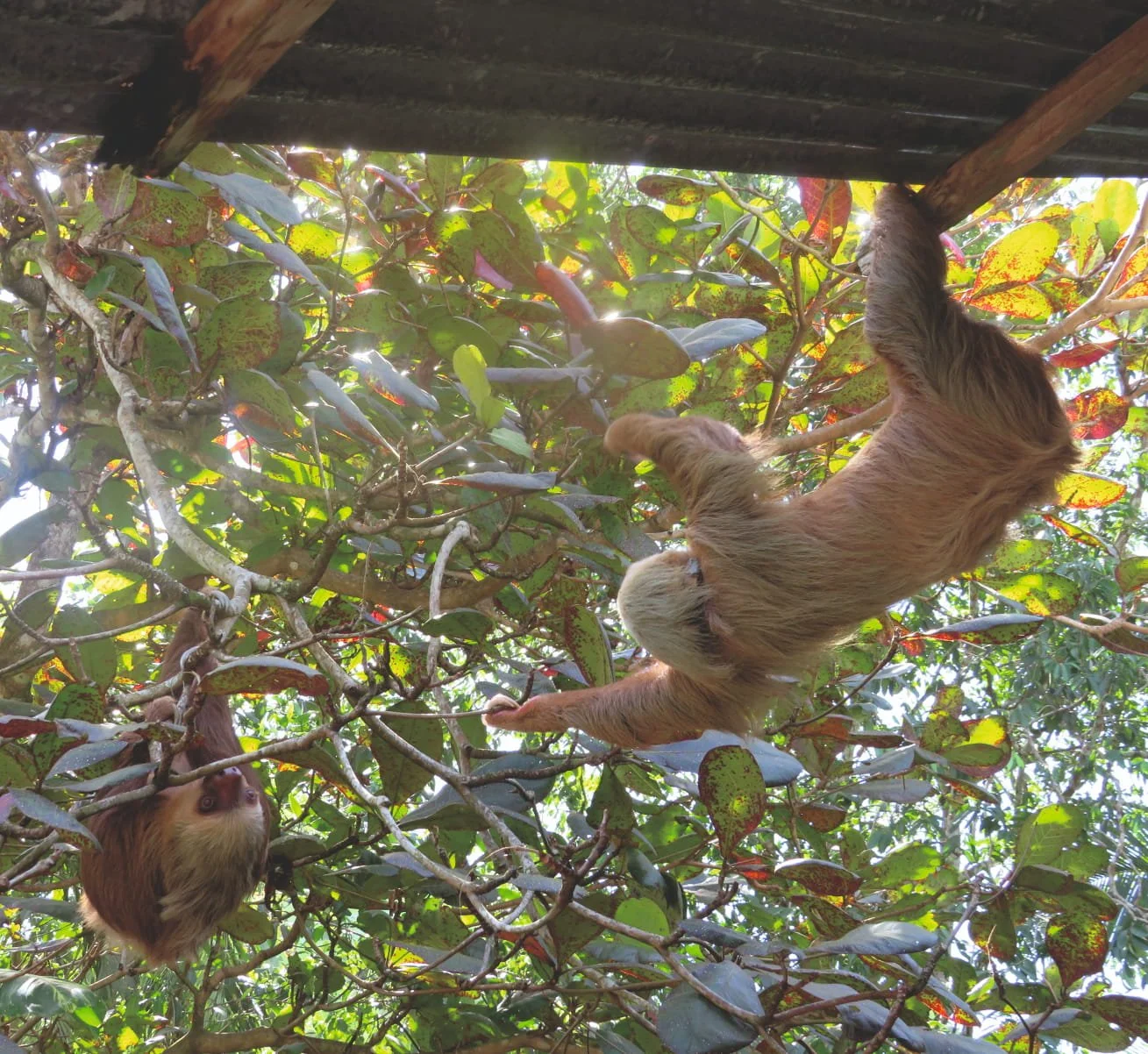
Pistachio and mysterious girlfriend
They interacted gently, touching and even licking around each other’s mouths, a subtle but telling display. This kind of behaviour is common in sloths during courtship: they rely heavily on scent, touch, and close contact to communicate interest. For a male like Pistachio, encountering a receptive female can be an intense moment.
Luiza
Our first outing of the year began under dark, cloudy, and windy skies. Strong gusts sent branches swaying dramatically as the tracking team dusted off the cobwebs after the winter break. Although we encountered several other three-fingered sloths in the area, José knew exactly where to head, one of Luiza’s favourite trees.
And there she was, high up in one of the tallest trees around. Luiza was unusually active, moving from branch to branch and even between trees. Slowly and deliberately, she climbed using lianas to reach the treetops. At one point, José laughed and remarked, “She looks a bit chubby from here.” We suspect she may have been enjoying some festive feasting over the holidays!
As she began to descend, she stopped at around seven metres above the ground… and then, mid-descent, decided it was time for a nap. Sloths as a species are famously unpredictable, with varied routines, waking hours, and tree preferences. Yet, on an individual level, tracking has shown us that they can be surprisingly consistent. Luiza, for example, loves climbing up and down vines with impressive agility, is usually active around late morning, and almost always chooses the highest points in the canopy.
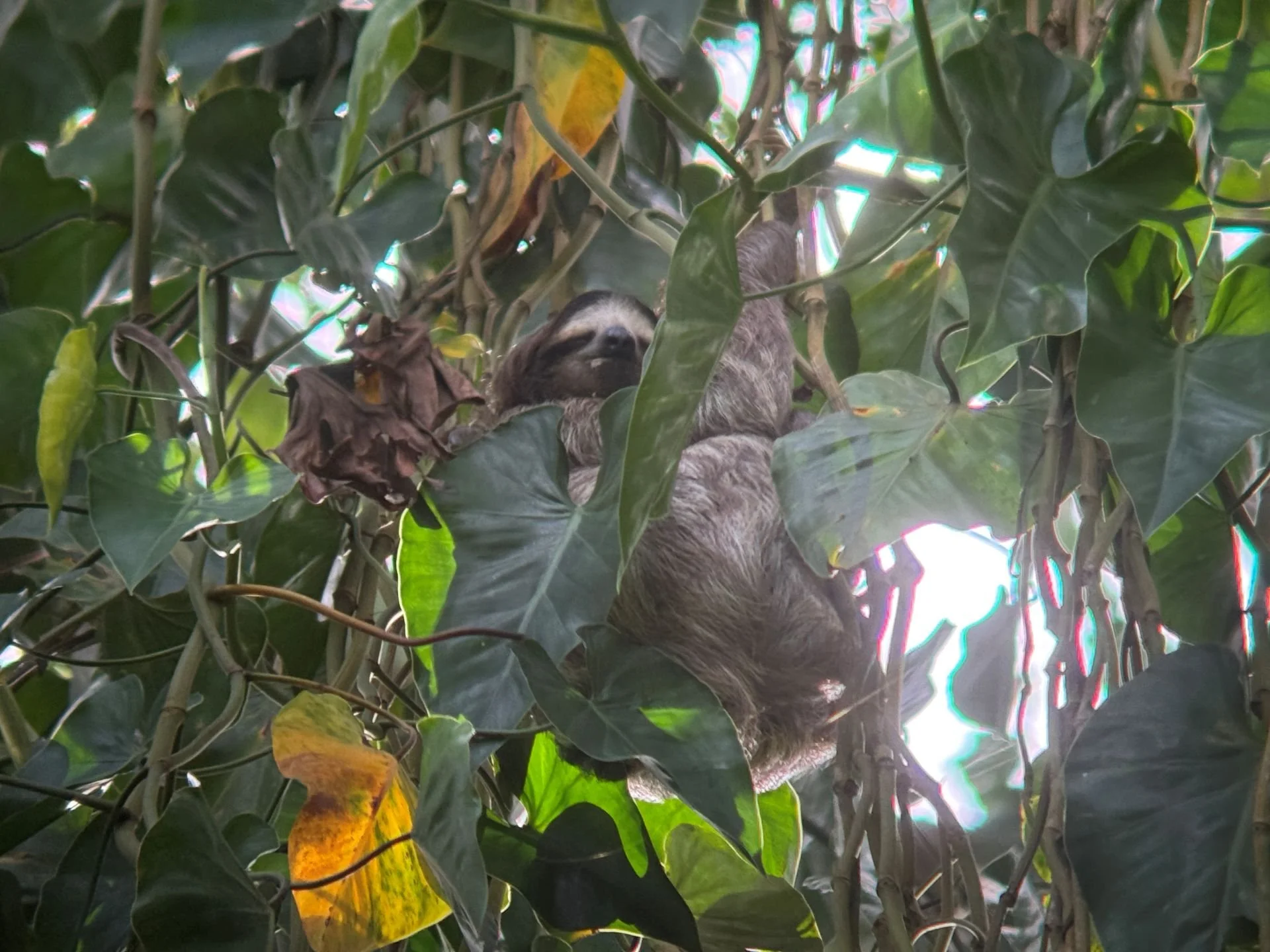
Luiza chilling
For the rest of the month, the days turned sunny and warm. Luiza remained settled in one of her favourite trees high along the Cocles Cliff. The forest was full of life: raccoons, birds, monkeys, and many other sloths were active nearby. On one visit, a lively group of spider monkeys played through Luiza’s tree, while she stayed right at the centre, curled into a tight ball, resting as though nestled in a bed of lianas. It was a peaceful month, marked by alternating sun and rain, and an abundance of fresh leaves to enjoy.
On our final outing of January, the antenna led us to a tree hosting four female three-fingered sloths! One by one, we carefully checked each individual with binoculars, searching for the tell-tale glimpse of a collar antenna. Deyber, with his keen eye for sloth details, helped us confirm the surprise: none of them were Luiza! It was a perfect reminder of why visual confirmation is essential. While VHF radio telemetry is a highly specialised and invaluable tool, it isn’t precise enough to identify an individual sloth, especially when they’re perched so high in the canopy.
Deborah
The signal led us to a large hibiscus tree near the parking area, but despite our best efforts, she remained hidden, tucked somewhere high in the foliage.
The following day brought a twist: the signal had shifted to an unusual tree near the road. The area was bustling with tourists and locals, all curious about our strange antenna and what we were tracking. From the ground, we spotted a large two-fingered sloth, but the signal didn’t match. Moments later, we noticed two other two-fingered sloths in the same area. After careful observation, we traced the signal to a beach almond tree. The antenna wasn’t visible, but judging by size and position, we suspected Debbie was the lower, larger sloth in the tree.
Then came the most thrilling discovery of the month: over two consecutive days, we received a very strong signal from a tree where Debbie is often found. When we approached, we were astonished: a mother was carrying a tiny newborn baby! We haven’t yet been able to confirm whether this is Debbie herself, but the possibility is electrifying. Could Debbie have entered this new chapter of her life as a mother?
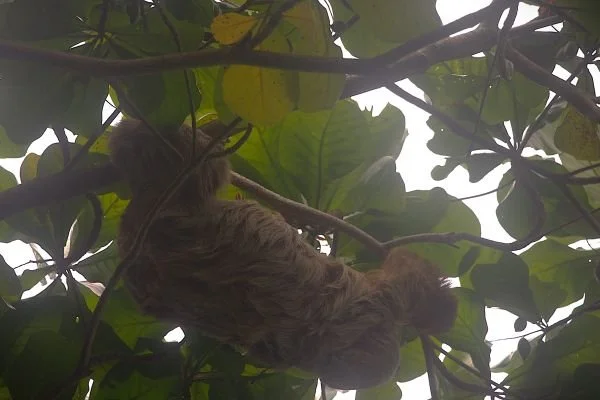
The suspense of not seeing her directly makes every signal exciting. Even when she remains hidden, we are reminded of the rich, hidden life that continues above the beach, and the life-changing milestones that most humans never notice. Soon, we hope to spot Debbie and her baby for the first time, confirming what would be one of the most heartwarming sightings of the year.
Tender
It has been several weeks since we last located Tender, after he moved into a property where we were denied access. We have done everything possible, from knocking on doors, requesting entry on multiple occasions, and speaking with neighbors, but unfortunately without success. The signal from his collar has now stopped transmitting, and we believe it may have been removed. This is the difficult reality of monitoring sloths in urban areas: Not everyone is willing to help or welcome our efforts. We can only hope that Tender is out there safe and living his best life, though he will be deeply missed by all of us. Thankfully though, we have since been able to collar one of his siblings, so the legacy of Tender’s mum, Tiki, carries on!....
Meet Tender’s Little Brother: Tango
Say hello to Tango, the newest sloth to join our tracking family! You may have already seen Tango when he was just a tiny baby riding on Tiki’s belly:
Tango wasted no time making an impression. His very first days of monitoring showed us a young two-fingered sloth learning to navigate a world that blends jungle life with the buzz of the town.
On a cloudy, windy day, we first spotted Tango in a new tree right at the edge of the Tasty Waves property. While monkeys and a three-fingered sloth shared the same tree, Tango chose the most sloth-appropriate response to urban chaos: a perfectly relaxed nap. Around him, a gardener trimmed plants and tourists wandered past. Life carried on, and Tango snoozed through it all.
The next time we saw him, Tango was already using the wildlife bridge we installed for his mum, Tiki, back in 2021! Tango crossed with surprising speed and grace, clearly confident navigating the man-made structures of the world he has been born into.
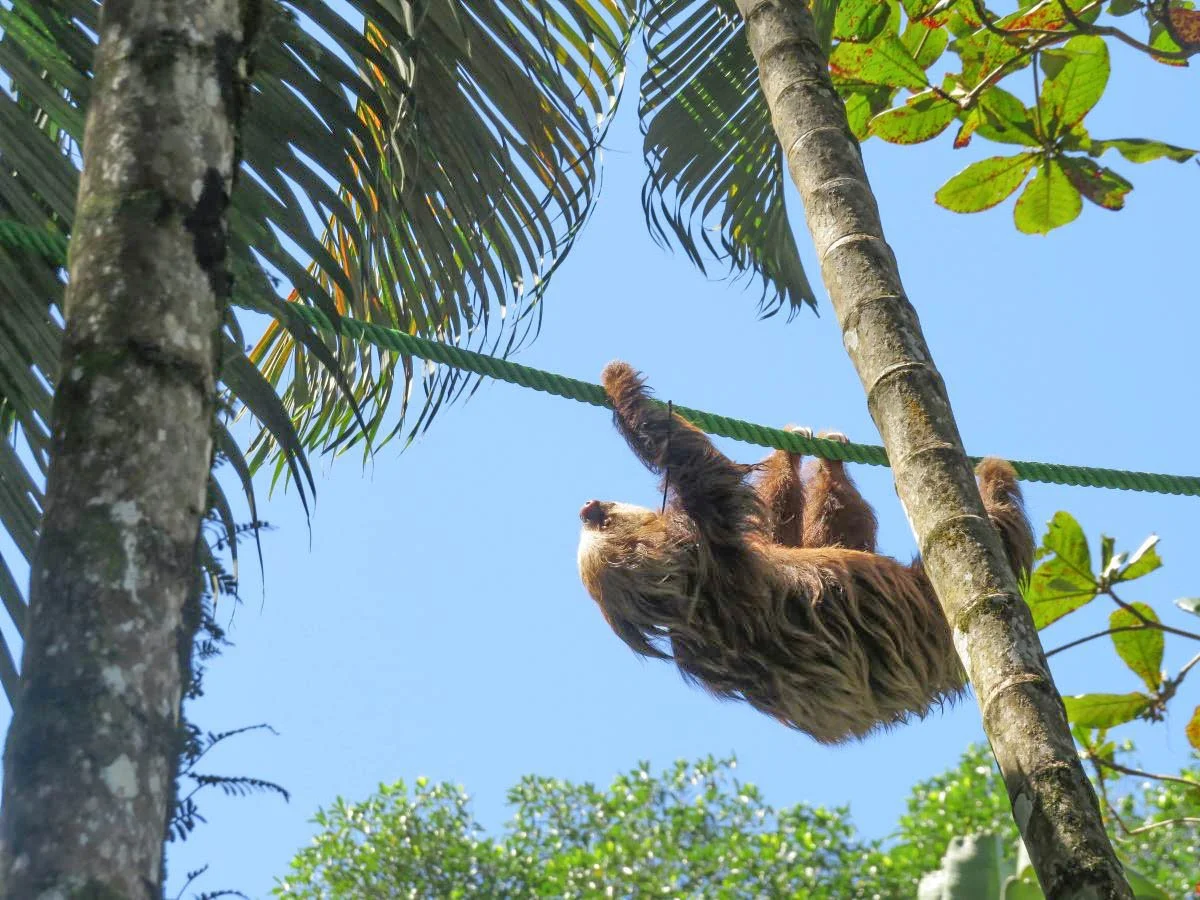
Tango using Tiki’s bridge
For many arboreal animals, new wildlife bridges can be unsettling at first. The unfamiliar texture underfoot, the different smells, and the sudden appearance of a structure where there was once open space can all trigger caution. Sloths, monkeys, and other tree-dwelling animals often take days, weeks, or even months before they fully trust and regularly use a bridge.
Sloths are known to have excellent spatial memory and rely on their surroundings to move safely through the canopy. Whether they navigate using visual landmarks, mental maps, or some combination of both is still one of the many mysteries we’re working to understand. What we do know is that consistency matters. When a structure remains in place and proves safe over time, animals begin to incorporate it into their mental understanding of the landscape.
This learning process is called habituation. Through repeated exposure, without negative experiences, arboreal wildlife gradually learns that the bridge is not a threat, but a reliable and useful pathway. Eventually, it becomes just another branch in their daily commute.
Tango’s confidence may also be shaped by the world he was born into. Growing up in an urban environment, he was exposed to wildlife bridges, buildings, and human activity from the very beginning of his life. While he was still clinging to his mum’s belly, Tiki regularly used this very bridge, meaning Tango quite literally learned the landscape while being carried through it. For him, these structures aren’t new or strange, they’re simply part of home.
This is what makes Tango especially interesting to study. While many sloths need time to cautiously investigate a bridge before trusting it, Tango appears to have skipped that learning curve entirely. What is unfamiliar or even frightening to other animals is, for him, completely normal. Understanding how early-life exposure shapes habituation may help us design safer, more effective wildlife crossings for animals growing up in increasingly urbanised forests.
As he crossed, a small crowd gathered below, watching in awe. Tango, it seems, already knows how to draw an audience.
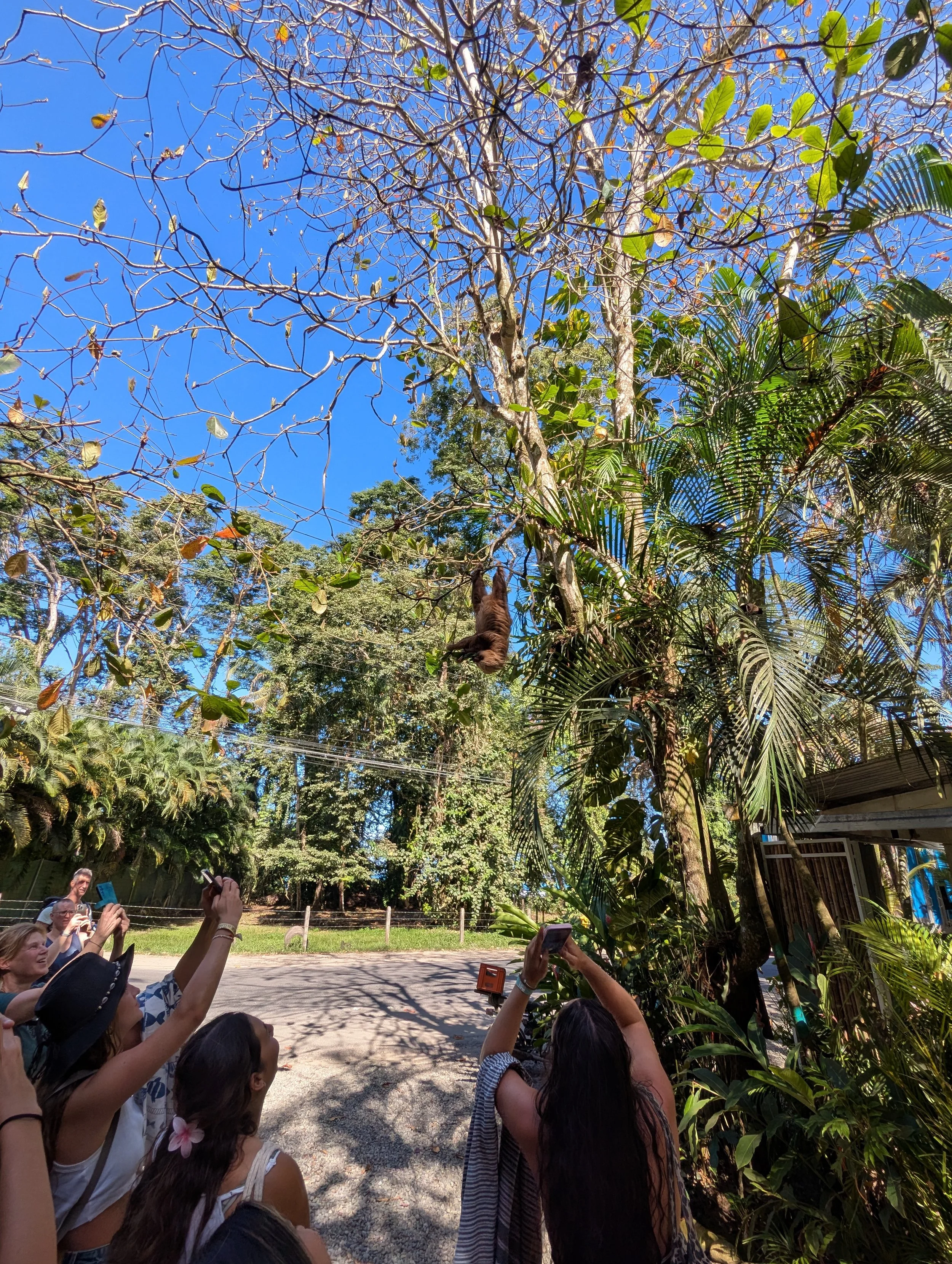
Everybody loves Tango!
Later, while climbing through another tree, Tango encountered two resting raccoons. There was a brief moment of dramatic tension (some stiff sloth posturing and a mutual “excuse me?”), before Tango calmly changed course and moved to a neighbouring tree.
The following day began bright and sunny, though the weather soon turned. As rain started to fall, Tango curled himself into a tight little ball and slept through the storm. By afternoon, as the skies cleared, he became active again, moving into a new almond tree that had previously been used by other two-fingered sloths. High in the canopy, surrounded by fresh leaves and the sound of wind in the branches, Tango settled in for another well-earned rest.
From nap-taking in busy urban trees to confidently using wildlife bridges, Tango’s first month shows he’s already mastering life between two worlds. And this is only the beginning.
Primary Forest Sloths
Ponder
This month was dominated by heavy rain days. Sheets of rain fell steadily, the ground became slippery, and the air was thick with the scent of wet leaves. The path to Ponder’s home range is already steep and rugged, but with the rain, it became a full-on workout just to keep our footing.
We weren’t having much luck locating him either but the thrill of trying to find the secretive Ponder keeps our spirits high. And then, finally, there he was: soaked to the bone, perched perfectly still, completely soaked from the downpour. The tree he had chosen wasn’t one we had recorded before, but it was near other familiar spots he frequents. Ponder remained completely still, seemingly unfazed by the storm or by our presence. Sloths are famously good at conserving energy, and in rainy weather they do this by resting for long stretches. During the whole month, we didn’t see Ponder move once. He is a real testament to the millions of years of evolution that have led to an animal perfectly capable of doing NOTHING. Some animals run, climb, and stress. Ponder?
Pipa
Our first outing of the year into the forest was to track Pipa, and it didn’t take long to find her. She had chosen a new tree for her post-holiday perch, though her position was unmistakably her usual, perfectly relaxed self. The morning was cloudy and cool, but by afternoon the sun broke through, creating ideal tracking conditions. Pipa slept quietly among the lianas, curled up close to the one dusty track that runs through the forest.
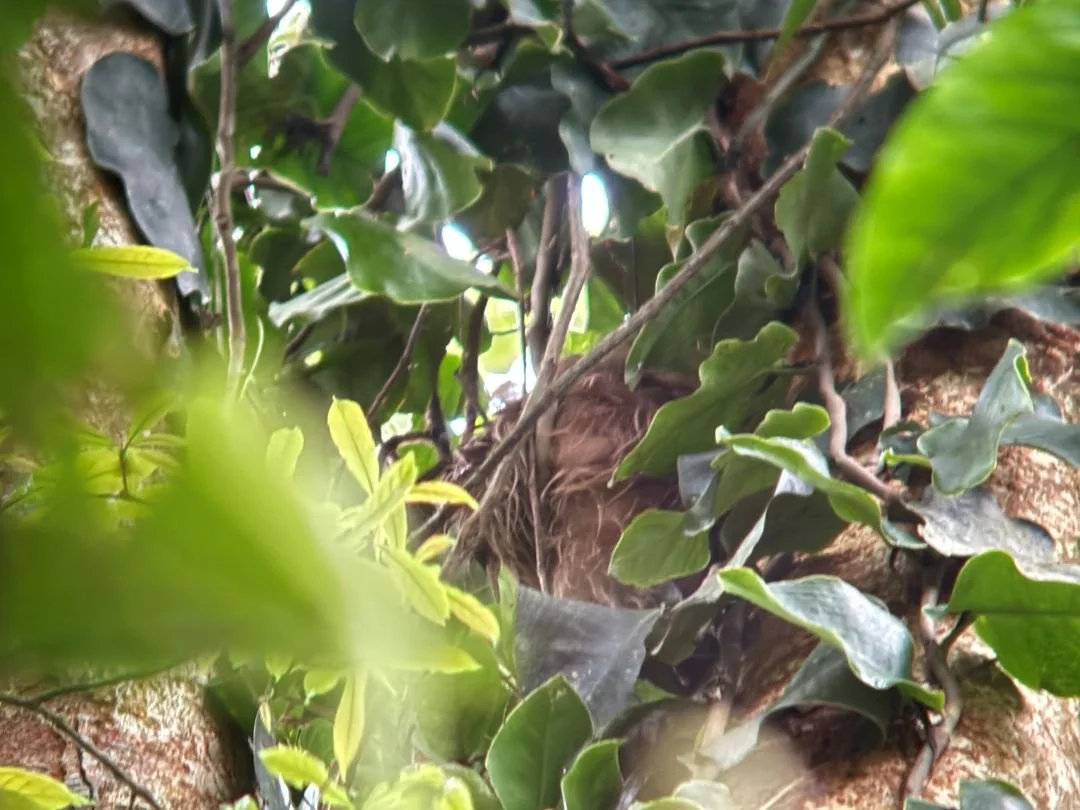
Our next search coincided with a heavy rainstorm, which later eased into a light drizzle. The forest floor was slippery and muddy, turning every step into a slippery balancing act, yet the team pressed on. Eventually, Pipa was located in a tall tree, drying herself in the newly emerging sun. She stretched out gracefully, basking in the warmth, her face clearly visible, and her body looking pleasantly plump: a little post-holiday indulgence, like Luiza, or perhaps. a baby?? The fascinating thing about sloths is that we can never tell if they are pregnant or just full of food. They can hold up to a third of their body weight in faeces!
After a few minutes of observation, Pipa began to move. Calmly, she climbed to the top of the tree, crossed to a neighboring tree, descended, and climbed again. Every move was deliberate and composed, a perfect demonstration of her energy-efficient lifestyle.
Introducing Flash
Another new sloth!
Flash was a completely unexpected capture, a true spur-of-the-moment opportunity that we couldn’t pass up. When we’re out and about doing fieldwork, we always keep our eyes peeled for easily accessible sloths that might be suitable for collaring. This time, luck was on our side.
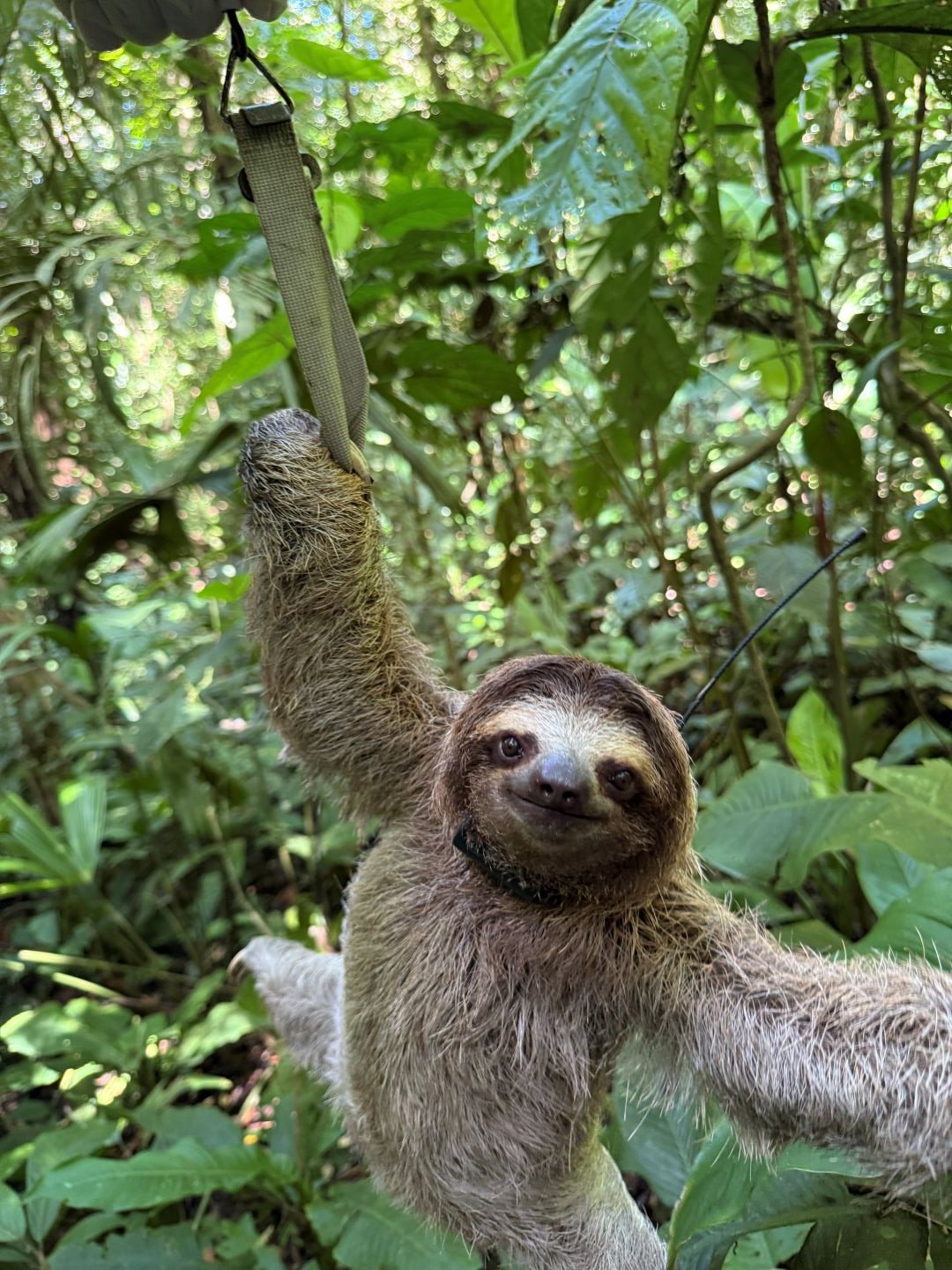
The story begins on a day scheduled for one of our early-morning sloth censuses, this time deep in primary forest. We arrived fully prepared and began by flying the drone. From the air, we recorded four three-fingered sloths at considerable height, all of them resting in cecropia trees.
After spotting the sloths with the drone, we took a short break before starting the visual transects. During this time, we were treated to an impressive array of wildlife sightings, including howler monkeys, spider monkeys, and capuchin monkeys. We also recorded several bird species, such as toucans, an oropendola, trogons, and pavas.
We then entered the forest to begin the transects, with each team member walking along their assigned line. During the first round, we encountered another three-fingered sloth. This individual was much lower than the others, about 10 meters above the ground. Unfortunately, we didn’t have our climbing or collaring equipment with us at the time, as it was still in the car, so we continued the transect as planned.
About an hour later, once the transect was completed, we returned to check whether the sloth was still there, and it was! We headed back to the car, collected the necessary equipment, and began the climb to the sloth.
As always, our trusty climber Dayber, made his way up the tree and managed to bring the sloth down, though not without difficulty. Despite being a three-fingered sloth, it behaved quite aggressively. Once on the ground, we successfully placed the collar, took the required measurements, and collected hair samples. We also gathered fecal samples found at the base of the tree. While these were not guaranteed to be from this individual, they were collected for completeness. Additionally, we sampled one or two sloth moths, all intended for future genetic studies.
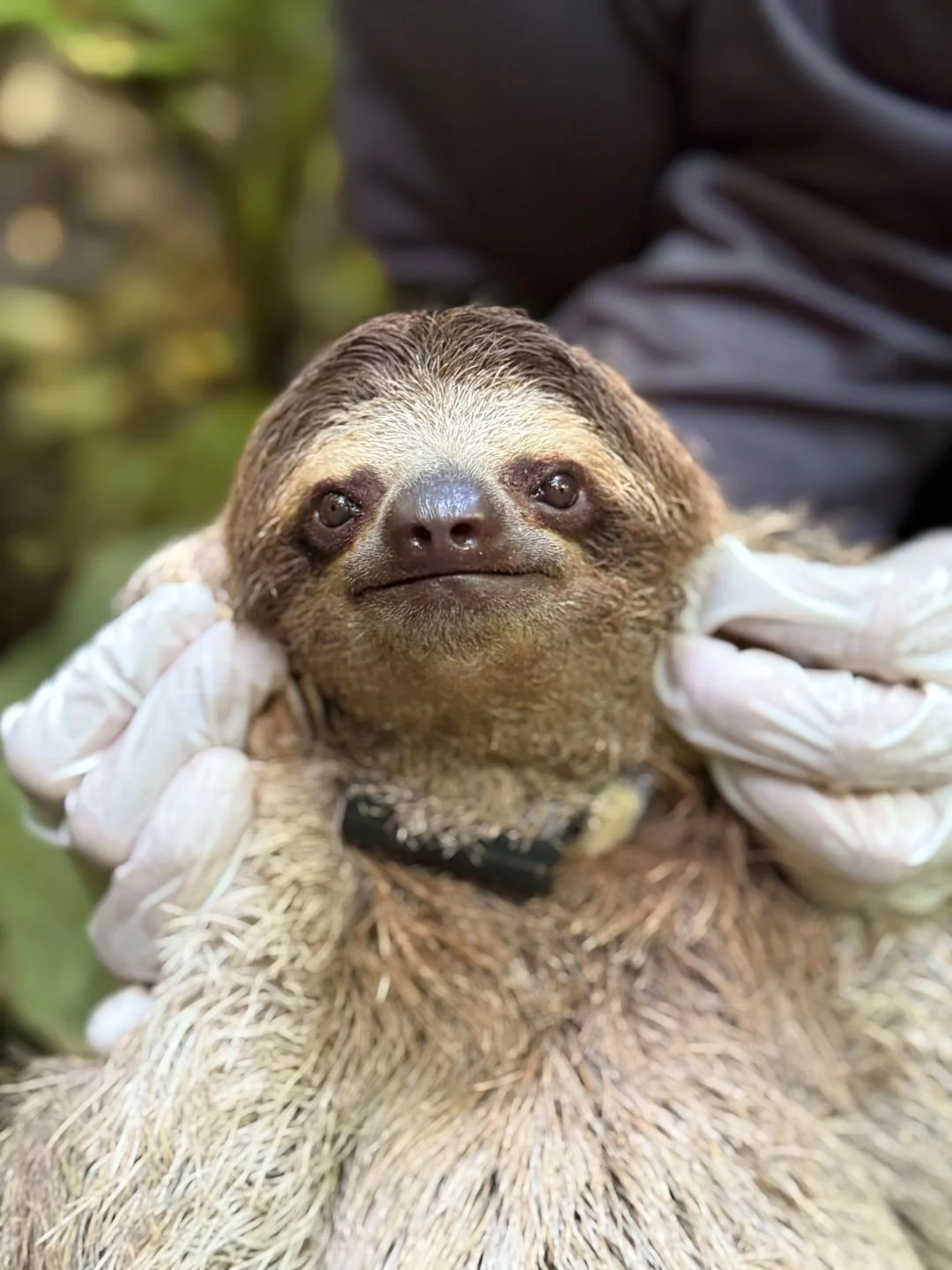
After completing the work, Flash was released straight back to where he was found. During the release, Flash remained extremely alert, seemingly waiting for us to move away before beginning to climb again. It took some time, but eventually, Flash made the ascent back into the tree.
Since then, we’ve been out to track him and fortunately, Flash has continued to remain in the area. The last time we located him, it was in a tree approximately 30 meters from the original capture site, which is a reassuring sign that Flash is settling in well.