Following the Sloth World Orlando tragedy, the Florida Fish and Wildlife Conservation Commission (FWC) is reviewing the regulations governing the possession of sloths in Florida.
On September 9, FWC will hold a virtual public meeting to present proposed amendments to Rule 68A-6.004, F.A.C., and hear feedback from stakeholders and members of the public.
Have your say on Florida’s proposed sloth rules
When: September 9, 2026
Time: 5:30 PM ET
Where: Online
Want to know what’s being proposed?
Can’t attend? You can still have your say. Submit your feedback directly to FWC through their online Public Comment Form.
The Sloth Protection Alliance, a collaboration between The Sloth Conservation Foundation (SloCo) and The Sloth Institute (TSI), welcomes this review. For years, our organizations have worked directly with wild sloths through research, conservation, veterinary medicine, rehabilitation, education, and advocacy.
We appreciate FWC taking the time to consider policy recommendations and introduce stronger safeguards for sloths. The proposed changes address some important weaknesses in the existing system.
But after examining the draft, we do not believe the changes go far enough to protect sloths in Florida or prevent another tragedy like Sloth World Orlando.
What FWC is proposing
There is a lot in the proposal that we support.
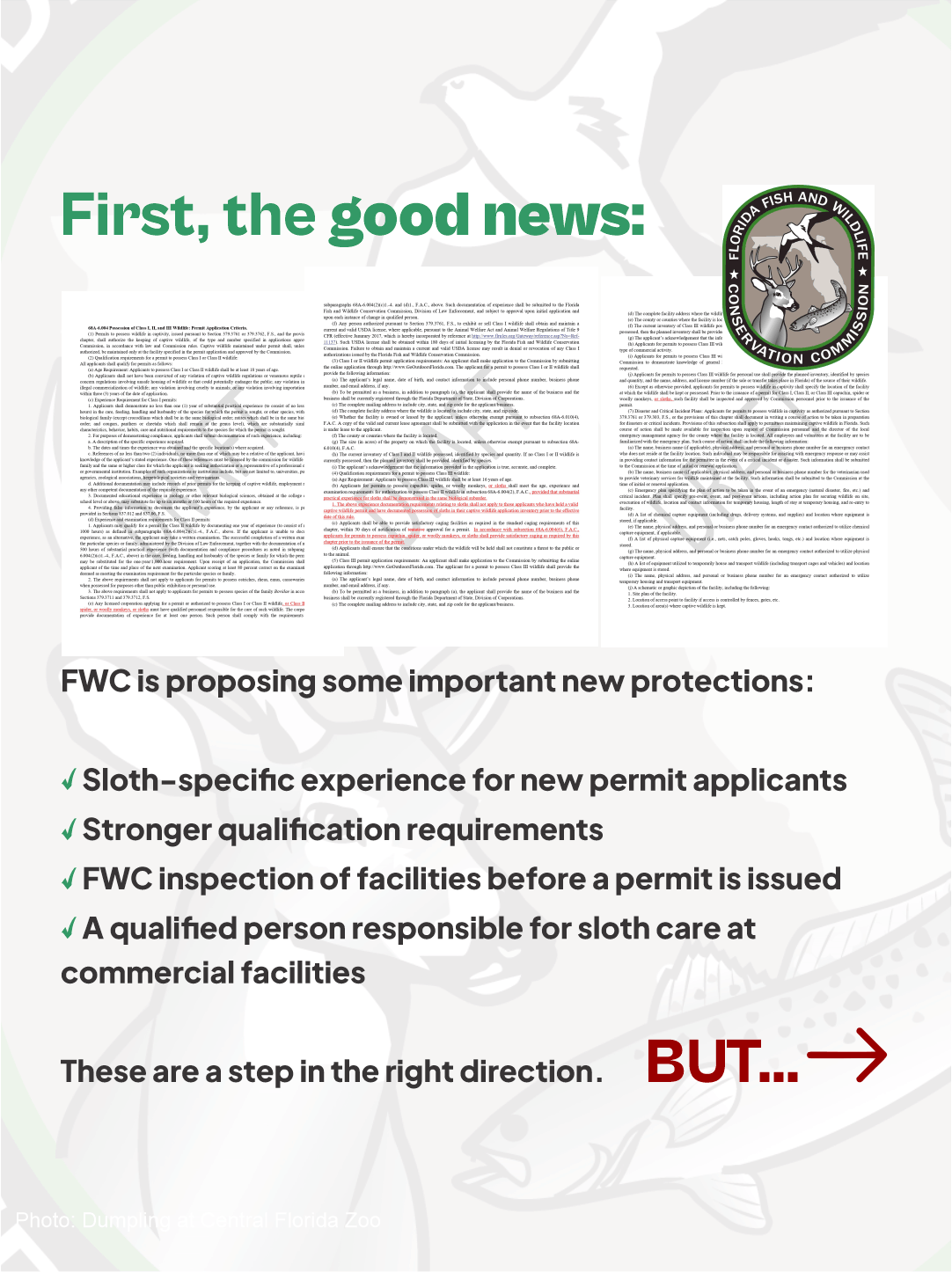
Sloth-specific experience
The proposal would require applicants seeking authorization to possess sloths to meet the experience and examination requirements applied to Class II wildlife.
The draft specifies that “substantial practical experience for sloths shall be demonstrated in the same biological suborder.”
This is an important recognition that sloths are highly specialized animals and that general experience caring for wildlife cannot necessarily substitute for relevant experience.
Facilities inspected before permits are issued
The proposed changes would also require satisfactory caging to be in place before a sloth permit is issued, and the facility would need to be inspected and approved by FWC personnel before receiving authorization to possess sloths. This is another important improvement. A facility should be fully prepared to safely house an animal before that animal arrives.
Qualified personnel
The proposal would require corporations possessing sloths to have qualified personnel responsible for their care and to provide documentation of experience for at least one person.
These are all steps in the right direction.
However, stronger permitting alone cannot address all of the problems exposed by the Sloth World Orlando tragedy. We believe several important gaps remain.
What we recommend
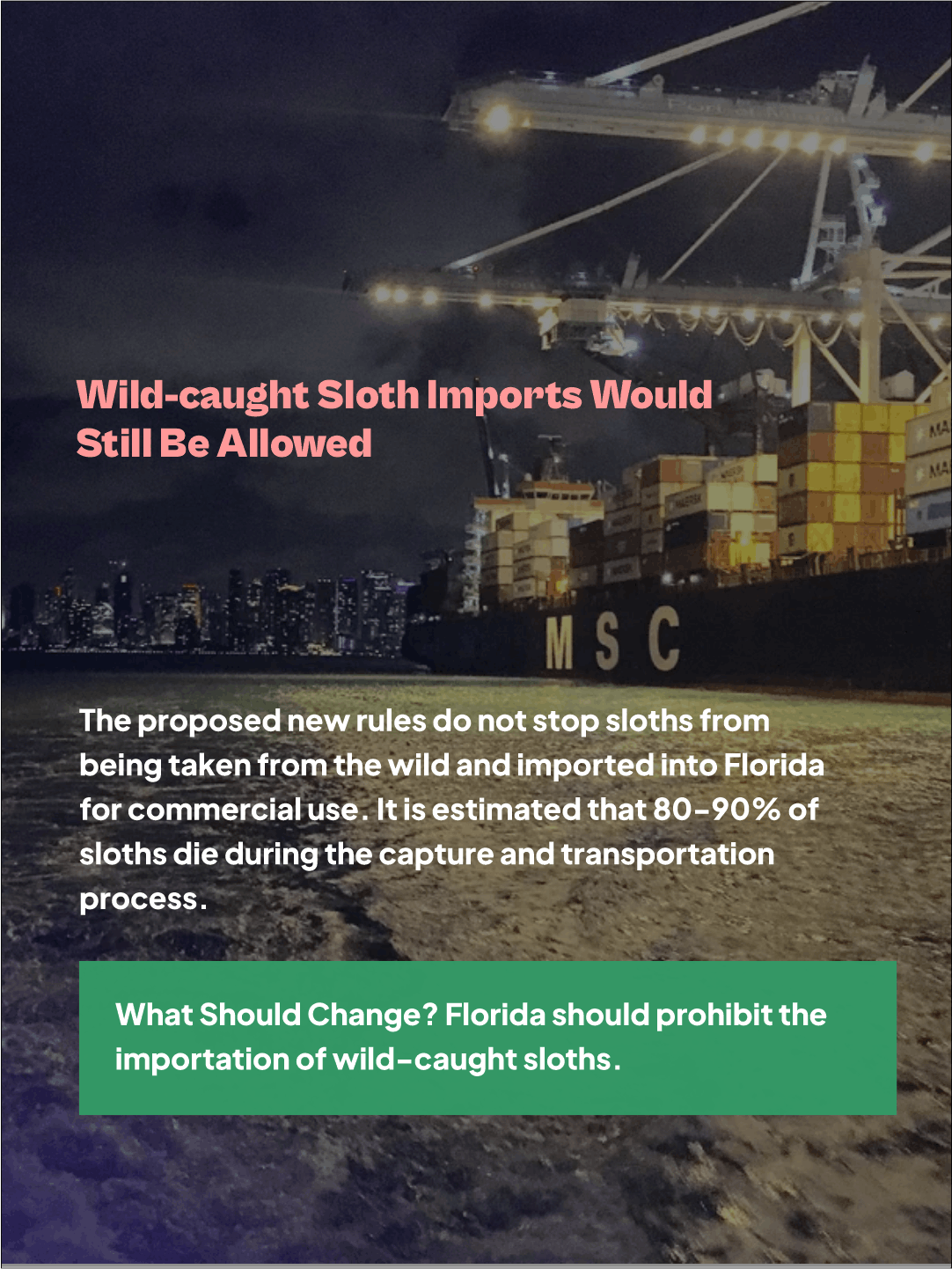
1. Prohibit the commercial importation of wild-caught sloths
Florida should prohibit the importation of wild-caught sloths for commercial exhibition and public encounter purposes.
Wild sloths entering international trade can be exposed to a chain of stressors before reaching their final destination, including capture from the wild, handling, confinement, pre-export holding, changes in diet and environment, international transport and repeated transfers. Much of this occurs outside Florida's jurisdiction.
Florida can inspect a facility before issuing a permit. It can establish experience requirements. It can regulate conditions once animals are inside the state.
But Florida cannot guarantee how a wild sloth was captured, how it was housed or fed before export, whether it received appropriate veterinary care, or what it experienced during the international supply chain.
The most effective way to eliminate those risks is not to regulate the final destination more carefully. It is to stop importing wild-caught sloths for commercial entertainment.
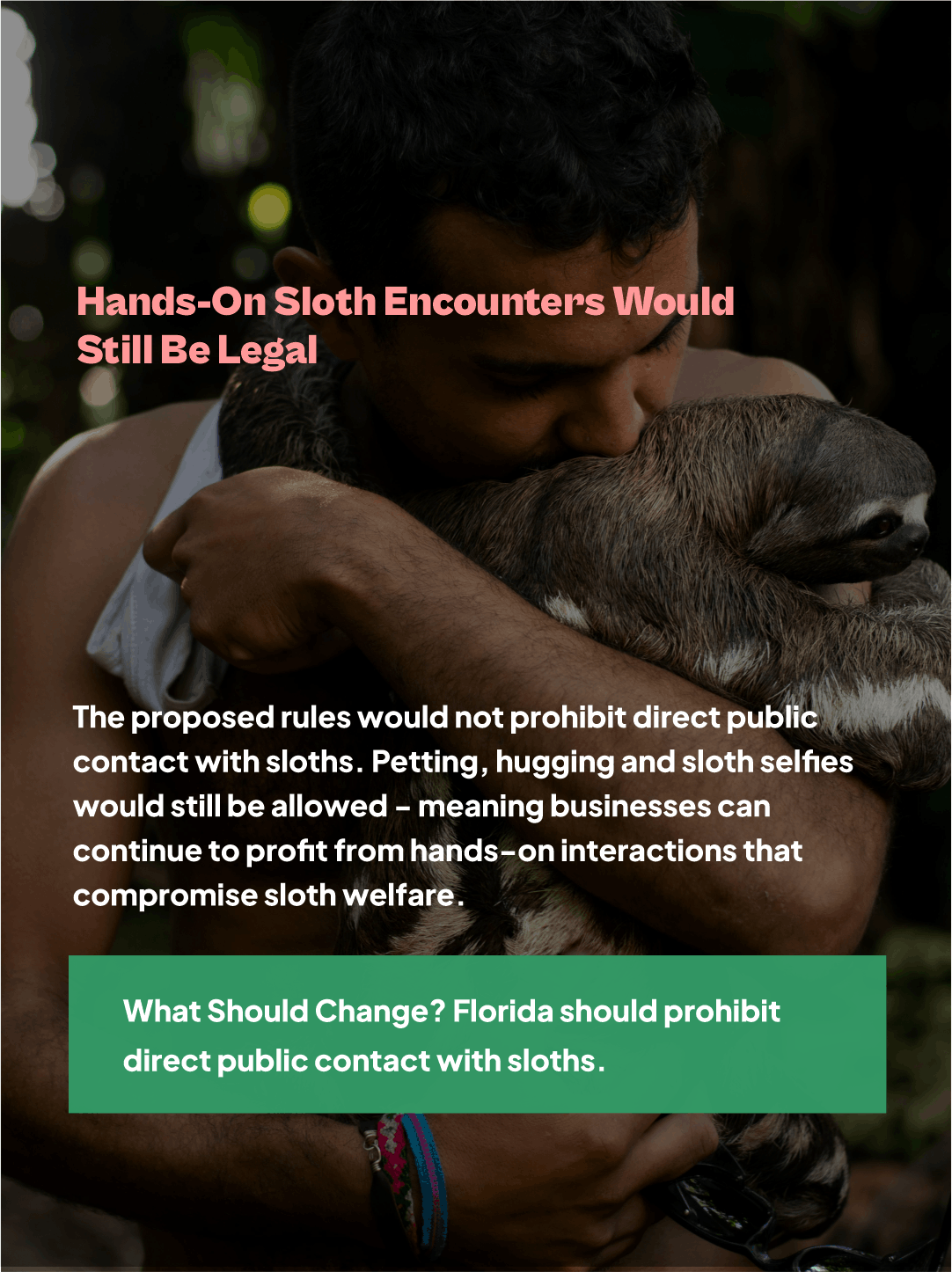
2. Prohibit direct public contact with sloths
The proposed amendments to Rule 68A-6.004 do not address direct public encounters with sloths. We recommend that FWC prohibit routine direct physical contact between members of the public and sloths, including holding and petting.
Sloths are highly specialized arboreal mammals. Importantly, a sloth remaining still during an interaction should not automatically be interpreted as evidence that the animal is comfortable with that interaction.
Scientific research examining sloths used in wildlife tourism has documented repeated physical manipulation during tourist handling and behavioral responses that raise animal-welfare concerns.
There is also a broader question worth asking: if direct contact is unnecessary for the health or welfare of the animal, why should a wild animal be required to tolerate it for entertainment?
Florida has an opportunity to move away from regulating how sloth encounters happen and instead establish a much clearer standard: no direct public contact with sloths.
3. Apply the new experience requirements to existing facilities
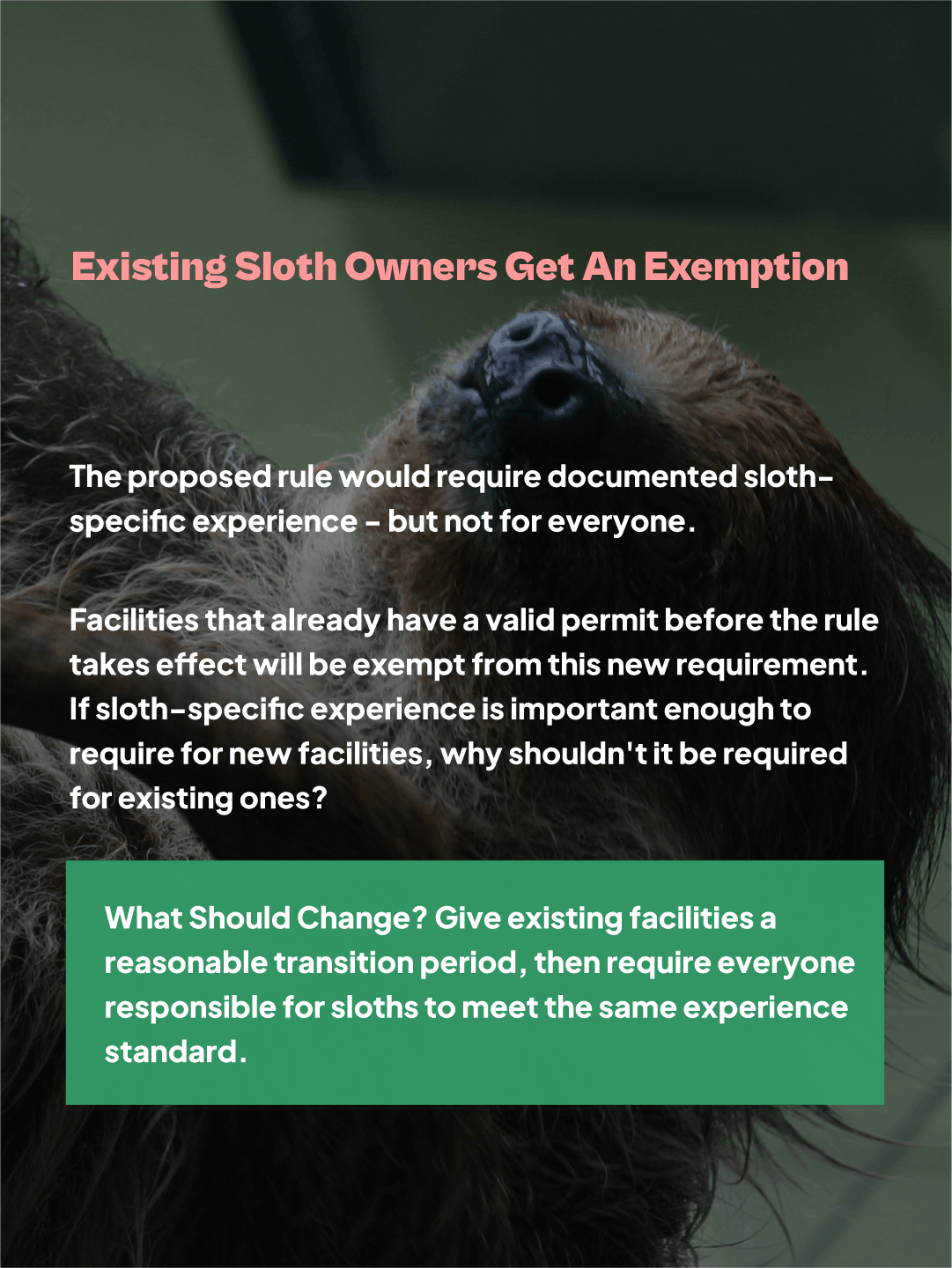
We strongly support FWC's proposal to require relevant practical experience with sloths. However, proposed Rule 68A-6.004(4)(b)1. creates an exemption. The new experience-documentation requirements would not apply to applicants who already held a valid captive wildlife permit and had documented possession of sloths before the rule takes effect.
We understand that existing facilities may need a reasonable period to adapt to new regulations, but a transition period is very different from a permanent exemption.
If FWC has determined that documented sloth-specific experience is necessary to demonstrate competency for new applicants, the same biological and welfare needs apply to sloths already living in existing facilities.
We also encourage FWC to establish clear criteria for what constitutes acceptable practical experience, so that the requirement can be evaluated consistently and meaningfully.
There should not be two different standards of competency for caring for the same animal.
4. Require an established veterinary care plan before sloths arrive
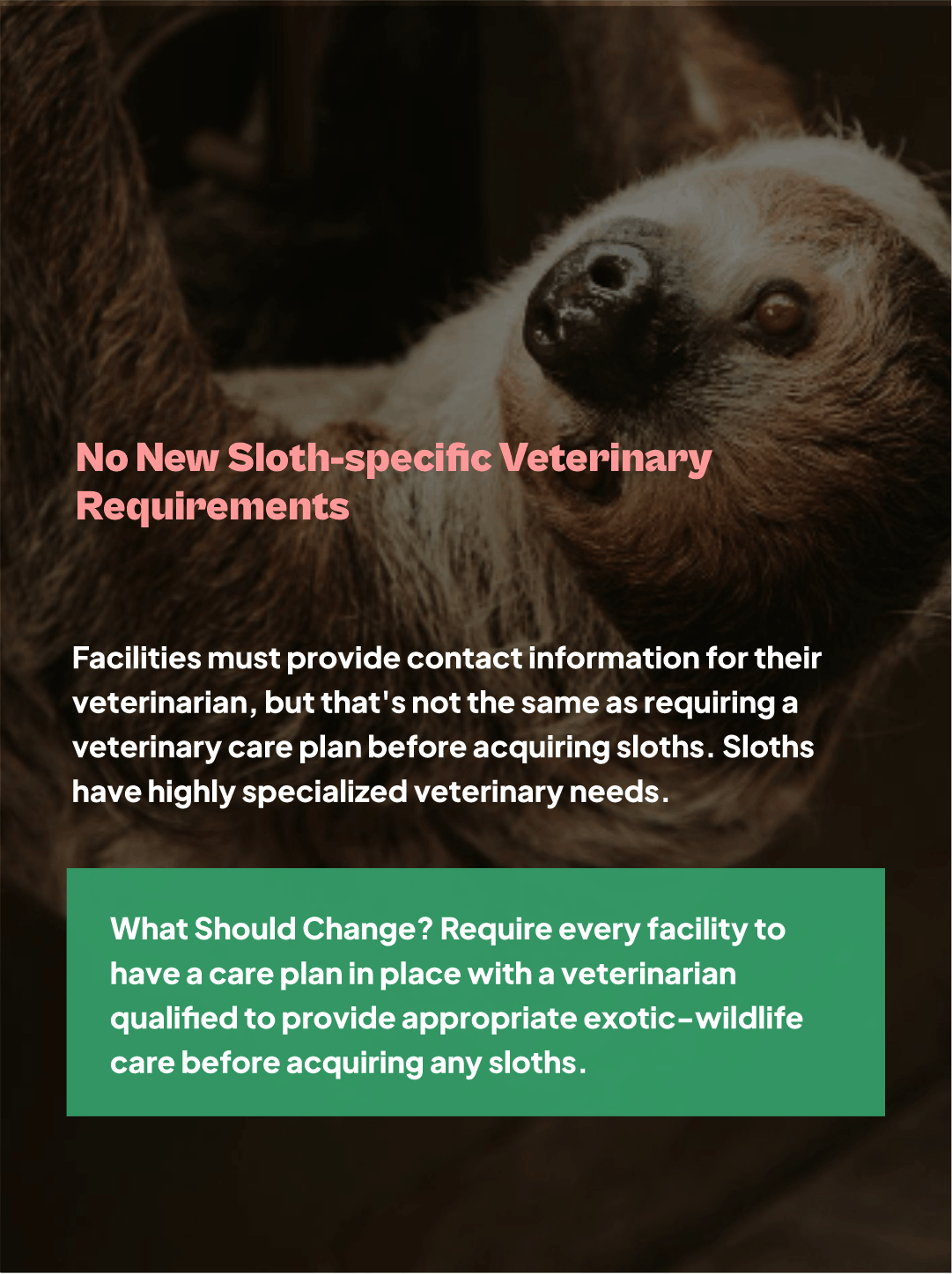
Existing Rule 68A-6.004(7)(b) requires facilities to provide information for the veterinarian used to provide veterinary services for wildlife maintained at the facility. Providing the name and telephone number of a veterinarian is not the same as demonstrating that appropriate veterinary care is actually established and available.
Sloths present unusual veterinary challenges. Their physiology, metabolism, gastrointestinal biology, thermoregulation and behavioral presentation differ substantially from conventional domestic animals. Detecting deterioration can also be difficult for inexperienced observers.
We recommend requiring facilities to establish a written veterinary care plan before acquiring sloths, with a veterinarian appropriately qualified to provide the necessary exotic-wildlife care.
At minimum, the plan should establish procedures for preventative care, quarantine, emergency treatment, diagnostic testing, mortality investigation and necropsy. Facilities importing sloths should have appropriate quarantine and veterinary assessment protocols established before the animals arrive.
Veterinary care should be part of preparing to keep sloths, not something arranged after an emergency occurs.
5. Review Florida's minimum housing standards for sloths
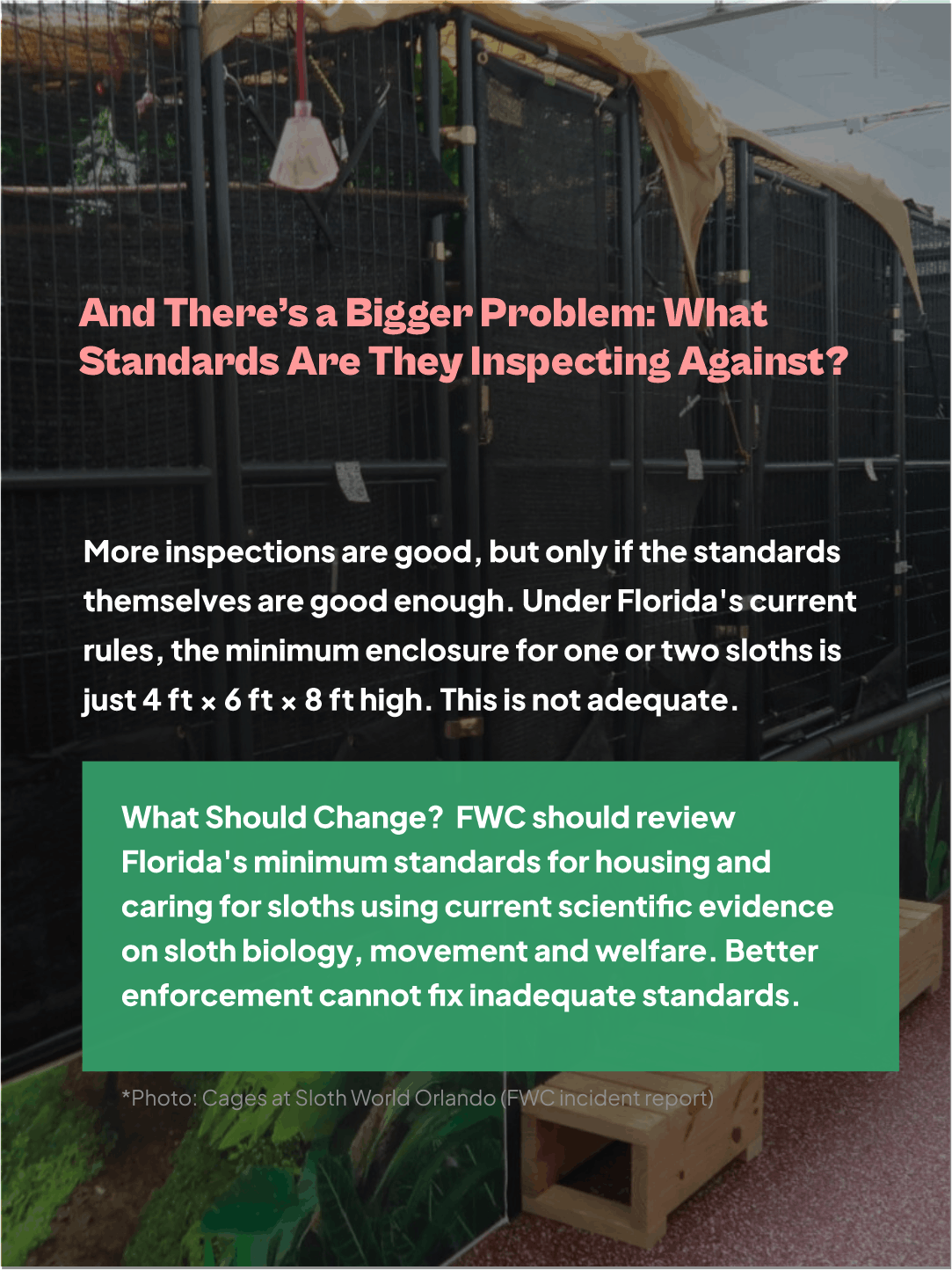
More inspections are valuable, but inspections can only protect animals if the standards being inspected against adequately reflect their biological needs.
Florida's existing Rule 68A-6.0128 establishes a minimum enclosure size of just 4 feet × 6 feet × 8 feet high for one or two sloths.
Sloths are arboreal mammals adapted to moving through complex, three-dimensional forest canopies. Appropriate housing therefore involves much more than simply providing something to climb on.
We strongly encourage FWC to undertake a science-based review of its sloth-specific housing and husbandry requirements.
That review should consider enclosure dimensions and usable three-dimensional space, continuous arboreal pathways, opportunities for movement and behavioral choice, resting and hiding areas, temperature and humidity, ventilation, species-appropriate nutrition and browse, social requirements, enrichment, sanitation, quarantine, biosecurity and objective indicators of animal health and welfare.
Better inspections and better standards need to go together.
This is an opportunity to get it right
Requiring relevant experience, strengthening permit criteria and ensuring facilities are inspected before authorization represent meaningful progress. The Sloth World Orlando tragedy exposed problems that extend beyond whether a facility has a permit or passes an inspection.
It raised fundamental questions about where commercially exhibited sloths come from, what happens to them before they reach Florida, who is qualified to care for them, whether appropriate veterinary support is already in place, the conditions in which they can legally be housed, and whether wild animals should be used for direct-contact entertainment at all.
This rulemaking process gives Florida an opportunity to address those questions now.
And if the lessons learned from Sloth World Orlando can help create stronger protections for sloths throughout Florida, then we should use this opportunity to make those protections as meaningful as possible.
Have your say
FWC's virtual public meeting takes place on September 9 at 5:30 PM ET.
Members of the public can review the proposed four-page draft and provide feedback to FWC. You can also submit comments online if you are unable to attend the meeting.
Read the proposal. Ask questions. Submit your comments. And help us make sure Florida's new rules give sloths the protection they deserve.
How You Can Help
The progress we've made has only been possible because people around the world chose to speak up. But our work is far from over.
You can support the Sloth Protection Alliance by signing our petition calling for stronger protections for wild sloths and an end to their commercial exploitation. If you're able, please also consider making a donation. Your support helps us continue investigating the wildlife trade, provide scientific evidence to policymakers, develop stronger legislation, and advocate for lasting protections that keep sloths where they belong: in the wild.