
Sloths in Town: Some Preliminary Findings from the Urban Sloth Project
In the beach town of Puerto Viejo de Talamanca, Costa Rica, it's not unusual to spot a sloth climbing a fence, reaching across a fruit stand, or napping above a kitchen sink. As rainforest canopy gives way to corrugated tin roofs and open roads, the world's slowest mammals are being forced to adapt to a very different kind of jungle, the concrete one.
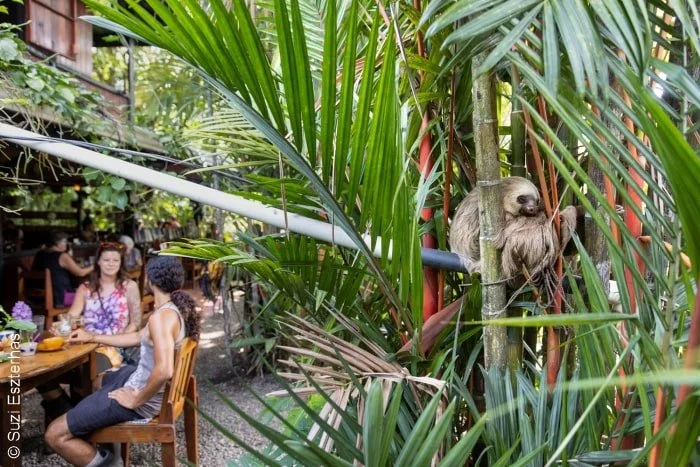
That's the question at the heart of The Urban Sloth Project (USP), a long-term study run by the Sloth Conservation Foundation (SloCo): how does living in a town, rather than an undisturbed rainforest, change the way sloths behave?
We're still in the middle of this research, and the numbers below are preliminary, but we wanted to share what the data is showing so far.
The study, by the numbers
To date (September 2026), the project has monitored 49 individual sloths, fitted with tracking devices, across two habitat types:
38 sloths in urban sites around Puerto Viejo town
11 sloths in primary (undisturbed) rainforest, our baseline for comparison
Both of Costa Rica's sloth species are part of the study:
28 three-fingered sloths, Bradypus variegatus (21 urban, 7 primary forest)
21 two-fingered sloths, Choloepus hoffmanni (17 urban, 4 primary forest)
The first equipment we used for this study was a small backpack fitted with a Daily Diary Data Logger. As technology improved, we stopped using the backpacks and attached the data logger to a VHF collar instead. Now, we use VHF or GPS collars with an accelerometer attached.
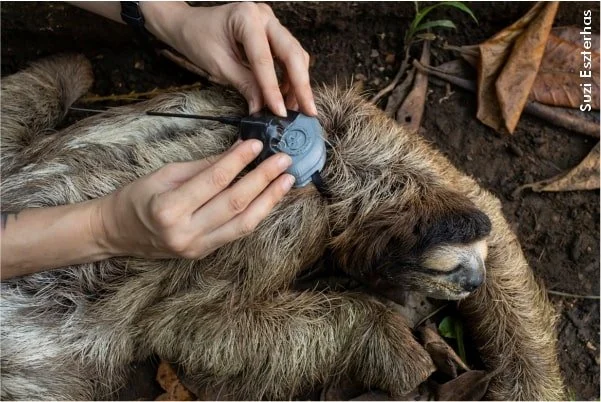
These devices record body movement, position, and temperature up to 40 times per second. Between all of the sloths monitored so far, these devices have collected:
31,819 total hours of behavioral data
22,470 hours from urban sloths
9,348 hours from primary forest sloths
That's the equivalent of over 3.6 years of continuous monitoring, spread across every sloth in the study—an enormous, still-growing dataset.
What we're seeing: daily activity budgets
We split each 24-hour period into three categories: sleep, rest, and active behavior, and compared the activity budgets of urban sloths to sloths living in primary forest, species by species.
To show what this data actually looks like at the individual level before it gets averaged into a species-wide number, here's a full 24-hour activity and temperature profile from one urban two-fingered sloth named Deborah:
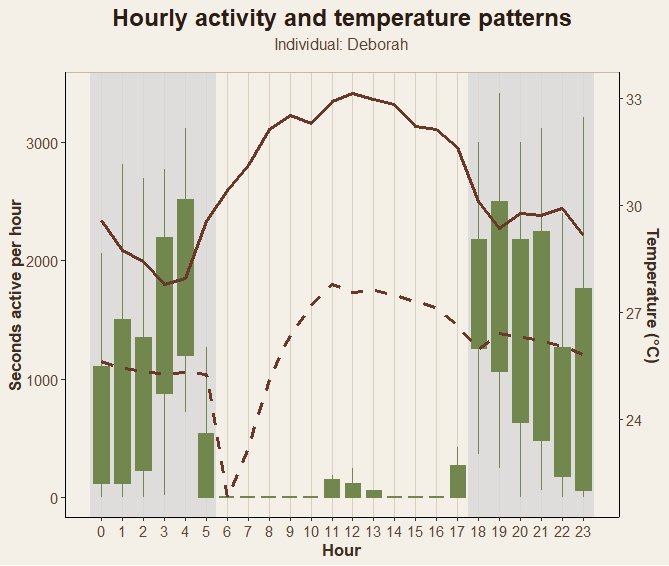
Every chart of this kind in the dataset follows the same key: the bottom axis shows the 24 hours of the day, grey shading marks night hours, the green bars are Deborah's average activity (in seconds active per hour) on the left axis, the solid line is atmospheric temperature, and the dashed line is the temperature recorded directly by her datalogger, both on the right axis. This is the kind of raw, individual-level pattern that gets rolled up into the species averages below.

Deborah and her baby Mel using the canopy bridge we installed in her area! You can read that story here.
Three-fingered sloths (Bradypus variegatus)
Sleep: 32.8% of the day in urban sites, compared to 24.4% in primary forest
Rest: 54.6% in urban sites, compared to 62.8% in primary forest
Activity: 12.6% in urban sites, compared to 12.8% in primary forest — nearly identical.
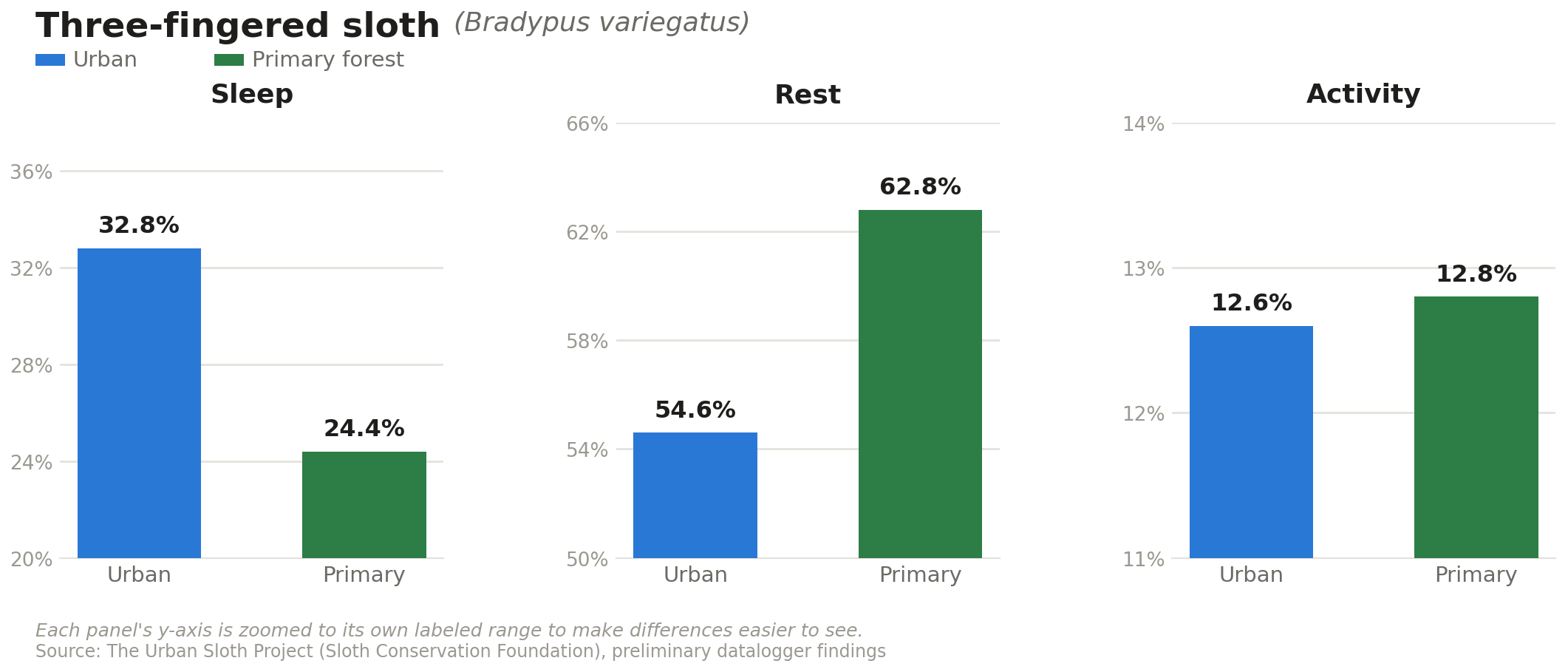
Urban three-fingered sloths are sleeping more and resting less than their primary-forest counterparts on average, while the amount of time spent actively moving stays about the same either way.
But sleeping and resting aren’t the same thing. A resting sloth may be completely still and conserving energy while remaining awake and responsive to its surroundings. During sleep, it is genuinely asleep and much less responsive. So urban sloths aren’t simply spending more time inactive, they’re actually spending more of that time asleep.
Two-fingered sloths (Choloepus hoffmanni)
Sleep: 37.8% in urban sites, compared to 34.1% in primary forest
Rest: 46% in urban sites, compared to 48.5% in primary forest
Activity: 16.2% in urban sites, compared to 17.4% in primary forest
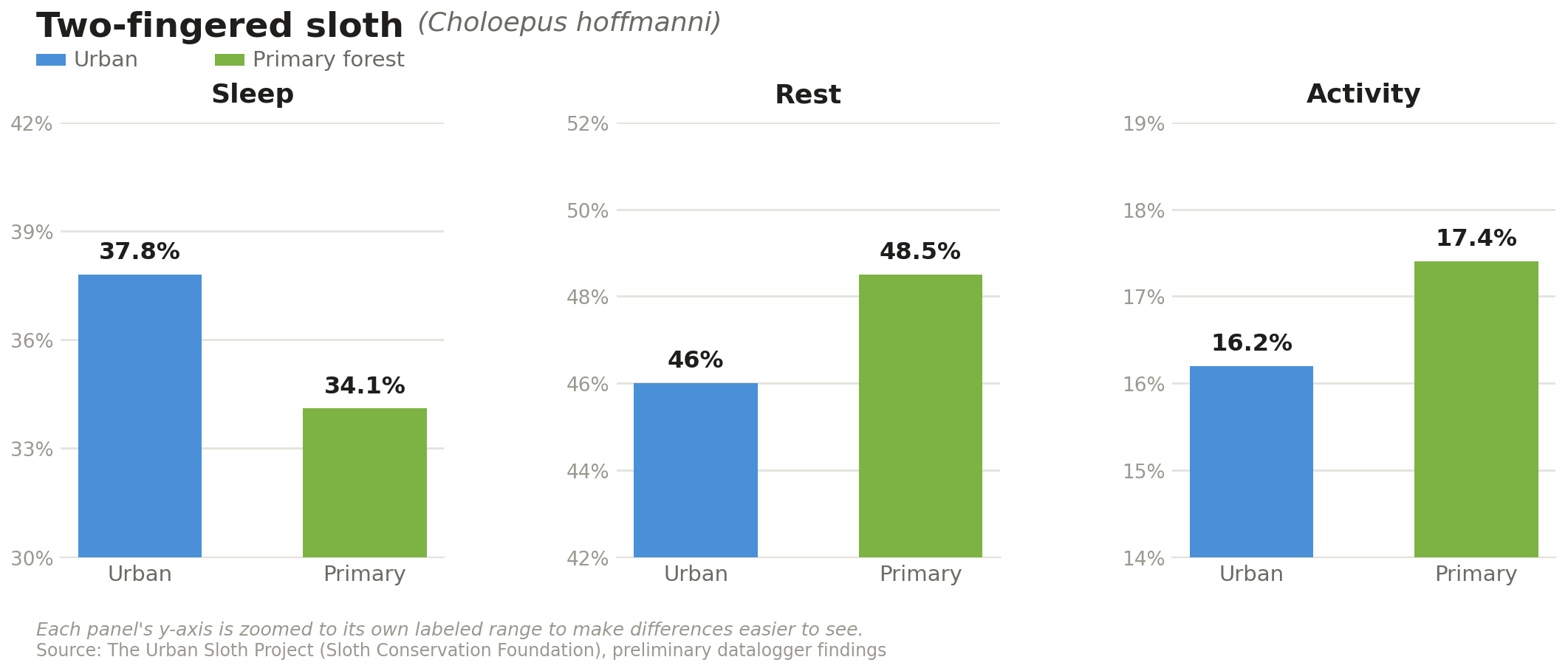
The gaps are smaller here, but the direction is consistent: urban two-fingered sloths sleep a bit more and are active a bit less than those in primary forest on average.
Across both species, one pattern has held steady in the data collected so far: males have generally been less active than females, regardless of habitat.
What we're seeing: environmental conditions and activity
Beyond just comparing habitats, the dataloggers let us look at how activity shifts as conditions change ( temperature, sunlight, and wind) and whether that response looks different in town versus the forest.
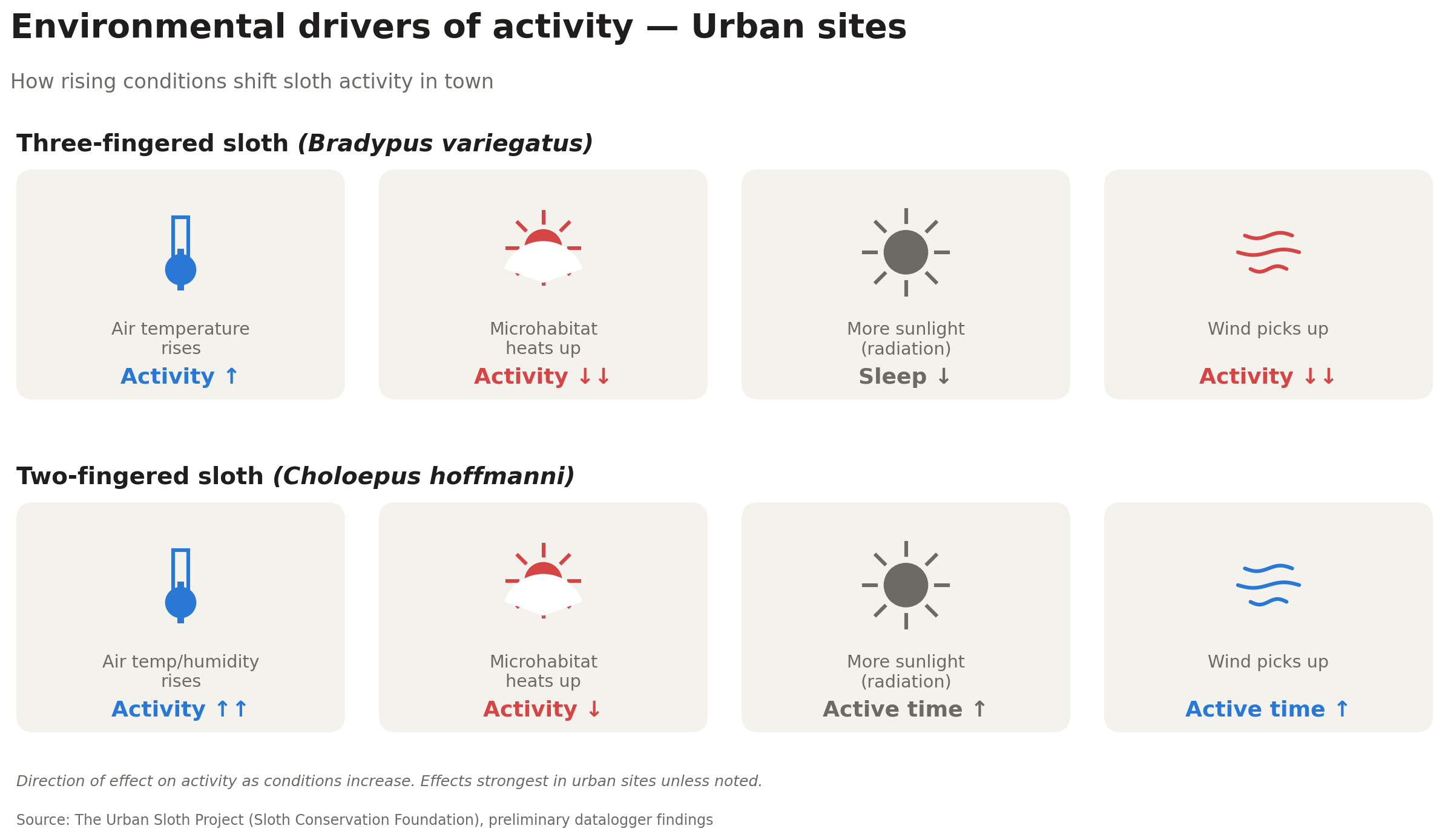
A few patterns stand out from the data so far:
Air temperature (what a weather app would report) tends to track with increased activity in both species.
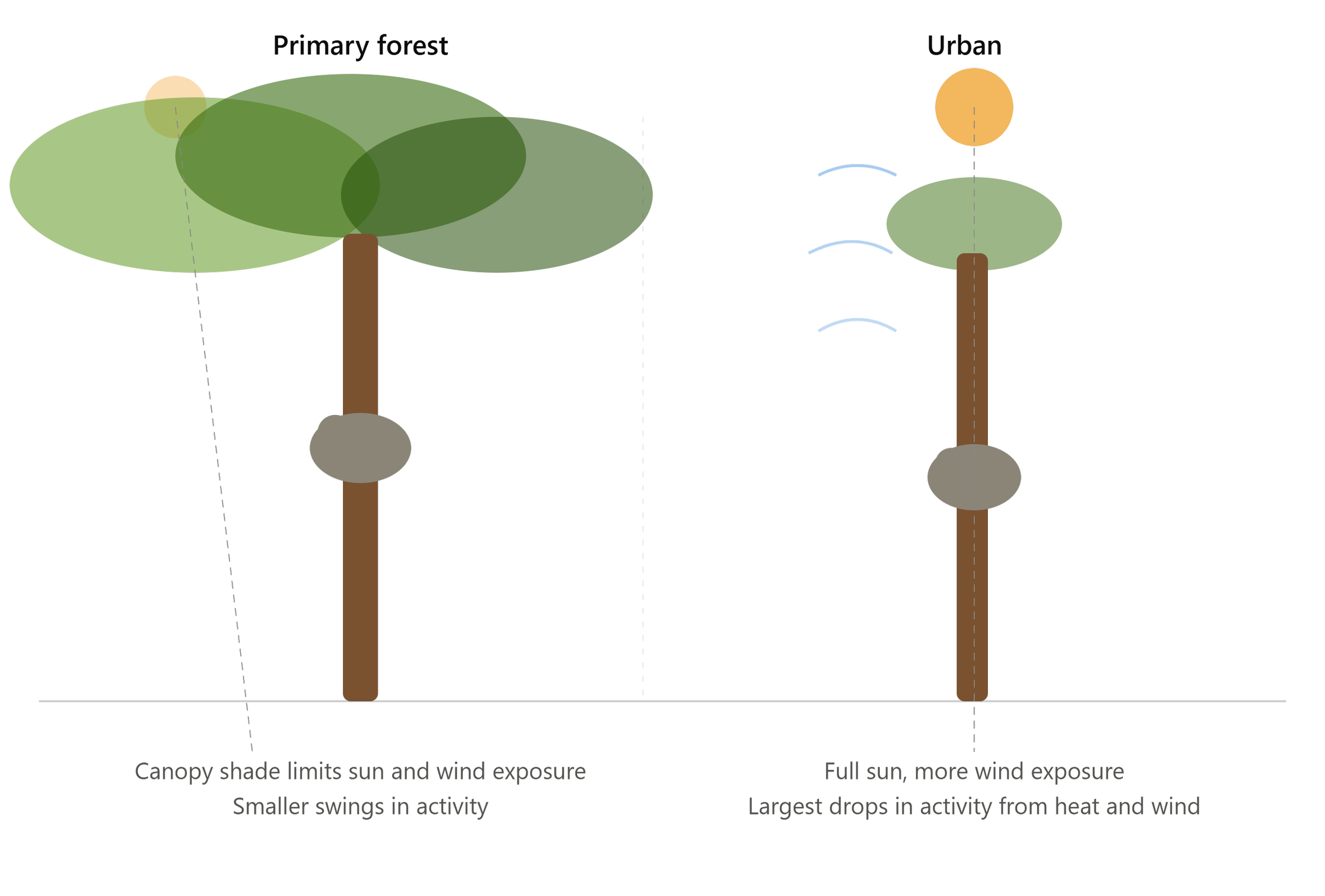
Microhabitat temperature (what the datalogger records directly on the sloth) tends to track with decreased activity, and this effect is largest in urban sites for both species.
Sunlight (radiation) shows opposite patterns by habitat for three-fingered sloths: associated with less sleep in urban sites, more sleep in primary forest; while for two-fingered sloths, it's associated with a lower overall likelihood of activity, but longer active bouts in urban sites specifically.
Wind is associated with reduced activity in three-fingered sloths, most strongly in urban sites, while in two-fingered sloths it's associated with increased active time in urban sites.
We're not drawing conclusions yet about why these patterns look the way they do, that's exactly what the next phase of research is for.
Circadian rhythm: when are sloths active?
The data is also letting us look at when, not just how much, sloths are active during the 24-hour cycle, and the two species look quite different from each other.

Two-fingered sloth sleeping
Three-fingered sloths show a pattern known as cathemerality: activity spread across both day and night, rather than being strictly nocturnal, which is consistent with previous research on this genus. Sloths in the study were reliably inactive at dawn across all habitats, and overall, roughly a third of the night was spent active, about double the activity level recorded during daylight hours. A small number of individuals living in urban sites showed circadian patterns that broke from this overall trend.
Two-fingered sloths have so far matched previous research suggesting nocturnality, with activity concentrated at night across the individuals studied. Some urban individuals showed slightly more daytime activity than their primary-forest counterparts.
Why this matters, and why we're not done
As deforestation and development continue to fragment sloth habitat across Costa Rica, more sloths are ending up on the ground, on fences, and in backyards, simply trying to move between the trees that remain. Understanding whether sloths behaviorally adjust to urban conditions, and how, is central to figuring out how to protect them.

Luna and Sol, one of the first sloths of the Urban Sloth Project
Right now, we can say that urban and primary-forest sloths show measurably different daily activity patterns, and that their responses to temperature, sunlight, and wind aren't identical between habitats either. What we can't say yet is why. These are preliminary results from an ongoing study, and any explanation for these patterns would be speculation at this stage.
A story from the data: Martita's crossing
Numbers and charts are only part of what this project is about. Sometimes a single sloth's GPS points tell a story all their own. For years, we've been trying to secure permission to install a canopy bridge across one particularly dangerous stretch of the main road, where sloths and other wildlife are regularly forced to cross on the ground. One of those animals was Martita, a three-fingered sloth and one of our GPS-tracked urban study subjects, who recently made the terrifying journey across that road carrying her tiny baby.
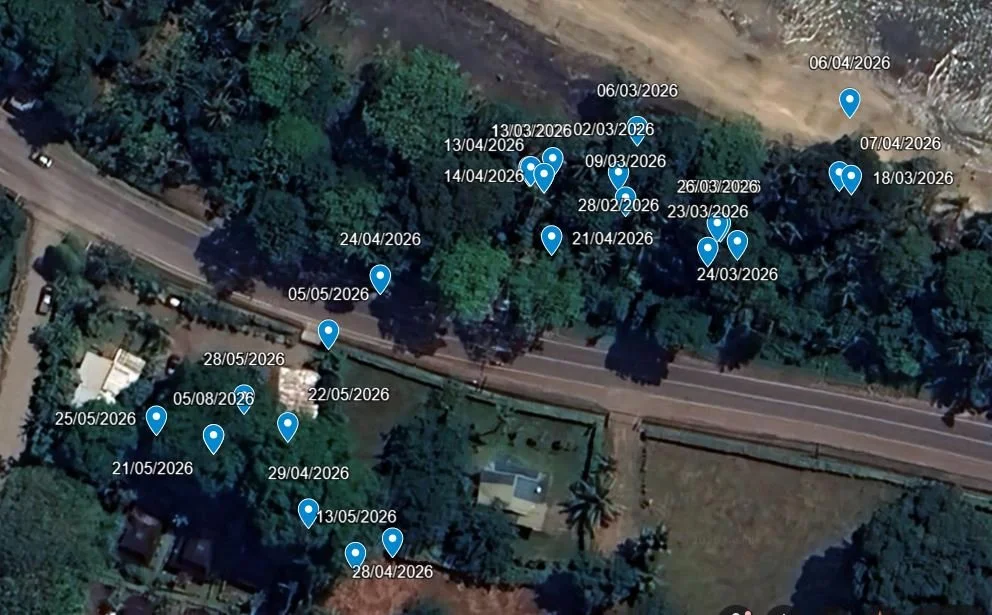
When we showed the tracking data from Martita's collar to Costa Rica's electricity provider, they could finally see exactly why this location mattered so much. It was the evidence we needed. They granted permission, worked with us to install a new Sloth Crossing canopy bridge, and the results were almost immediate: less than 24 hours after the bridge went up, an entire troop of howler monkeys marched safely across it. And then Martita herself was spotted using the bridge!
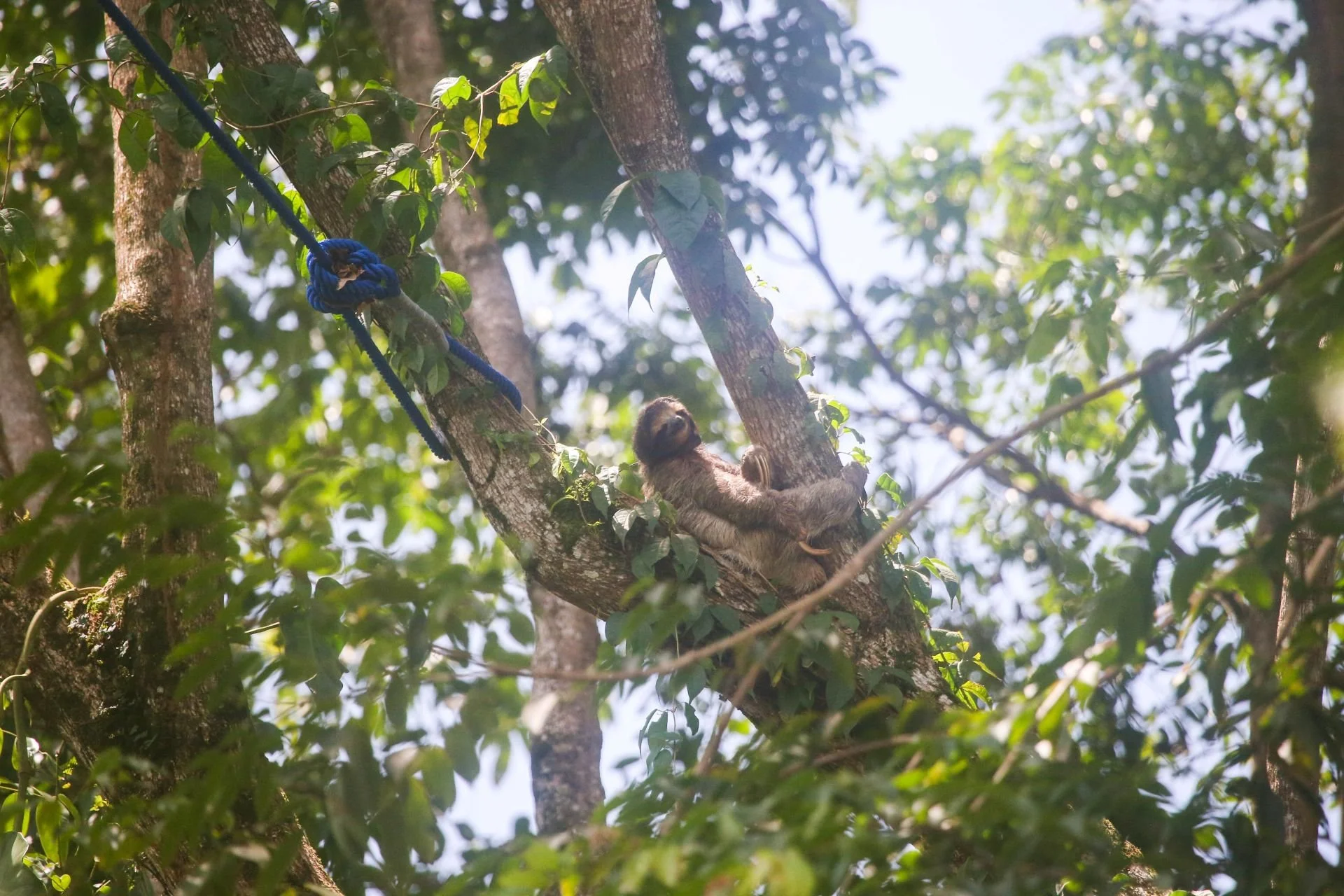
It's a good reminder of why this monitoring work matters beyond the data itself: every GPS point is a real sloth, making a real journey, and sometimes that journey is enough to change a road.
What's next
The next phase of the Urban Sloth Project will carry out fine-scale drone habitat mapping: canopy cover, tree connectivity, and microclimate data at a much more detailed level than we've had access to so far. That mapping is what we hope will give us more insight into which features of a landscape are behind the differences we're seeing between urban and primary-forest sloths, rather than simply describing that the differences exist.
More sloths, more datalogger hours, and more habitat data are on the way. We'll share updates as the research continues.
