
Why Do Sloths Eat the Placenta After Giving Birth?
Our research team was carrying out one of their routine monitoring sessions for The Urban Sloth Project when they came across a small group of excited tourists. A wild Hoffmann's two-fingered sloth (Choloepus hoffmanni) had just given birth. By the time our team arrived, the mother had already delivered her baby and was carefully cleaning her newborn after eating the placenta.
While this behavior may seem surprising, or even unsettling, it is actually common among mammals. But why do they do it?
Why Do Sloths Eat the Placenta?
The act of eating the placenta after giving birth is known as placentophagy, and it has been documented in the vast majority of placental mammals, from rodents and carnivores to primates and ungulates. Humans are one of the few notable exceptions.
Although scientists have studied placentophagy for decades, there is still no single explanation that fully accounts for why it evolved. Instead, several complementary hypotheses have been proposed.
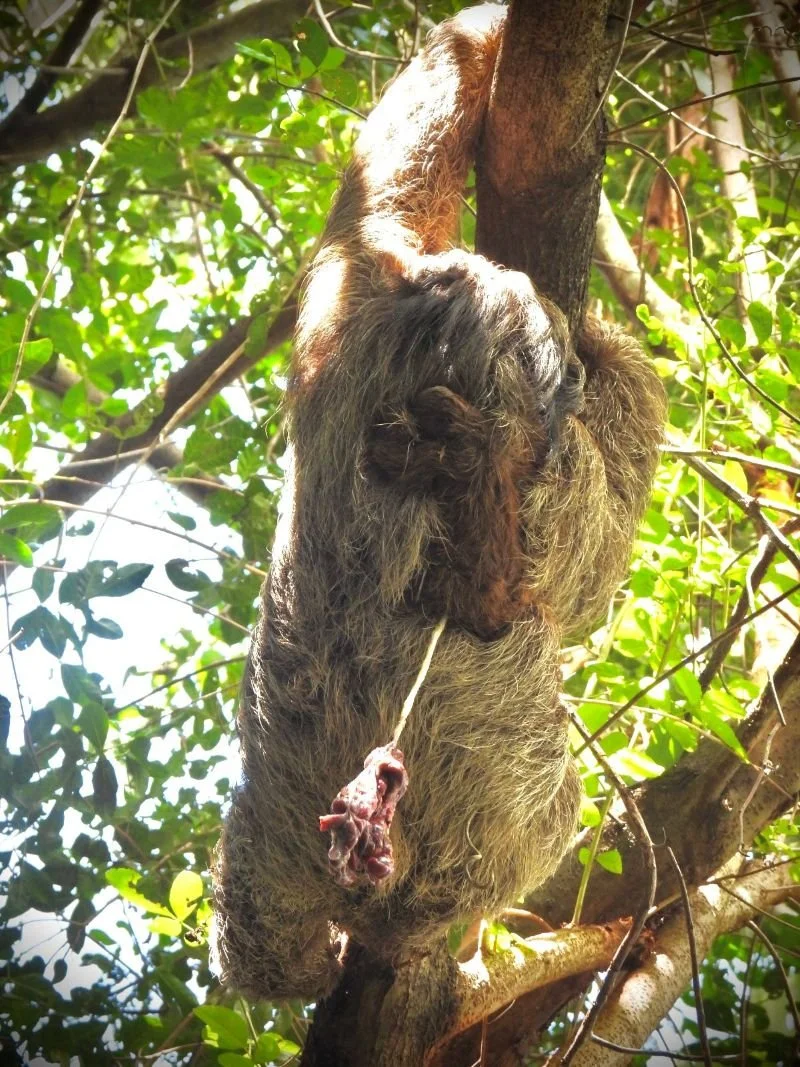
Maned sloth (Bradypus torquatus) with a newborn and placenta | Credit: Instituto Preguica de Coleira
1. Removing Evidence of Birth
The leading hypothesis, particularly for wild mammals, is that eating the placenta helps remove evidence of birth, and for sloths, this explanation is particularly compelling.
Sloths have evolved to go unnoticed. Their camouflage, slow movements, and even their lack of body odor all help them avoid detection by predators, making them incredibly difficult to detect.
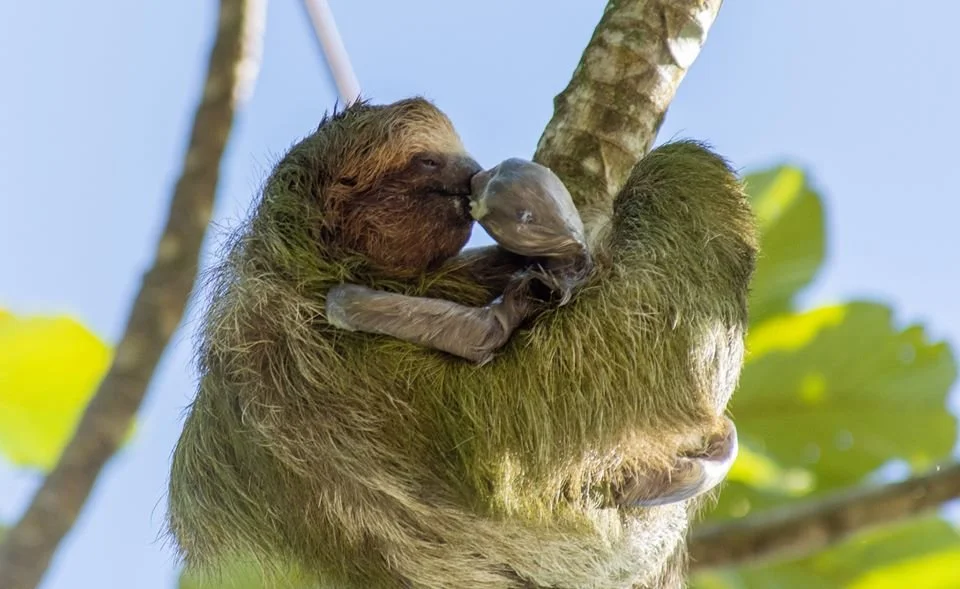
Brown-throated three-fingered sloth (Bradypus variegatus) Credit: Agustin Murillo Viquez
A freshly delivered placenta, however, is rich in blood and bodily fluids, and it likely produces strong odors that could advertise the presence of both mother and newborn to predators. By consuming the placenta immediately after birth, the mother may be eliminating one of the few obvious clues that a birth has just taken place, helping her and her baby remain hidden during one of the most vulnerable moments of their lives.
Although this hypothesis has not yet been tested specifically in sloths, it fits remarkably well with their overall survival strategy: stay invisible.
2. Recovering Nutrients and Energy Lost During Birth
Another commonly proposed hypothesis is nutritional recovery. Pregnancy and labor require substantial energy. The placenta contains proteins, lipids, iron, hormones, and other nutrients that could help replenish some of the mother's reserves immediately after giving birth.
This idea seems particularly interesting for sloths. Sloths have one of the slowest metabolic rates of any mammal and survive on a remarkably low-energy diet consisting primarily of leaves. Producing a placenta, carrying a developing fetus, and giving birth all require considerable energy.
Could eating the placenta help replace some of those lost nutrients? Possibly. The placenta certainly contains nutrients that could be recycled, but scientific evidence suggests this benefit is probably modest. Reviews of placentophagy have found limited evidence that nutritional gains alone are sufficient to explain why the behavior evolved. Instead, nutrient recovery may simply be one of several advantages.
3. Hormones and Maternal Care
Some researchers have suggested that placentophagy may also influence maternal behavior: the placenta contains hormones and bioactive compounds that have been hypothesized to promote bonding between mother and offspring, stimulate milk production, reduce pain after birth, or help regulate postpartum physiology.
Most of this evidence comes from laboratory studies in rodents, and results remain mixed. At present, there is no evidence that these hormonal effects occur in sloths, but they remain an intriguing possibility.
Rather than one single reason, placentophagy likely provides several small benefits that together have favored its evolution across mammals.
Other Documented Cases
Although witnessing sloths giving birth is exceptionally rare, this is not the first documented case of a sloth consuming its placenta.
Researchers have previously recorded this behavior in the Northern Maned Sloth (Bradypus torquatus) and in the Brown-throated Sloth (Bradypus variegatus), suggesting that placentophagy may be common across different sloth species.
Each new observation helps fill important gaps in our understanding of sloth reproductive biology, one of the least studied aspects of their natural history.
Because births are so rarely observed in the wild, every documented event provides valuable information that helps scientists better understand how these remarkable mammals reproduce, care for their young, and survive in the rainforest canopy.
Why This Matters
Despite being among the world's most recognizable mammals, many aspects of sloth biology remain a mystery. We still know surprisingly little about their courtship, pregnancy, birth, parental care, and the challenges mothers face while raising young in fragmented landscapes.
Long-term studies like our Urban Sloth Project allow us to witness these incredibly rare moments and answer questions that would otherwise remain unknown. Every observation, no matter how small, helps us better understand how sloths live and how we can better protect them.
