SLOTHS Act: A Bipartisan Bill to End Wild Sloth Imports into the U.S.
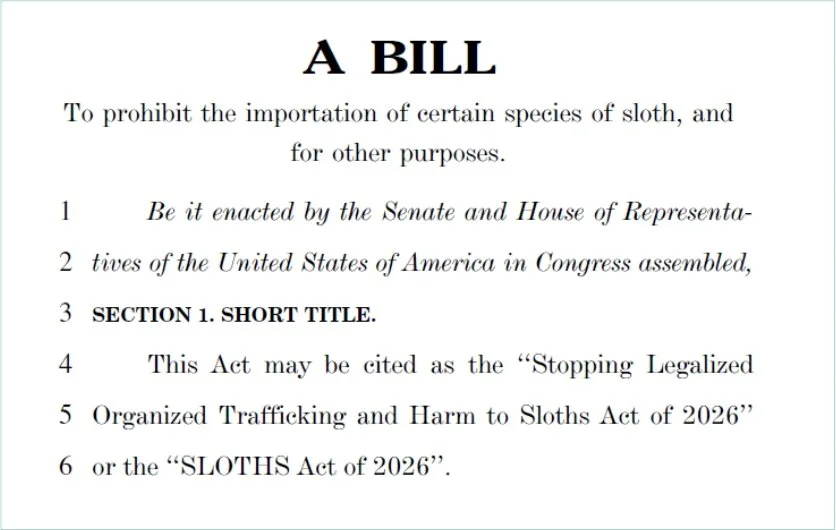
On International Sloth Day, October 20, 2026, the Stopping Legalized Organized Trafficking and Harm to Sloths Act of 2026 (SLOTHS Act) was introduced in the U.S. House of Representatives. The bipartisan bill would prohibit live sloth imports into the United States, with limited exceptions, to reduce the demand driving their capture in the wild.
Stopping Legalized Organized Trafficking and Harm to Sloths Act of 2026 (SLOTHS Act) was introduced in the U.S. House of Representatives.
The legislation is the result of months of work led by the Sloth Protection Alliance (SPA), formed by the Sloth Conservation Foundation (SloCo) and the Sloth Institute (TSI). Both organizations worked side by side with U.S. lawmakers to develop the bill and bring it to Congress, following the deaths of 58 sloths connected to Sloth World Orlando.
Representative Maxwell Alejandro Frost (D-FL) and Representative Laurel M. Lee (R-FL) introduced the bill jointly, bringing Democrats and Republicans together to protect wild sloths.
The SLOTHS Act has been endorsed by the Association of Zoos and Aquariums, Animal Welfare Institute, Animal Legal Defense Fund, and International Fund for Animal Welfare.
As a major market for wild-caught sloths, the United States helps sustain a trade supplying commercial exhibitions, hands-on encounters, and private ownership. Closing this import route would have an impact far beyond U.S. borders, helping protect sloths in the forests where they belong.
The SLOTHS Act has been introduced in the House of Representatives and is expected to be referred to the House Committee on Natural Resources, potentially followed by its Subcommittee on Water, Wildlife and Fisheries. The committee referral has not yet been confirmed. Introduction begins the legislative process: the bill is not yet law and must advance through Congress before it can take effect.
What Would the SLOTHS Act do?
END COMMERCIAL IMPORTS: Prohibit the importation of sloths for commercial exhibition, animal encounters, and the exotic pet industry.
PROTECT SCIENTIFIC RESEARCH: Allow deceased sloth specimens to be imported for scientific research.
SUPPORT CONSERVATION BREEDING: Permit eligible captive sloths to be transferred to AZA-accredited institutions for breeding programs, provided the animals were not taken from the wild after enactment.
ESTABLISH MEANINGFUL PENALTIES: Introduce civil penalties of up to $20,000, criminal fines of up to $100,000 for knowing violations, and provisions for forfeiture of illegally imported animals and cancellation of applicable federal authorizations.
Would the bill ban sloth encounters or private ownership?
The SLOTHS Act focuses on importation. It would not itself prohibit hands-on sloth encounters or the ownership and exhibition of sloths already in the United States.
Those issues remain part of the Alliance’s wider campaign. We will continue advocating for stronger captive welfare protections, an end to hands-on encounters, transparency about animal deaths, and greater accountability.
Why does the United States need a sloth import ban?
Many people who visit a sloth attraction have no idea that the animal in front of them may have been captured in the rainforest.
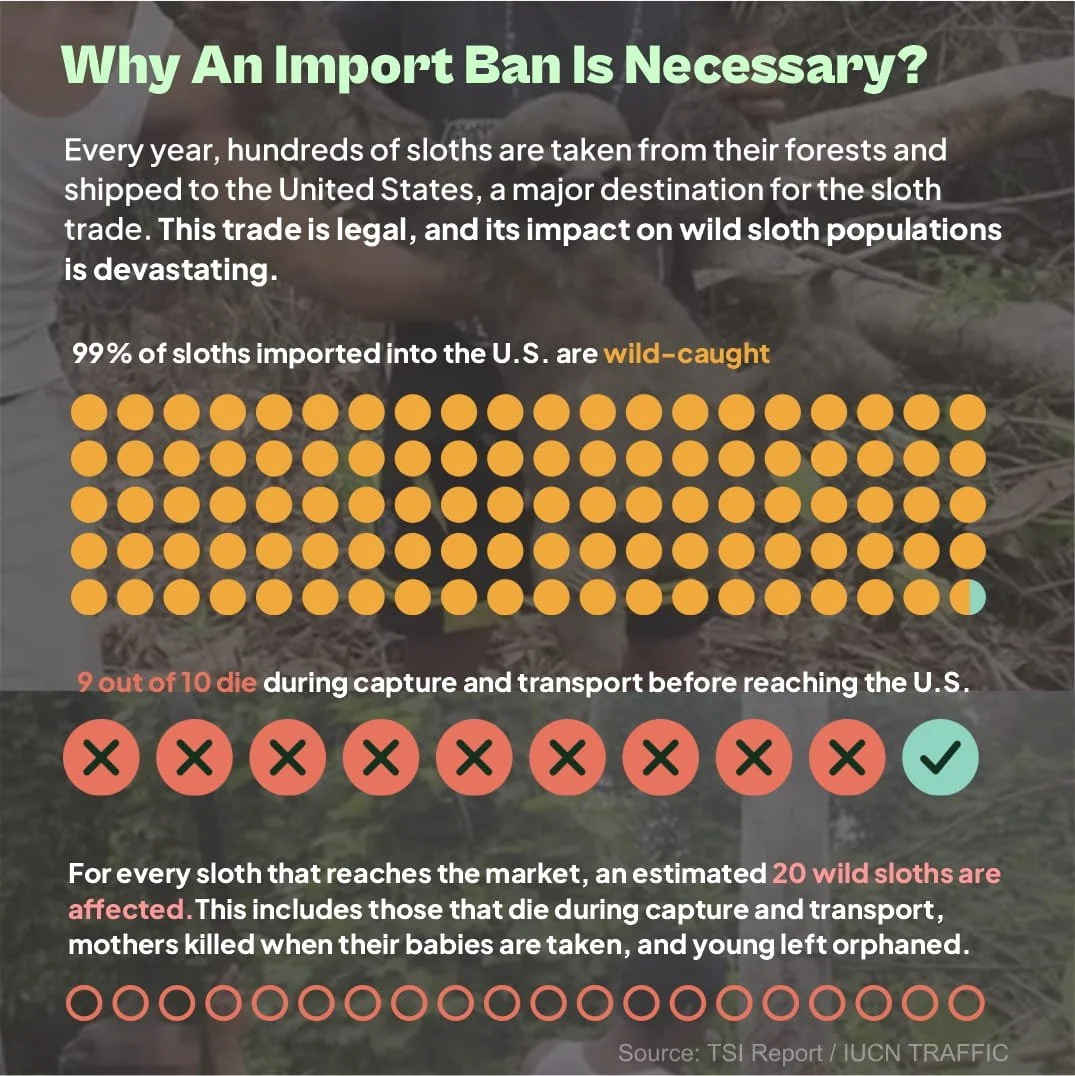
The Sloth Institute’s analysis of federal wildlife trade records found that the United States imported 1,146 live sloths between 2011 and 2021. Of those animals, 1,141 were recorded as wild-caught, more than 99 percent. About 97 percent of live imports came from Guyana.
Those records describe a market overwhelmingly supplied by wild-caught animals. An import ban addresses that supply directly, before more sloths are captured and transported to satisfy U.S. demand.
The United States is a major destination for the international sloth trade. IUCN and TRAFFIC identify it as a principal importing country for Hoffmann’s two-toed sloths (IUCN and TRAFFIC, 2025, p. 71). The US is also the largest exotic pet market globally (Evans et al., 2025)
Source: IUCN TRAFFIC Report
Sloth Welfare
Sloth traffickers target infants rather than adults, often killing the mother to take her young. Many of these infants struggle to adjust to captivity or die from stress before reaching their destination (Nuwer, 2013). Consequently, official trade figures understate the full impact of sloth trafficking on wild populations.
At least nine sloths are estimated to die from stress and difficulty adapting to a captive diet for every individual that reaches the international pet market. When these deaths and the loss of mothers are considered together, each sloth reaching the pet market could represent the loss of at least 20 individuals from wild populations (Moraes-Barros et al., in litt., 2025).
Sloths are predominantly solitary mammals adapted to life in the rainforest canopy, with complex dietary, environmental, and behavioral needs that are difficult to meet in captivity. Their exceptionally slow metabolism, specialized digestion, and limited ability to regulate body temperature make them particularly vulnerable to inappropriate diets and temperatures. Capture, transport, repeated handling, and unsuitable housing expose them to stress and conditions that can compromise their health and survival. Their apparently calm behavior can conceal distress, allowing serious welfare problems to go unnoticed.
Existing Legislation Failed to Prevent the Suffering of Dozens of Sloths
The Sloth World tragedy occurred within a regulatory system that allowed the import of wild sloths for commercial exhibition. Fifty-eight sloths died in connection with the operation, yet the Orange County Sheriff’s Office investigation found no evidence of criminal neglect. The existing framework failed to protect these animals.
The investigative record documented inadequate preparation, heating failures, inconsistent husbandry, and staff without appropriate training. Pathology findings identified infectious disease, including evidence of viral involvement, alongside serious nutritional and other health problems.
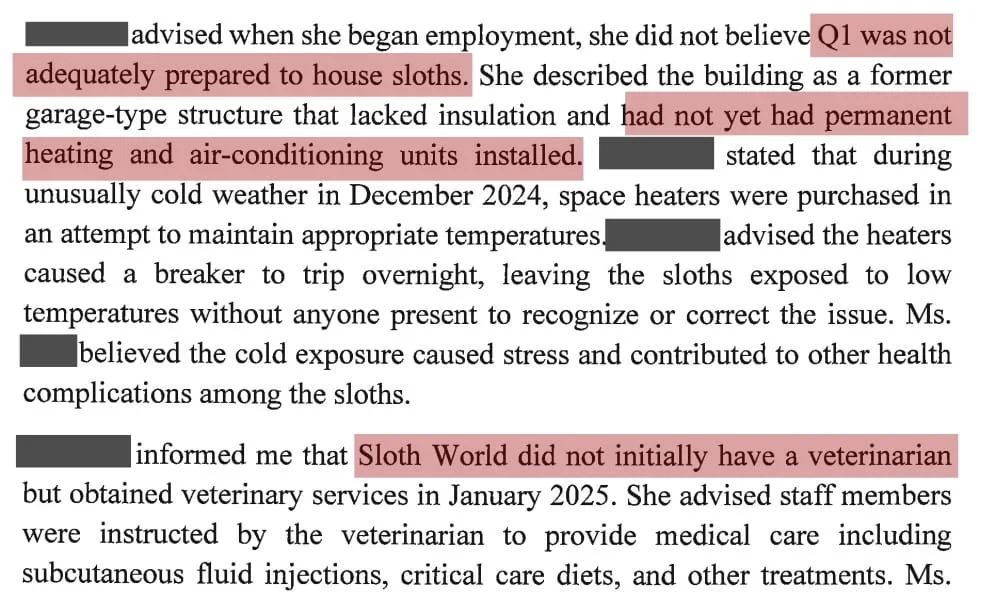
The absence of malicious intent does not erase failures in care or make preventable suffering acceptable.
If some sloths arrived already sick, malnourished, or otherwise compromised, that strengthens the case for restricting the trade. It means the harm may have begun during capture, holding, or transport, before the animals reached Florida. A system that permits wild animals to enter this commercial supply chain cannot rely solely on intervention after they arrive sick or begin to die.
The veterinary review reported a novel sloth gammaherpesvirus and other pathogens. The reviewed records do not establish human transmission of that virus. Separately, research published in CDC’s journal identifies wildlife imports as a route for zoonotic disease introduction, supporting prevention of avoidable exposure.
Public Demand For Federal Action!
The failed commercial attraction Sloth World provoked public outrage over the deaths of the imported sloths and the commercial trade behind them. Central to that concern is the removal of wild animals from their natural habitats to supply an entertainment attraction. Congress can respond by preventing further imports of wild-caught sloths for commercial exploitation.
Even within the exotic pet sector, support for excluding wild-caught animals from sale is strong. A 2026 study found that about 80% of surveyed exotic pet owners, breeders, and sellers in the United States supported selling only captive-bred animals (Pratt et al., 2026).
By passing the SLOTHS Act, the United States can demonstrate leadership in animal welfare and encourage other countries to protect wild sloths from commercial exploitation.
Take Action and Ask Congress to Support the SLOTHS Act!
We’ll update this page as soon as the SLOTHS Act receives its bill number and its committee referral is confirmed.